
Researchers at Graz University of Technology have built a ceramic cooling wall from 3D-printed porous cubes that lowered air temperature by nearly seven degrees Celsius in a controlled indoor test, offering cities a low-energy alternative to air conditioning as heatwaves intensify.
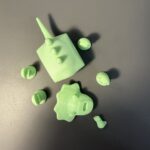
The cubes, each about 23 centimetres on a side, are digitally designed and printed from a clay mixture, then fired at low temperatures to produce a highly porous consistency. Water absorbed into the ceramic through capillary forces spreads across a large internal surface area, where it continuously evaporates and pulls heat from the surrounding air. “This has been working for centuries, both in clay jugs and in traditional wind towers,” said Milena Stavric from the Institute of Architecture and Media at TU Graz. “The key technological advance here lies in the use of 3D printing, which enables us to produce highly complex, porous and functionally optimised geometries from clay mixtures.”
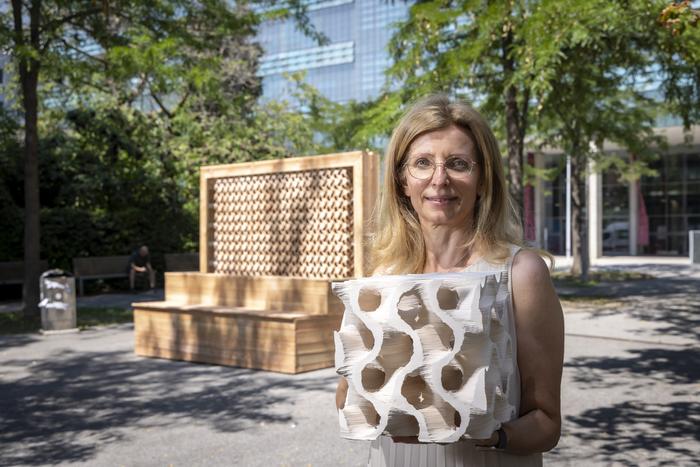
The geometry isn’t arbitrary. The team uses a minimal-surface structure known as TPMS, which maximises surface area while minimising material use. To push porosity further, the institute’s Shape Lab is experimenting with adding fungal cultures and sawdust to the clay as a nutrient medium. A mycelium network grows through the material before it’s fired; the fungi and sawdust burn away, leaving behind a network of micro- and macro-pores that distribute water more effectively inside the cube.
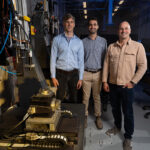
The field test was conducted in a hot attic at TU Graz. Kristijan Ristoski, who wrote his Master’s thesis on integrating the cubes and their water supply into a cooling wall system, measured the temperature drop. “The cooling effect was clearly noticeable throughout the room,” Ristoski said.
One of the more unusual material experiments involves sediment dredged from Lake Neusiedl in Austria. The shallow lake requires regular dredging to prevent silting, and most of that sediment has historically been disposed of without any use. The team is testing whether it can be incorporated into the clay mixture as a sustainable, locally sourced building material.
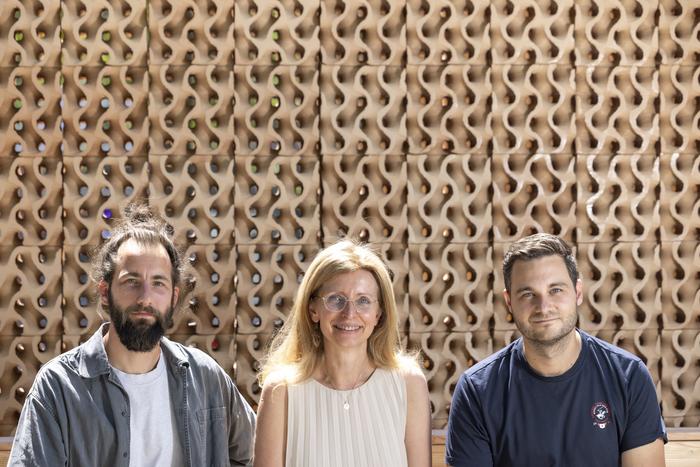
A two-by-two-metre demonstration wall made from the ceramic cubes now stands in Stremayrgasse at TU Graz’s Campus Neue Technik, where the public can experience the cooling effect directly. A second installation is on display at the Museum of Perception in Graz. The project was funded by Austria Wirtschaftsservice GmbH through its proof of concept programme and carried out in collaboration with TU Graz’s Institute of Building Physics, Services and Construction.
“Our aim is to provide cooling where people suffer particularly from the heat — for example, in cities where trees are sometimes unable to provide sufficient cooling. To achieve this, we rely on natural cooling principles rather than energy-intensive air-conditioning technology,” Stavric said.
Source: eurekalert.org