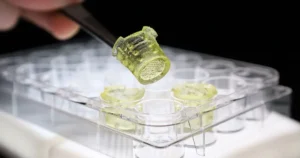
Lawrence Livermore National Laboratory printed a sub-millimeter diagnostic cone ten times faster with two-photon polymerization.
That cone is a compound parabolic concentrator, or CPC. It sits inside experimental targets at the National Ignition Facility, the Lab’s giant laser used for high-energy-density physics and national-security work. The part is about 1.5 millimeters across. Its small end is only 20 microns wide, less than half the width of a human hair, and it has no flat faces to grip.
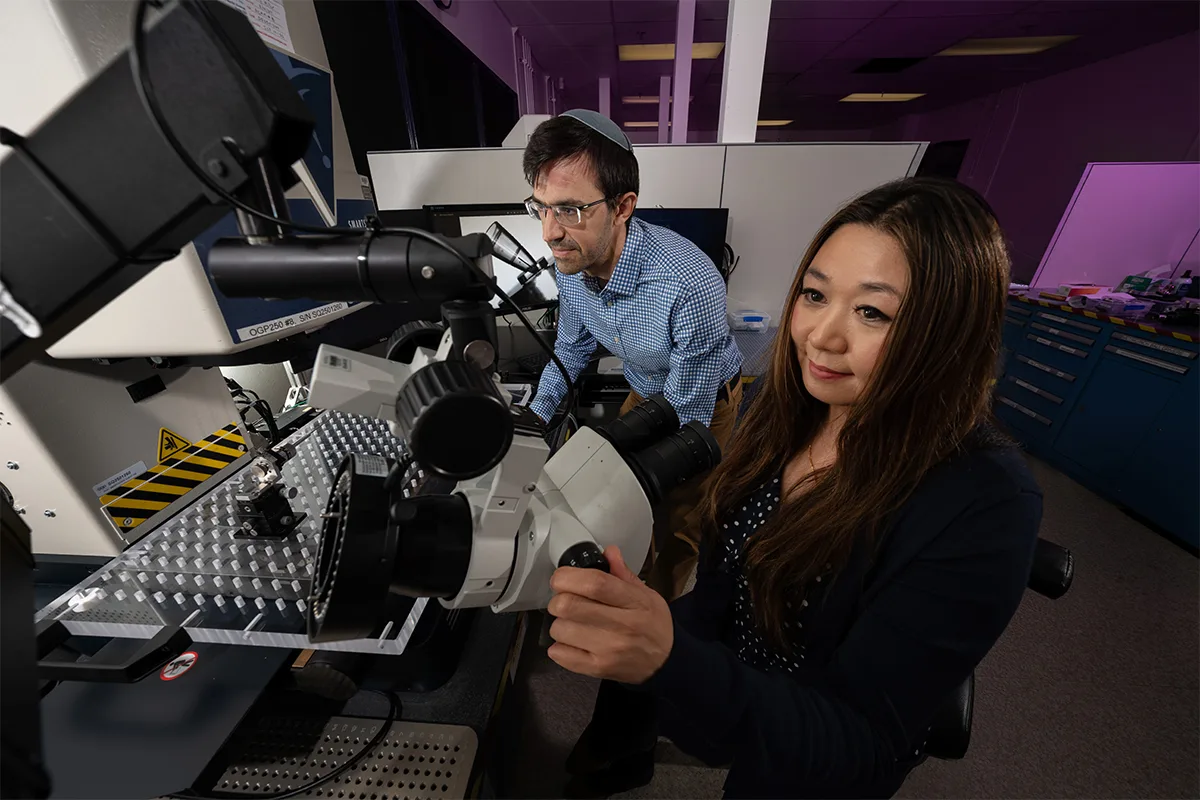
“The compound parabolic concentrator is very challenging to work with,” said Scott Vonhof, a mechanical designer at LLNL. “At about 1.5 millimeters in size, it’s smaller than the vacuum tips we used to manipulate parts and it has no flat surfaces. It was a problem in need of a solution.”
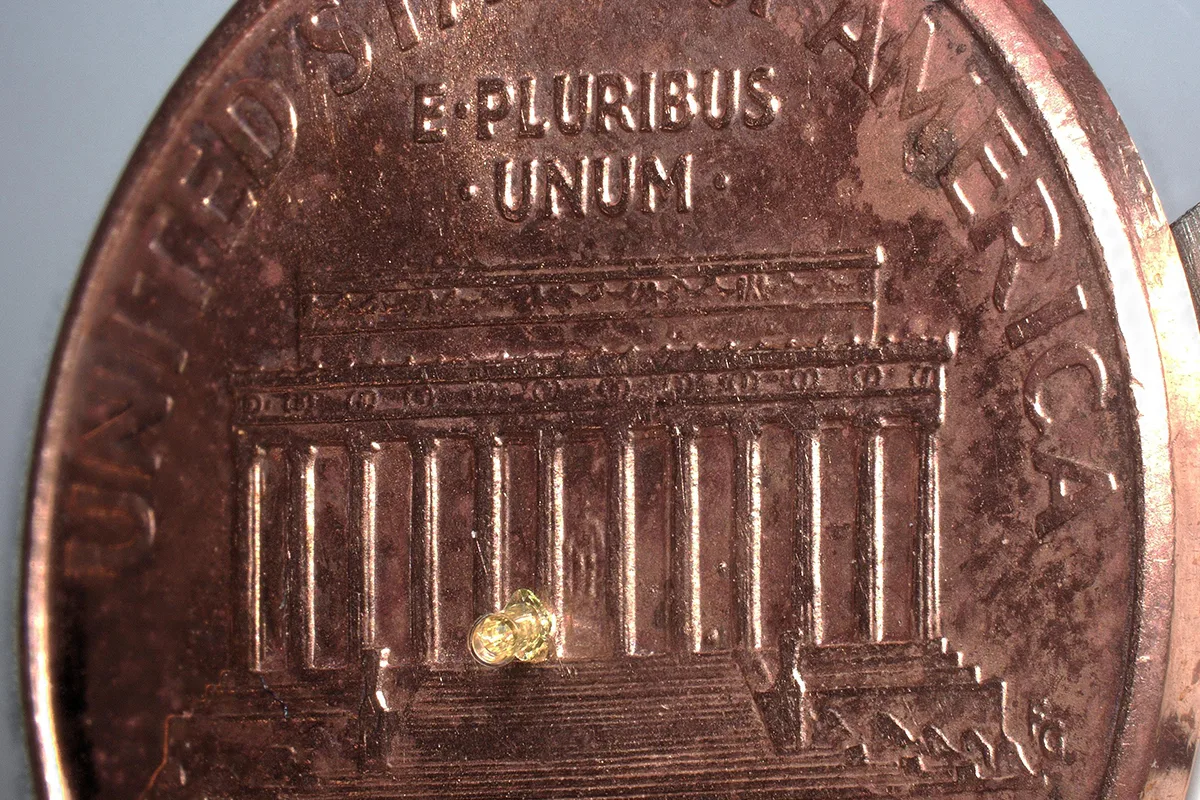
Older tooling took about ten days. Teams diamond-turned a copper mandrel, coated it with gold and plastic, machined the final shape, leached the mandrel away, then mounted the cone. Two-photon polymerization, or 2PP, prints the part as one piece with a tightly focused laser whose spot is smaller than a micron. The printed CPC needs no gold coating. Build time fell from ten days to one.
“Previously, additive manufacturing couldn’t achieve the required feature sizes,” said Maxim Shusteff, additive manufacturing deployment lead for target fabrication. “And the print area was too small, so we had to stitch parts together and those parts didn’t meet the surface roughness requirements. 2PP opens a lot of design space for target fabrication.”
Any new NIF component must prove it will not spoil scarce shots. The Lab fields only about 300 NIF experiments a year. New parts first see other lasers, including LLNL’s Jupiter Laser Facility and the University of Rochester’s Laboratory for Laser Energetics. Targets also need tight surface finish so reflected light does not damage beamline optics.
In April 2026, a 2PP CPC flew on a gold disc target used to calibrate diagnostics and matched conventionally made parts. That cleared the way for a harder job. An ion fast ignition discovery-science campaign needed a new target that joined an Advanced Radiographic Capability ion source to a capsule in an indirect-drive layout. Discovery science gets about 8 percent of NIF shot time.
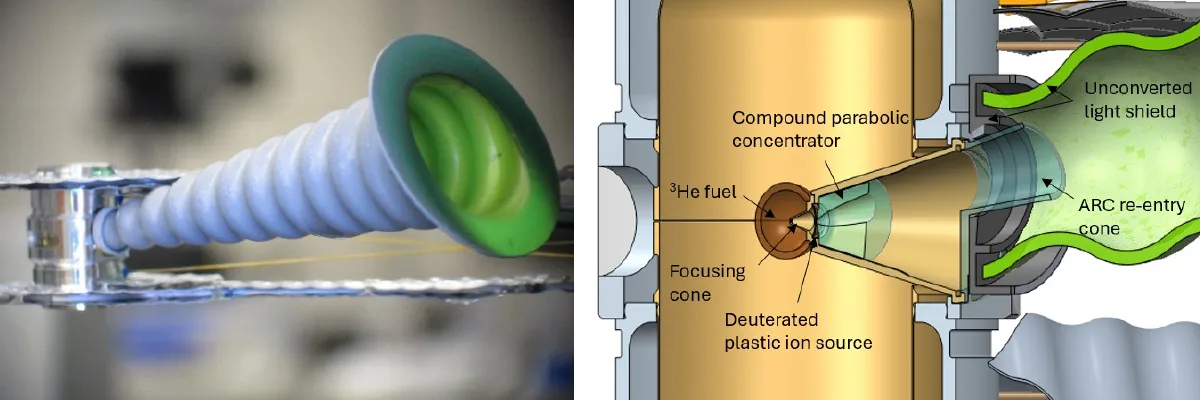
“This would have been impossible without the new 2PP method,” said Soojin Stadermann, a target fabrication engineer. “Directly attaching the CPC to the ion source was challenging because of the obscured location and stringent assembly tolerances.”
Fabricators printed a CPC with the same inner shape as an earlier comparison shot. Its outer profile changed so the cone could slide into a gold housing on guide rails and be tacked with glue. 2PP also made the nearby re-entrant cone, whose off-axis shape would have been hard to diamond-turn while still blocking backscatter.
First experiment data arrived after a successful September 2026 shot. Researchers are still reading the results and planning the next run. Engineers are also looking at 2PP for fuel capsules with lattice structures that could hold wetted foams.
“Now we have this geometric freedom that has really blown open the design possibilities,” Vonhof said. “This component is just the beginning.”