Northwestern engineers have printed paste-like functional inks into freestanding lattices more than four times faster than extrusion.
The work comes from the Robotic Matter Lab at Northwestern University’s McCormick School of Engineering in Evanston. Assistant professor Ryan Truby led the study with Ph.D. candidate Pranav Kaarthik as first author. They report the method, called direct ink additive lithography or DIAL, in Science Advances.
Light-based printers are fast and sharp but picky about inks. Extrusion handles thick, particle-filled pastes, yet it draws every line and slows down when features get fine. DIAL is a hybrid that tries to keep both sides of that bargain.
A slot-die nozzle lays down a thick sheet of paste. A blade then scrapes it to about 50 microns. Patterned light from a projector hardens only the voxels that belong in the part. The next sheet goes on top, and the stack builds layer by layer.
The trick is the ink itself. Mixed with fumed silica, it behaves like a yield-stress fluid. It holds its shape until the blade moves through it, then stiffens again. That unhardened paste braces overhangs and thin walls while the print runs, so the team skips co-printed scaffolds. Afterward they wash the spare ink away and can reuse what is left on the bed.
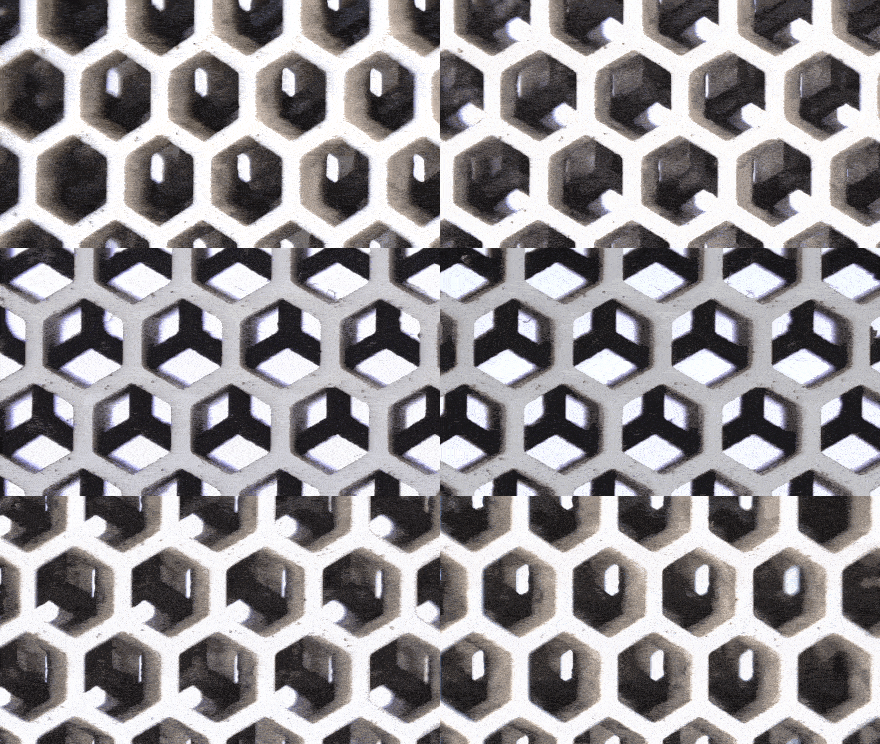
In a head-to-head on a porous grid, DIAL finished in 30 minutes. The same geometry on conventional extrusion took 124 minutes. The light-built parts also came out with sharper features and fewer defects. Lattices with walls down to 150 microns, which extrusion could not match, printed on DIAL. So did interlocking chainmail that is awkward for either process alone.
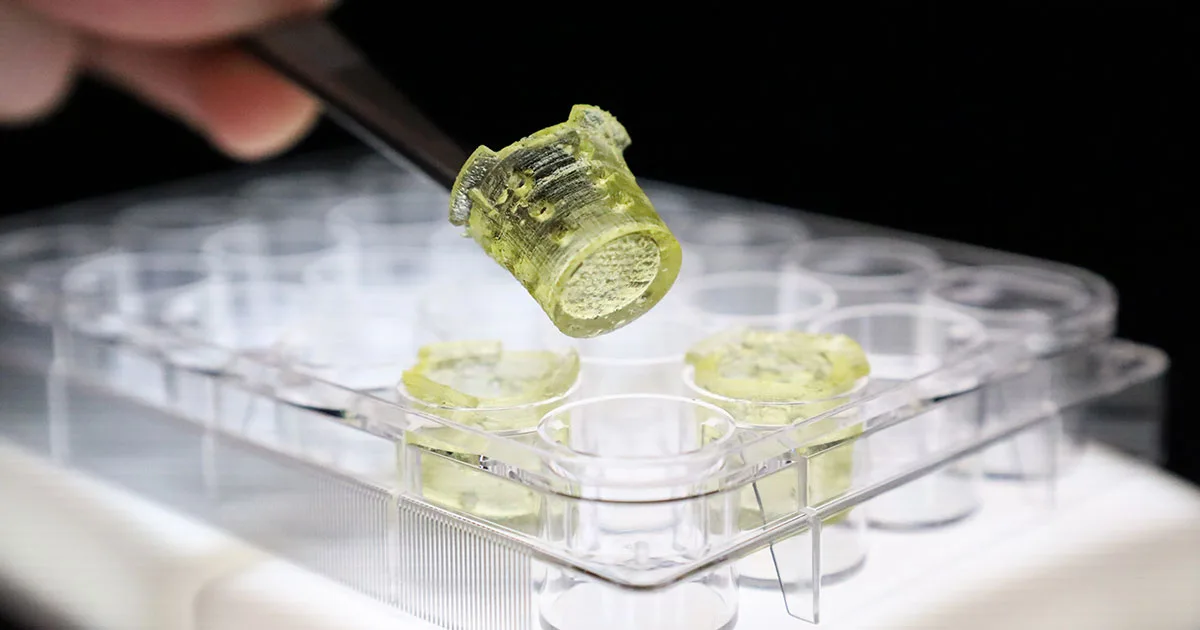
Because the projector can travel, the group also printed a honeycomb nearly four times wider than the projector’s native illumination field. Multimaterial stacks worked too. So did structural electrolyte lattices about the size of coin cells, with 15 of them done in a 15-minute job. Hydrogel cups modeled on lab cell-culture inserts carried arrays of tiny inverted pyramids.
“DIAL can produce parts that have been challenging if not impossible to make with other 3D printing methods,” Truby said. He frames the process as a way into architectures that aerospace, robotics and medicine keep asking for, but that older toolchains struggle to form in functional materials.
Kaarthik puts the support problem more bluntly. Without a scaffold, delicate prints fail. With one, removing it can wreck the very features you wanted. DIAL ducks that loop by letting the bath of unused paste do the bracing.
This is still a lab gantry and a set of model inks, not a shop-floor machine. The paper and Northwestern release point to batteries, soft robotics, medical devices and even space-facing parts as targets. How far the slot-die-plus-light stack scales, and which commercial pastes will behave, are open questions the group is still chasing.
Source: Northwestern Engineering