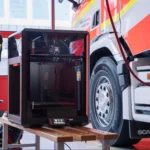
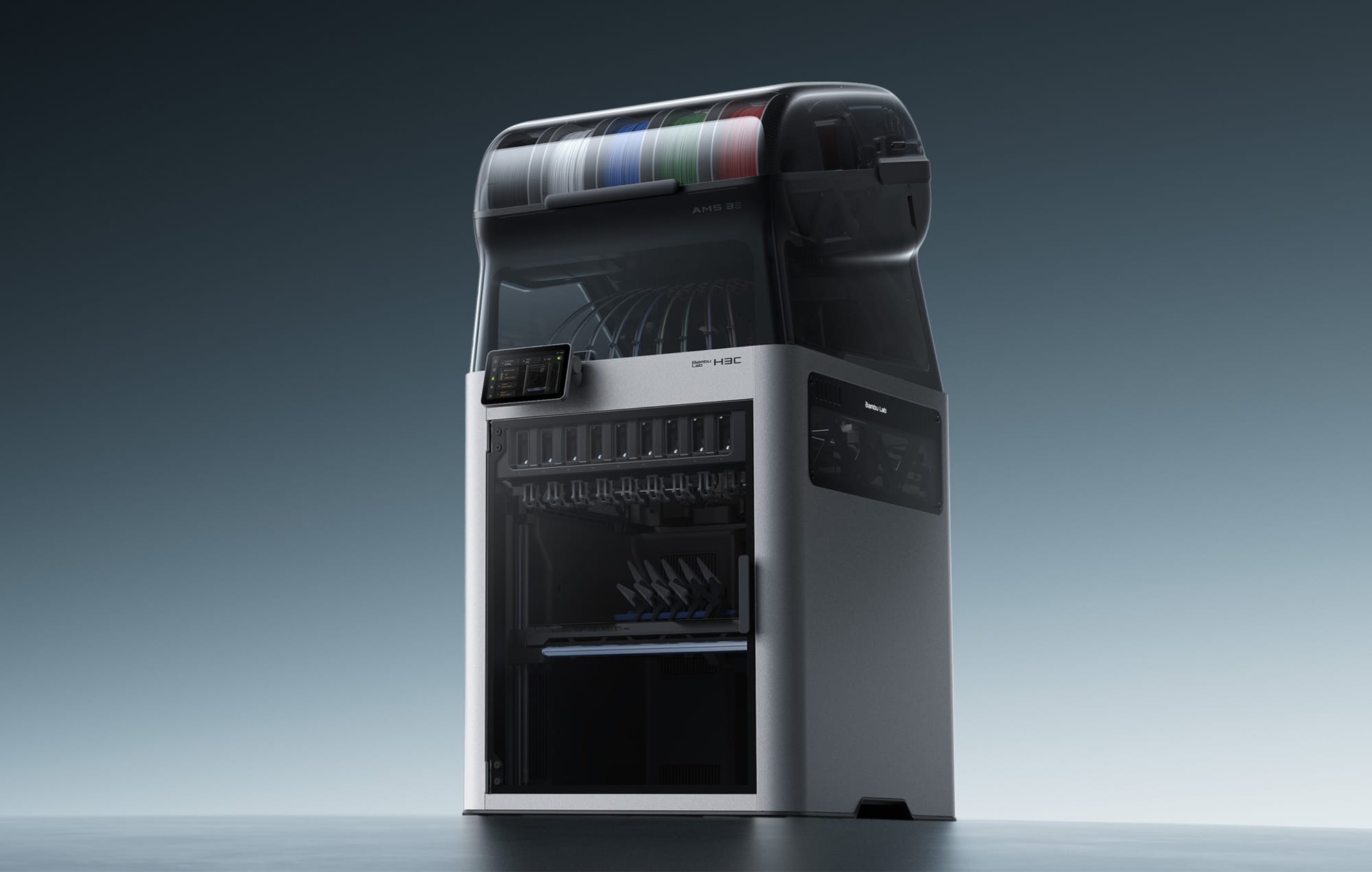
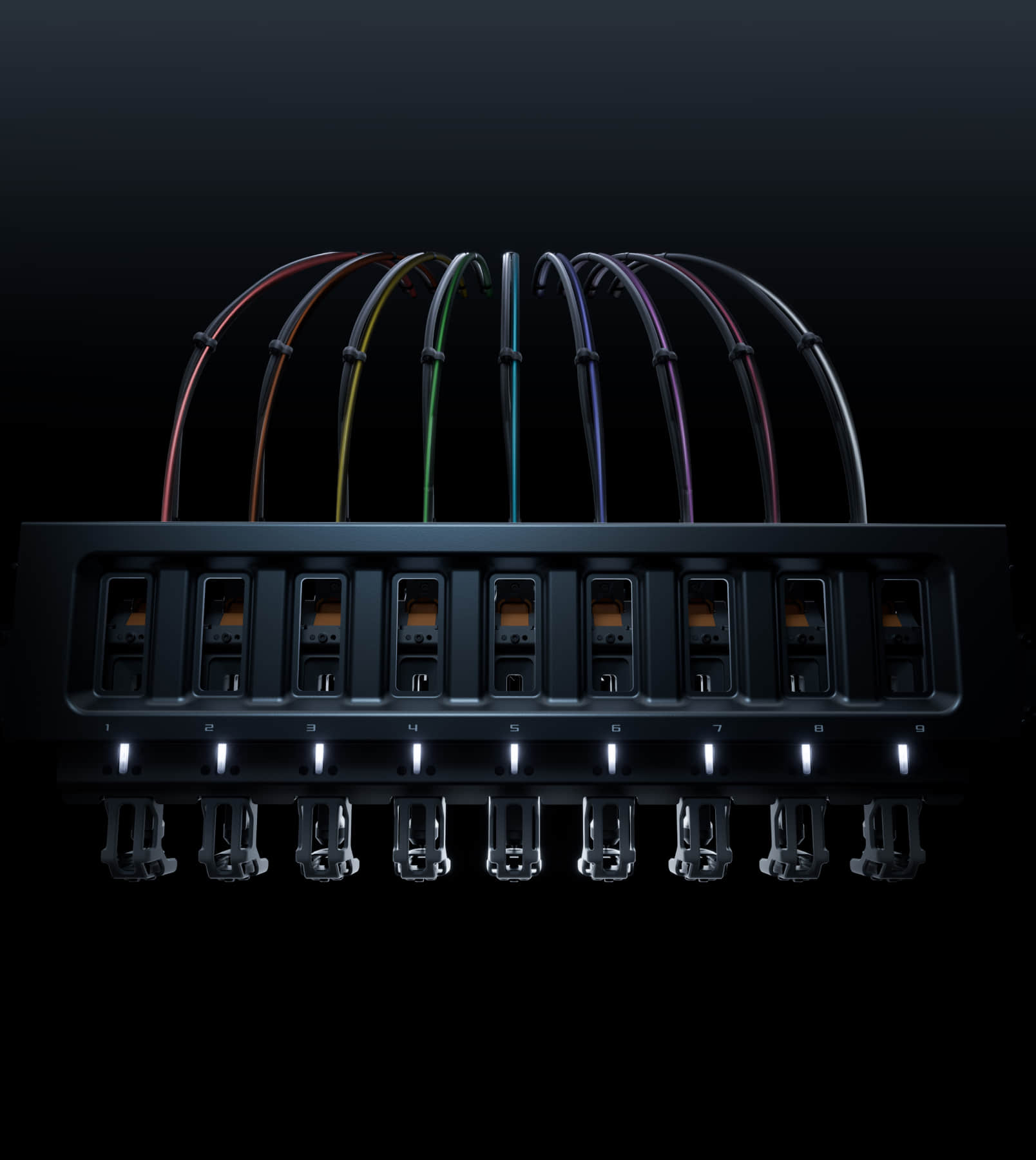
Bambu Lab has launched the H3C, the first printer in its third generation and a nine-tool tool changer. Nine print tools dock in a rack inside the chamber that retracts out of view while printing, each with its own filament path and its own heater, and the machine swaps between them in 3.4 seconds, by Bambu’s count. From the last line of one material to the first line of the next, Bambu quotes 6 seconds. It went on sale today, November 3, 2026, at $2,499 in the US and €2,499 in the EU, and every bundle ships with the new nine-slot AMS 3H built into the printer.
The pitch is simple. Single-nozzle multicolor 3D printers, including Bambu’s own AMS machines, pay for every color change in time and purged filament. A tool changer keeps every material loaded and hot, so the cost of a change drops to a few seconds and, Bambu says, 0.038 g of purge. The company is calling the architecture Swaptek, and it is the reason the H3C can also carry mixed nozzle sizes in one print and swap in cutting and drawing tools without a manual tool change. A separate new extruder, FlexFeed, handles soft TPU. Load CMYKW PLA Palette filament and the H3C layers cyan, magenta, yellow, black and white to build full-color models from a handful of spools.

Bambu Lab H3C Combo
H3C printer plus AMS 3H | Nine print tools | 330 x 320 x 325 mm
US, before tax, free shipping | €2,499 EU incl. VAT
Inside the base bundle is the whole system: the printer, the AMS 3H and nine print tools, each fitted with a 0.4 mm hardened steel nozzle that reaches 350°C. Underneath the tool changer the rest of the printer is H2D-grade or better. The chamber heats actively to 65°C in two zones, the bed to 120°C, and the toolhead and X-axis are 40% lighter than on the H2D, which Bambu uses to justify 25,000 mm/s² acceleration and 1,400 mm/s travel. Rated flow on the stock nozzle is 40 mm³/s with ABS at 280°C. Cooling comes in four layers: a part fan on the toolhead, two auxiliary fans in the chamber, a fan dedicated to the print tools, and a chamber intake fan on the back of the AMS 3H. Full calibration of all nine tools, docking, offsets and bed leveling, runs before every print without the user being involved. Two 1080p cameras cover live view and the toolhead; an optional BirdsEye top camera and an optional Vision Encoder, which Bambu says keeps motion accuracy under 50 µm as the mechanics drift, are sold separately.
Best for: Anyone with a shelf of filament already who wants the tool changer itself, or who prints mostly engineering materials and has no use for the color starter pack.

H3C Combo with Filament Starter Pack
H3C plus AMS 3H plus PLA Palette (CMYKW) and TPU
US, before tax, free shipping | €2,579 EU incl. VAT
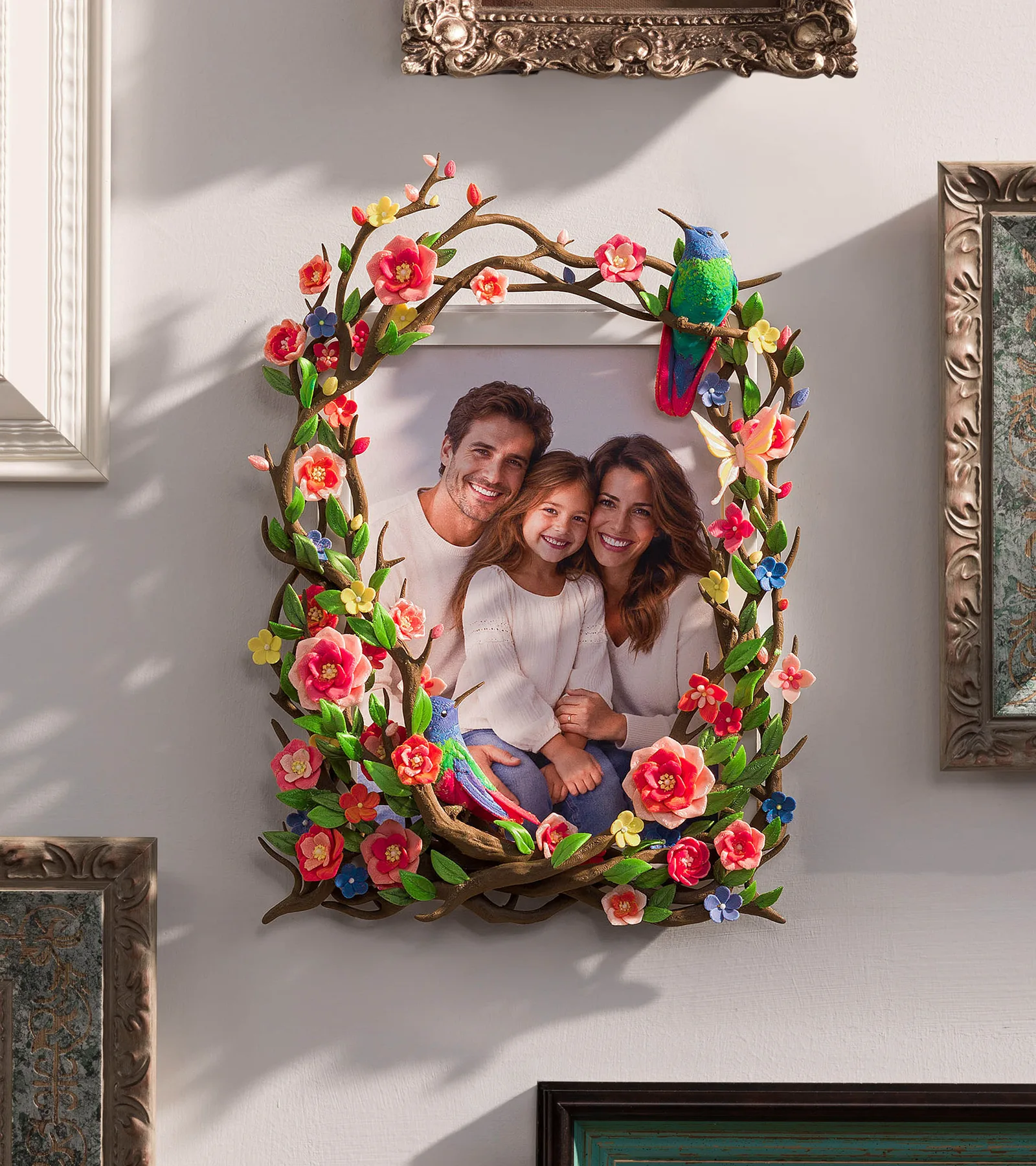
For $90 more, Bambu adds the two filament families that show off what the tool changer does. PLA Palette is a cyan, magenta, yellow, black and white set made for layered color mixing: the slicer puts thin layers of the five base colors on top of each other and the eye blends them, so a handful of spools covers a wide range of shades. On an AMS machine that approach was impractical because every one of those thin layers cost a full filament change; on the H3C each change is a tool swap. The same bundle includes TPU for the new FlexFeed extruder. Bambu’s own note is that the color mixing result depends on using the Palette set, which is why it bundles it. In the EU store this variant comes in two flavors, one with the standard TPU and one with a multi-color TPU selection, at the same price.
Best for: First-time Bambu buyers and anyone who wants to try layered color mixing and soft TPU on day one without placing a second order.
Order with standard TPU for $2,589
Order with multi-color TPU for $2,589

H3C Station Bundles
Filament Starter Pack bundle plus Bambu Station L stand, open or enclosed with the E1 air purifier
Open stand, US before tax | €2,789 EU incl. VAT
Enclosed stand plus E1 purifier, US before tax | €3,039 EU incl. VAT
Bambu Station L is a stand built for the H3C. It lifts the printer to working height and puts storage for spools, tools and spare parts underneath, which matters for a machine that stands 587 mm tall and that Bambu says needs 593 x 1,056 x 1,306 mm of clear space to operate. The open version is the cheaper of the two. The enclosed version adds the Bambu Lab E1 air purifier, which starts filtering when a print starts and targets VOCs, PM2.5 and microplastics, on top of the H11 HEPA and carbon filtration already inside the printer. Both station bundles include the PLA Palette and TPU starter pack. The order button below is for the open stand; the enclosed bundle with the E1 is listed on the same Bambu store page.
Best for: A dedicated workshop corner or a shared office where the printer runs engineering materials and air quality is a concern. For a desk at home the base Combo on existing furniture is the sensible buy.
Which H3C bundle to choose?
Every bundle contains the same printer and the same AMS 3H. There is no H3C bundle without the AMS 3H. The differences are the filament starter pack and the stand; prices for every region are in the table further down.
Take the base Combo if you have filament on the shelf. The $90 step to the Filament Starter Pack is worth it for a first Bambu machine, because Bambu says the color mixing feature needs the Palette set to give the intended colors. The station bundles are a furniture decision more than a printer decision. Our Bambu Lab printer comparison covers the H2D, H2C and X2D; we will add the H3C once we have had one on the bench.
How the Swaptek tool changer works
A conventional multi-material printer has one hotend. To change color it retracts the filament, cuts it, pulls it back to the AMS, feeds the next one in, heats, purges the old material out of the nozzle, and only then prints again. The H3C has nine hotends, each parked in the rack with its filament loaded and its heater under control. A change means the toolhead parks the tool it is holding and picks up another, which Bambu times at 3.4 seconds. Active Pre-Heat reads ahead in the G-code and brings the next nozzle to temperature while the current one is still printing, so the 6-second figure is the swap plus a short prime, by Bambu’s count. The rack itself retracts the guide tubes during printing, partly so you can see the print and partly so the tubes do not rattle against each other during long jobs. Bambu also says the retracting rack is what lets the machine offer its full Z height without being taller.
Nine hotends stay loaded and hot. A change is a 3.4-second swap and a short prime, with 0.038 g of purge in Bambu’s best case.
Takes 1.75 mm and 2.85 mm filament. The thicker TPU resists buckling, so Bambu claims 75A at up to 3x the flow of the previous generation.
Sealed slots for nine spools with RFID and auto-loading, a two-slot dryer to 85°C that can run mid-print with some filaments, and room for 24 spools with older AMS units.
All nine hardened steel nozzles reach 350°C and the chamber heats actively to 65°C, so PC, PA-CF and PPS are on the supported list.
What follows from a cheap tool change
Layered color mixing is the obvious one. With five Palette spools loaded, Bambu Studio stacks thin layers of cyan, magenta, yellow, black and white to produce intermediate shades, the same idea we describe in our guide to full-color 3D printers. The technique has existed for a while; what changed is that each of those thin layers no longer costs a full filament change and a purge tower.
Mixed nozzle sizes come next. Bambu’s demo is a wristwatch printed as one body: a 0.2 mm nozzle for the dial markings, 0.4 mm for the case, and a dedicated TPU nozzle for a 75A band. Bambu Studio gets a new toolpath planner that lets each nozzle work at its own layer height instead of forcing the whole model onto one. Extra hotends in other diameters are sold separately.
Soft materials get the same treatment, through the FlexFeed extruder. Bambu shows a bag that combines 75A, 90A and 95A TPU in one print, each hardness where the design wants it, and a trainer printed in 75A.
Then there are the CraftTools. The same dock that holds a print tool holds an optional CutTool, DrawTool or DebossTool, and foil transfer appears among the demonstrated processes, so the machine can print a part, then cut, draw on or deboss a flat sheet with the appropriate 2D plate in place and no manual tool change in between. One caveat from Bambu’s own documentation: 3D printing and 2D work run in separate software environments today, so a single job cannot yet print and then cut. Several 2D processes can share one job. The CraftTools are sold separately and are not in any launch bundle.
News for H2D, H2C and X2D owners
Alongside the launch, Bambu said the mixed nozzle size feature, which it calls multi-orifice nozzle printing, is coming to the H2D, H2C and X2D. On the H2D and X2D, with two nozzles, it means one can handle fine detail while the other handles bulk; on the H2C it applies across its swappable nozzles. Part of it is due this year and the remainder by the first quarter of 2027, according to Bambu.
Who is the H3C for?
At $2,499 this is not an upgrade for someone whose AMS does the job. It is for people who have been paying the multicolor tax in hours and purge waste: figure and miniature makers who want many colors per model, product designers combining rigid and flexible parts, and small shops that run engineering filaments and need the dryer, the 65°C chamber and the 350°C nozzles anyway. What we cannot tell you yet is how the docking and offset calibration hold up over weeks of swaps, how loud nine tools are in practice, and whether the 6-second figure survives contact with PETG and TPU rather than PLA Basic under ideal conditions. Those are review questions, and we intend to answer them.
Regional pricing
Launch pricing from Bambu Lab’s announcement. US and Canadian prices are before tax with free shipping; EU, UK and Australian prices include tax. Check the Bambu Lab product page for your region and for current stock.
Note on pricing, availability and claims: All prices are Bambu Lab’s launch prices as published on November 3, 2026, and may change. The 6-second material switch, the 0.038 g purge and the 3x TPU flow figure are Bambu Lab’s own internal test results under optimal conditions (PLA Basic with filament-saving purge for the switch time; comparison with the previous-generation machine on 1.75 mm filament for the flow figure) and will vary with material and slicer settings. Color mixing requires the PLA Palette set. Mixed nozzle sizes require extra hotends, and the 24-spool figure requires previous-generation AMS units, both sold separately. BirdsEye-enhanced AI monitoring is planned for the first half of 2027. 2.85 mm filament feeds through the bypass only. Drying while printing is limited to filaments Bambu lists as stable at drying temperature. Bambu’s EU store page lists the TPU flow gain as 5x; the product page and launch post say 3x, and that is the figure with a test condition attached, so we use it. Details are on the H3C product page and in Bambu Lab’s launch post. 3DPrinting.com earns a commission on purchases made through the order buttons on this page, at no extra cost to you.