
Two engineers at a U.S. Navy warfare center have designed a 3D printable safety clip. It locks small submunitions in place so bomb disposal teams can handle them without accidental detonations.
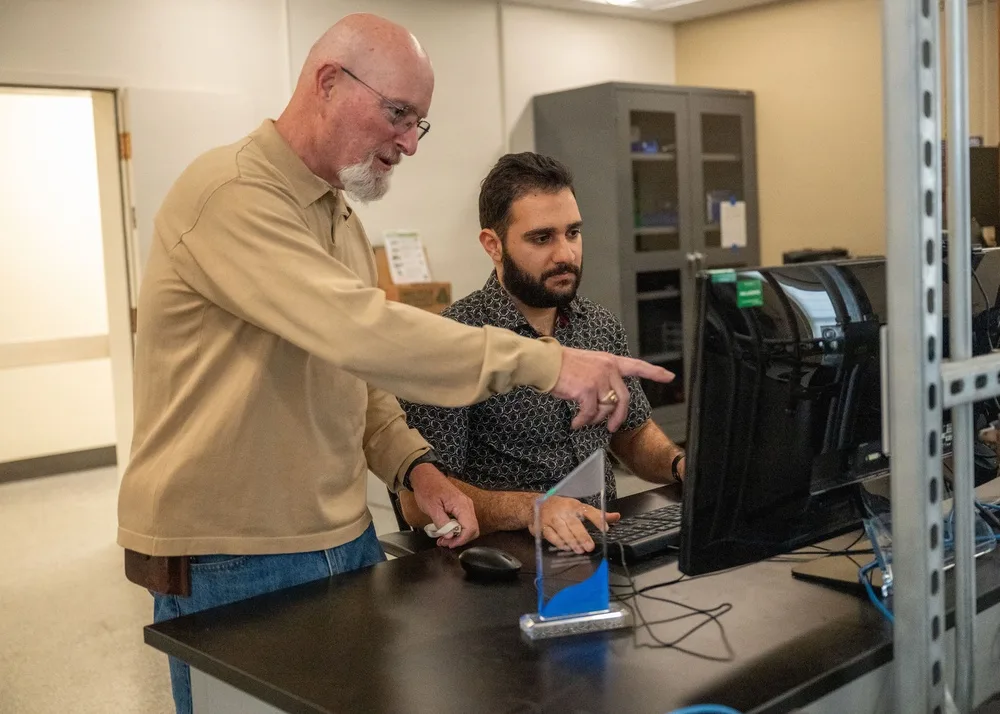
Engineering technician Samuel Larter and engineer Darren Mansour work on the Close Combat Engineering Team at Naval Surface Warfare Center (NSWC) Corona Division in California. Their Submunition Clip is a low-cost, printable device for explosive ordnance disposal (EOD) work. It earned the team a Naval Sea Systems Command (NAVSEA) Excellence in Safety Award for fiscal year 2025.
The clip mechanically locks a submunition’s arming components in place, which prevents detonation. It replaces a slow legacy procedure that immobilizes the firing pin with epoxy or plaster. That older method uses large amounts of expensive material. It also does not guarantee the munition is fully neutralized.
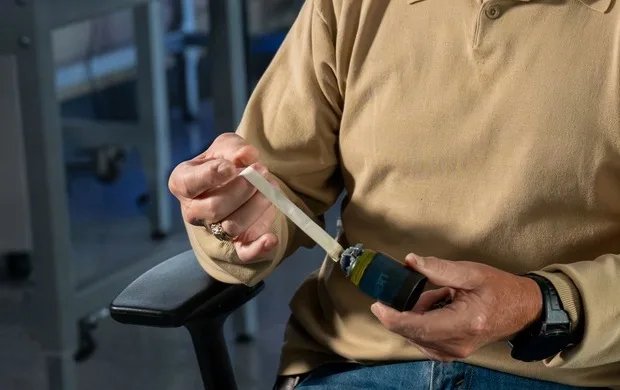
The clip is aimed at the M42 and M46 Dual Purpose Improved Conventional Munitions. U.S. forces used these high-explosive, anti-tank and anti-personnel submunitions during the 1991 Gulf War. Each one fits in the palm of a hand, yet it can tear through standard armored units. Clearance of the leftovers continues to this day.
Larter knows the problem firsthand. As a Marine Corps staff sergeant and EOD technician with the 15th Marine Expeditionary Unit, he helped clean up unexploded munitions in Kuwait and Iraq after the war. “One of my teams in Karbala encountered and neutralized tens of thousands of these,” he said. “Inside this thing is a shaped charge munition…it will easily penetrate rolled homogeneous steel armor.”
For years he thought about ways to prevent unplanned detonations. “I had the idea about something that could clip on the munition and keep it from moving,” Larter said. “Then we had a group of new engineers come in a couple of years ago, and I explained it to Darren Mansour. Darren said, ‘I could do that,’ and he did.”
Mansour, a recent San Diego State University graduate, turned the idea into a tool for technicians in the field. He wanted it to be printable from the start. “I wanted this to be 3D-printable, so they didn’t have to wait for some supply chain to spin up,” he said. “We could just have them print it themselves and they’d have plenty.” The model can be stored in an online database that already holds other printable CAD models.
The team has filed for a provisional patent on the clip with the United States Patent and Trademark Office. That opens the door to working with industry and licensing production to companies.
Larter sees room to apply the same idea to similar explosives. “There are hundreds of ordnance items that are similar to this that we could come up with a way to immobilize the firing train… and make it safe for transport,” he said. “I just want to see this get out there so people can use it to save lives.”
NSWC Corona has provided analysis and assessment for the Navy since 1964. Its more than 4,000 scientists, engineers, sailors, technicians and support staff are based in Norco, California, with detachments in Fallbrook and Seal Beach.
Source: DVIDS / NSWC Corona Division