
Nagami has grown from one chair for the Centre Pompidou into a 36-person robotic 3D printing business in Ávila, Spain, that works only with recycled and recyclable plastic.

The story starts in London, where founder and CEO Manuel Jiménez García, an architect by training, ran the Design Computation Lab at University College London. When the Pompidou asked for an object for its Printing the World exhibition, he and Gilles Retsin, his colleague at the lab, answered with the Voxel Chair, a reworking of the Panton chair printed in mid-air. It was the first prototype designed with software written specifically for large-format robotic printing, and it now sits in the Paris museum’s permanent collection. The chair caught the attention of leading names in design and architecture, and Nagami launched in 2018 with chairs made with Zaha Hadid Architects and designers Ross Lovegrove and Daniel Widrig.
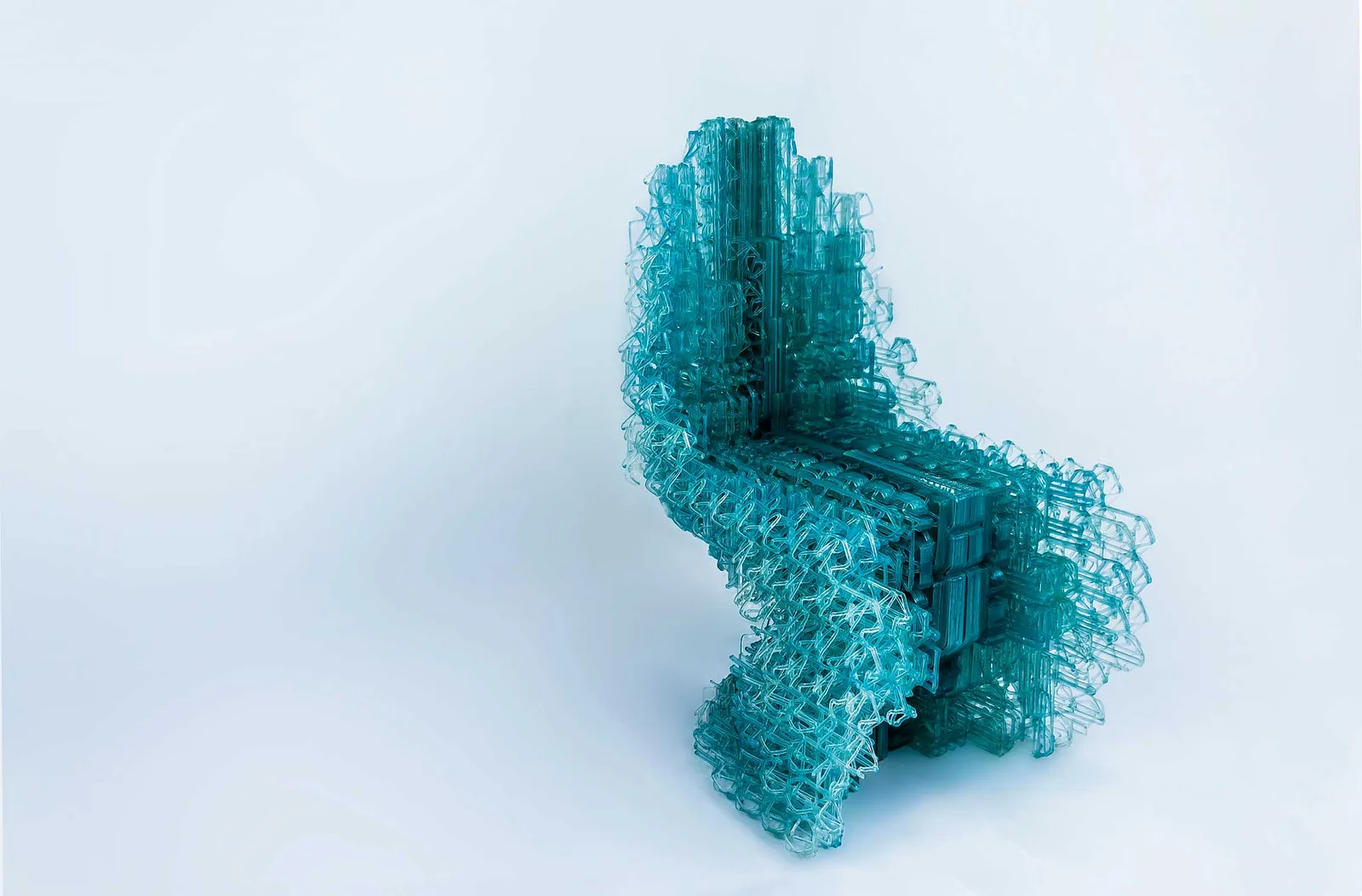
Jiménez García founded the company with his brother Miguel Ángel Jiménez García and Ignacio Viguera. When they started in 2016, nobody made vertical extruders to mount on a robot, so the team built its own and is now on version seven. The shop has since grown to 21 printers. The Throne, a rethink of the portable toilet, was the first object it printed that stood 3.5 meters tall.
Feedstock comes from sources such as ocean and hospital waste, and the team also blends recycled plastic with organic waste such as coffee grounds, olive pits or oyster shells. Those additives tune the material, from a glossy, matte or satin finish to reflectivity or how well it copes with different structural stresses.
The client list shows where that leads. Nagami’s work appears at the Santiago Bernabéu Stadium and in fashion brand Ecoalf’s flagship store at Las Rozas Village, Nagami’s first complete interior design project. Its first façade was for Dior. In Puerto Banús, a collaboration with Dior and Parley Ocean Plastics produced a printed store front of panels that fade from deep blue to white.

The machines are portable, and Nagami has often taken a robot on-site to print what a client asked for. Without inventory, it can print a vase one day and a wall the next, close to where the part is needed and without long-distance transport.
“The future of 3D printing lies in distributed manufacturing, and we’re launching several partnerships across different continents to make this possible,” said Jiménez García.
Construction is where the scale is heading. Nagami is already printing corridors hundreds of meters long and enveloping entire stores, has several outdoor projects, and is negotiating larger jobs in which perhaps 50% of a building, or all of its interior walls, would be printed in recycled plastic. More robots also mean lower production costs.
Staying in Ávila, inside the medieval city wall, was a deliberate choice. It is the founders’ hometown and that of many employees, with affordable space and easy access to different sectors of local industry. Jiménez García would like to see more of Spain “using depopulated areas as an advantage to innovate and foster a different kind of industry.”
Source: Moeve