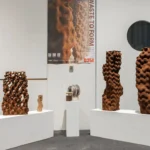

Researchers led by Singapore University of Technology and Design (SUTD) have 3D printed polymer color routers that steer light to camera sensor pixels instead of filtering most of it away.
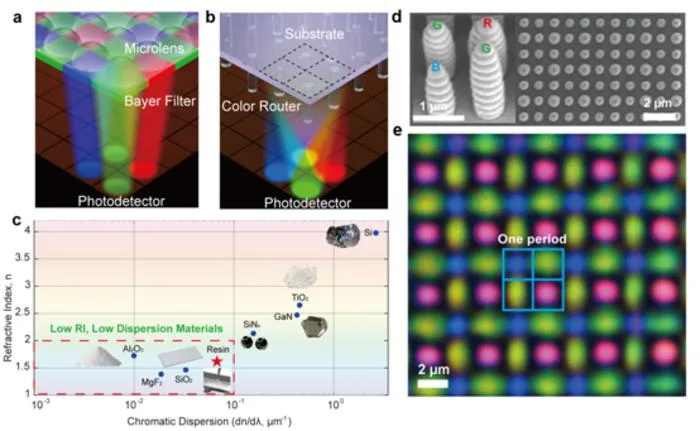
Most camera sensors sit behind a Bayer filter array. It passes one color to each pixel and absorbs the rest, so only about a third of the incoming light gets through. In dim conditions that means more noise, longer exposures and more motion blur. The SUTD team, working with researchers in China and Japan, built a router that sends red, green and blue light toward the matching sensing regions instead.
“A colour router instead steers those colours towards the corresponding sensing regions, allowing three times more of the incoming light to be used,” said Joel Yang, the SUTD professor who led the research.
Earlier color routers relied on high-refractive-index materials such as titanium dioxide or gallium nitride. Those bend light strongly but need precise, multi-step fabrication. The SUTD group chose ordinary low-index polymers instead. They are cheaper and suit simpler manufacturing. The catch is that they interact with light far more weakly, so the team set out to make up the difference with geometry.
Each unit cell holds four cylindrical nanopillars. They are printed with two-photon polymerization, which can produce features as small as 150 nanometers. The pillars do not act as separate color filters. Light scattered by all four interferes collectively and steers each color to its spot. To choose the pillar heights and radii, the team used particle swarm optimization. The algorithm simulates candidate shapes and refines them based on the weakest color channel. That way red, green and blue all route well together.
The best design reached a simulated routing efficiency of almost 90 percent across the visible spectrum. Commercial Bayer filters typically manage about 20 to 35 percent. The printed devices packed 250,000 unit cells onto a one-millimeter square and reached about 70 percent. The team attributes the drop to fabrication deviations rather than a fundamental limit. In tests with a monochrome sensor, images taken through the router showed better color fidelity with a third of the exposure time of a standard filter.
The pillars share a flat base and have no overhangs or enclosed cavities. That 2.5D geometry lends itself to mass replication. “Nanoscale 3D printing is just the beginning as it allowed us to check that our concepts and designs work,” said Yang. “The path to manufacturing will require updated designs optimised for foundry compatible materials and processes.”
Beyond phone cameras, the approach could stretch past three colors to compact multispectral sensors. One target is fluorescence imaging of living cells, where signals are faint and strong light can damage samples. Next, the researchers plan to put the router directly onto an image sensor and measure the gains in a working camera. They also want to cut leakage between color channels, handle light arriving at wider angles and show repeatable replication.
The paper, “3D printed designer colour routers with low refractive index for low-light imaging,” is published in Nature Communications.
Source: EurekAlert! / Singapore University of Technology and Design