
Milan researchers have turned okara, the soybean waste left over from making tofu and soy drinks, into a 3D printable bioactive material aimed at skin repair.
The study, published in Communications Materials, was coordinated by Carmen Lammi, a professor in the Department of Pharmaceutical Sciences at the University of Milan. She worked with the team of Serena Graziosi, a professor in the Department of Mechanical Engineering at Politecnico di Milano. Raffaele Pugliese, a researcher at the NeMO Lab Research Center at Niguarda Hospital in Milan, also collaborated. The longer-range goal is a printed device that treats pain locally, for women who are breastfeeding or recovering from breast cancer surgery.
Okara is generally treated as a by-product, yet it still carries a significant amount of protein. The team broke that protein down into a hydrolysate rich in bioactive peptides, short chains of amino acids. They tested it on human dermal fibroblasts, the cells that maintain skin structure and support tissue repair. In vitro, the hydrolysate showed antioxidant and anti-inflammatory activity and helped the fibroblasts migrate, an important step in wound healing.
The researchers then mixed the hydrolysate into poly(ε-caprolactone) (PCL), a biodegradable polymer already used in biomedical research, to make a printable bioactive blend. Mechanical, thermal and structural analyses showed the hydrolysate left the main properties of PCL intact. The blend also released the peptides gradually over time. Just as important, the blend kept its antioxidant, anti-inflammatory and pro-regenerative behavior after it had been through the printer.

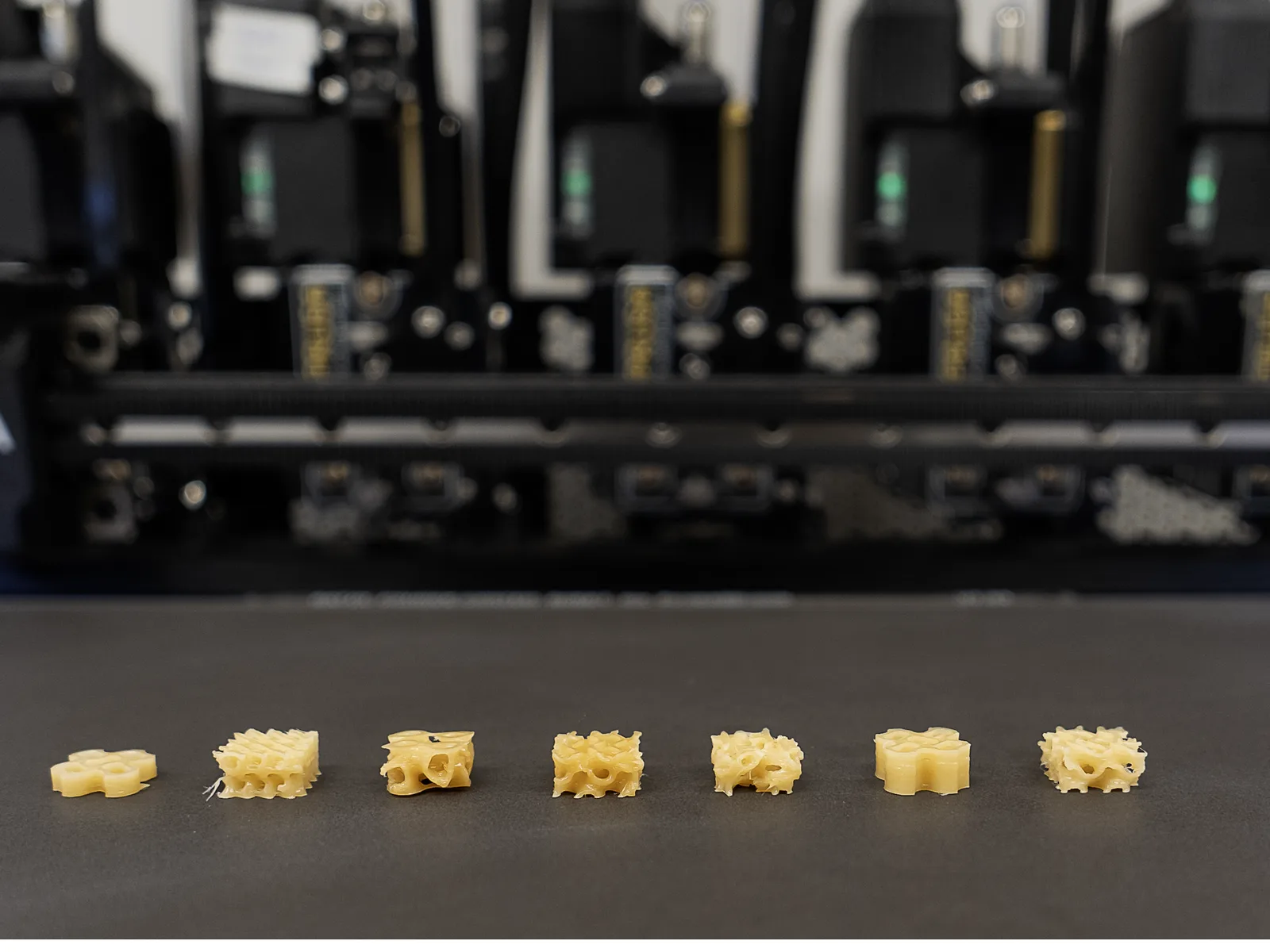
Test prints with complex geometries showed the material can take on the kind of tailored shapes a wearable device would need. That was the point of 3DBioPad, the research project behind the study. Graziosi coordinated it until it ended in February 2026, with European Union funding from the NextGenerationEU recovery program. It aimed at lightweight, breathable pads that can be personalized and deliver treatment directly through the skin. The project drew on mechanical design, materials science, food and pharmaceutical sciences, product design and additive manufacturing.
The okara work fits a wider push to get value out of food industry residues instead of discarding them. It also points toward a biodegradable option for local wound care.
“The research will continue with the 3D printing of a biomimetic phantom, an experimental model capable of reproducing some of the main characteristics of breast skin tissue,” said Lammi. The phantom will let the group study how the biomaterial behaves under controlled conditions before later validation phases.
For Graziosi, the material and the part cannot be designed separately. “In the 3DBioPad project, the valorization of the okara is part of a design approach that considers, from the outset, product function and geometry, material properties and the manufacturing process as interdependent elements,” she said.