
Old Dominion University engineer Oleksandr Kravchenko has received a $400,000 National Science Foundation award to make 3D printed composite parts stronger and more reliable.
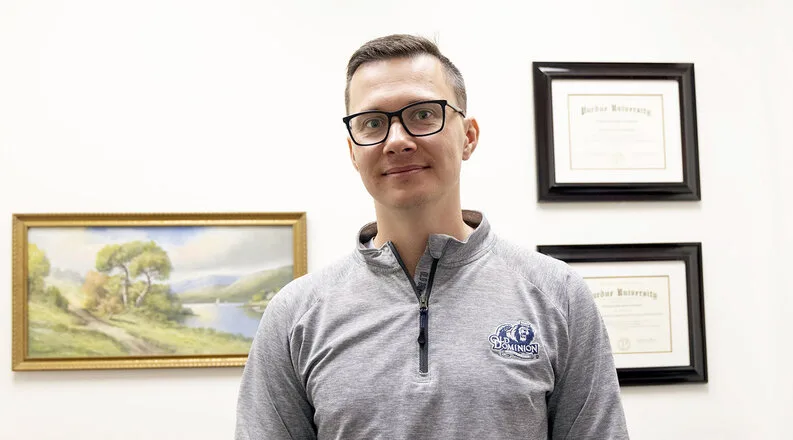
The three-year project builds on a post-processing method he patented with former doctoral student Jimesh Bhagatji. Called hot powder bed compaction (HPBC), it uses heat and pressure from a surrounding powder bed to densify printed composite parts without molds. Kravchenko is an associate professor in the university’s Department of Mechanical and Aerospace Engineering.
The method targets the weak spot of printed composites. Tiny voids and weak bonds between layers keep many of these parts out of demanding aerospace, defense and automotive work.
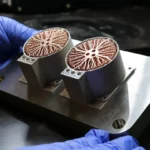
In HPBC, a standard printed part is covered in thermoplastic layers that contain reinforcing fibers. It then goes into a bed of fine powder. As the powder heats up, it passes heat to the part and presses on it from all directions. The plastic melts, the pressure closes air pockets, and the layers bond more strongly. The fibers control the viscosity of the melt, so the part keeps its shape.
The result is a denser part that performs closer to compression molded composites, which normally require expensive metal molds. The process window is narrow. Material that flows too freely loses its structure. Material that flows too little leaves layers unfused.
One of the first prototypes came from a senior design project by engineering technology students. They used the process to make a clutch pedal and an accelerator pedal for a Formula race car. Tested under 350 newtons, or 79 pounds of force, the pedals matched the strength of the original aluminum parts. They weighed 43 percent less.
The funded project will scale the method to larger and more complex parts in a range of advanced thermoplastic composites. Shrinkage is the main open problem. Parts shrink differently depending on their shape and print configuration. The team will build multi-physics simulations that predict shrinkage and track how heat and pressure move through the powder into the part. It will also vary temperature, pressure and heating time. Then it will measure how those settings change strength, stiffness, dimensional accuracy, internal stresses and microstructure.
“Some thermoplastics we are looking at need to be processed at about 350° C, which is representative of the materials used by the aerospace industry,” said Kravchenko. “The best part is that with HPBC you can turn your printed part into a truly structural-grade component using the existing Fused Deposition Modeling (FDM) technology used in most of the commercial 3D printers today.”
Undergraduate and graduate students in the university’s Composites Modeling and Manufacturing Group will also work on the project.
Source: Old Dominion University