Engineers at South Korea’s Ulsan National Institute of Science and Technology (UNIST) have built an ultrasonic check that shows when 3D printed concrete can carry the next layer.
The method reads the concrete from one side only. That keeps the setup simple and avoids pressing on soft, freshly printed material. The team is led by Professor Myoungsu Shin of the Department of Civil, Urban, Earth and Environmental Engineering. It published the work in the November issue of Cement and Concrete Composites.
Each printed layer has to hold its shape and bear the growing weight above it, a property called buildability. The key measure is green strength, the compressive strength of concrete that has not fully set. Stack the next layer too early and the print can deform or collapse. Standard green strength tests crush separate specimens, so they cannot follow the material during a print. Ultrasonic pulse velocity testing avoids crushing anything. But it needs sensors embedded in the concrete or held against both sides.
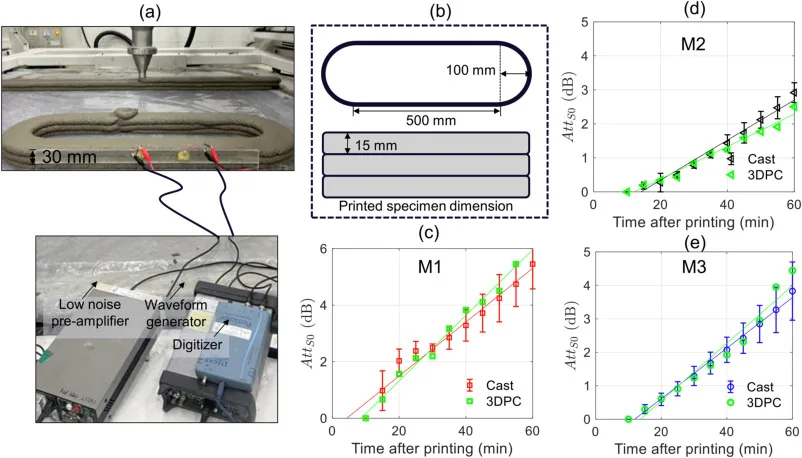
The UNIST setup attaches a thin acrylic plate to one face of the print. Two piezoelectric sensors sit on the plate, one sending ultrasonic waves and one receiving them. As the concrete hardens, more of the wave energy leaks out of the plate and into the concrete. The received signal gets weaker, and that drop tracks the strength gain. The team also tried an aluminum plate. Its signal barely changed over time, so acrylic was used for the main tests.
The researchers tested three mixes. One was a plain reference, and two contained cellulose microfibers of different lengths. Each was measured from about 10 minutes to two hours after casting, alongside compression tests at set intervals. The amplitude of one guided wave mode, called S0, fell steadily as the concrete set. Its match with measured green strength reached a coefficient of determination above 0.97 for every mix, where 1 means a perfect fit. A second measure, relative attenuation, scored above 0.927. The signals also told the three mixes apart.
A printed three-layer specimen behaved the same way. Its attenuation rose over time much like that of the cast samples.
“We can see how the concrete is setting from one side of the print,” said Shin. “That could be used to adjust the printer’s speed so the next layer goes on once the layer below has hardened enough.” He added that the work has so far been tested only on small three-layer prints. More research is needed before it can be used on full-size buildings.
The next step is to convert the readings into green strength and compare it with the load from the layers above. That would give printers a nondestructive buildability check while they work. A target attenuation level could then set when each new layer goes on and how long to wait between layers.
The research was funded by South Korea’s science ministry and the National Research Foundation of Korea.
Source: Cement and Concrete Composites and UNIST