A University of South Florida class is 3D printing clay bricks to rebuild oyster habitat along Tampa Bay seawalls.
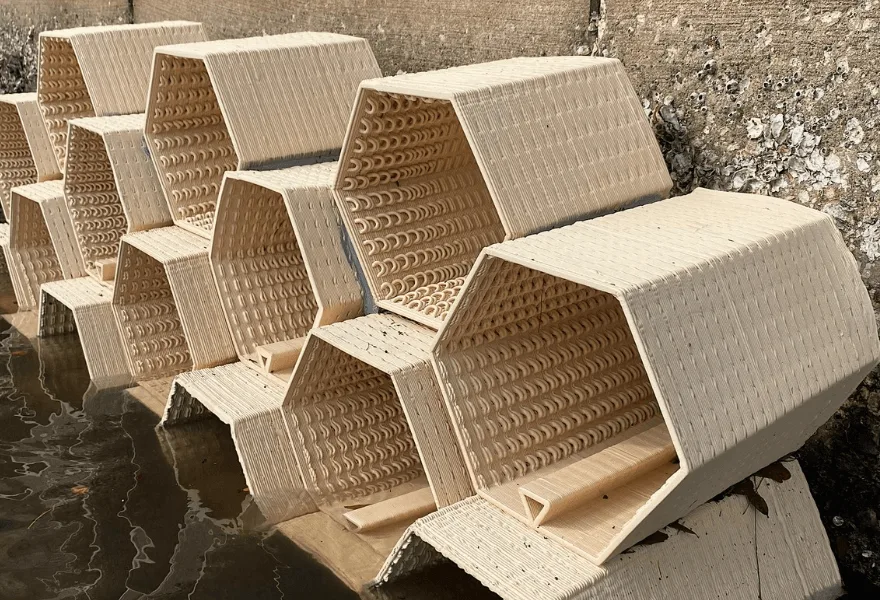
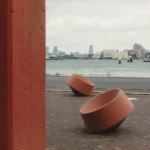
The shape is called a hexa-log, a hollow six-sided clay unit that stacks in front of the wall. It started in 2022 as a class project in Art and the Environment, a course at USF’s Judy Genshaft Honors College. Every class since has reworked the design.
Tina Piracci teaches that course. She launched the Oyster Restoration Brick (ORB) project with William Ellis of USF St. Petersburg because oyster numbers were dwindling. Her students come from majors as far apart as biomedical sciences and computer engineering.
For Piracci, the printer earns its place by making shapes a flat seawall can’t offer. “With clay 3D printing, we’re able to replace these habitats and increase the surface area, create loops and interstices, and even implement a propagation strategy,” she said.
That strategy hinges on a removable propagation brick in the stack. Once oyster larvae have grown into spat, or young oysters, the team can move them to new transplant sites. Permitting rules keep the stacks within 18 inches of the seawall. The blocks also have to soften incoming waves.
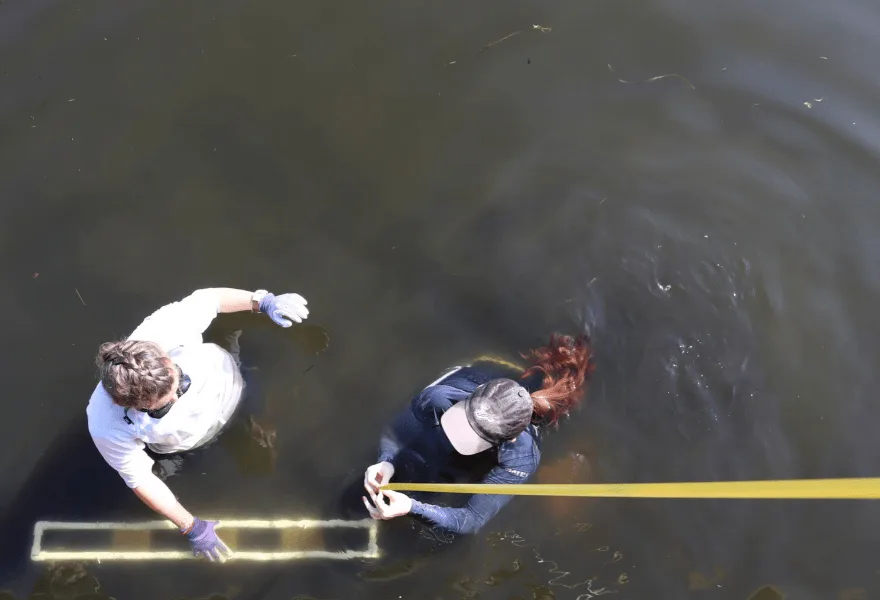
The team has tested the bricks for years in Bayboro Harbor, next to the USF St. Petersburg campus.
None of it is meant to stay at USF. Piracci wants to release the design as open source so conservation groups elsewhere can use it.
Lily Boyer worked on ORB as a student research assistant and has since graduated from the Honors College. She presented the design and data at the 39th Annual Conference on Beach Preservation Technology in St. Augustine, Florida. The U.S. Environmental Protection Agency and the Army Corps of Engineers were among the attendees.
Boyer has co-founded a nonprofit, the Habitat Laboratory or Hab Lab, with Piracci and others. It lets alumni keep working on ORB after they graduate. Current students can already stay on after class as research assistants or studio tech interns.
Boyer sees the design spreading to other ecosystems and helping wildlife beyond oysters. “Whenever you’re creating a scalable project, it’s kind of like a seed,” she said. “We’re creating the seeds that we can spread out and let them grow across the US and even internationally.”
Source: University of South Florida