University of Tokyo researchers have 3D printed the muscles, tendons and ligaments of a life-sized pair of robot legs from one flexible material.
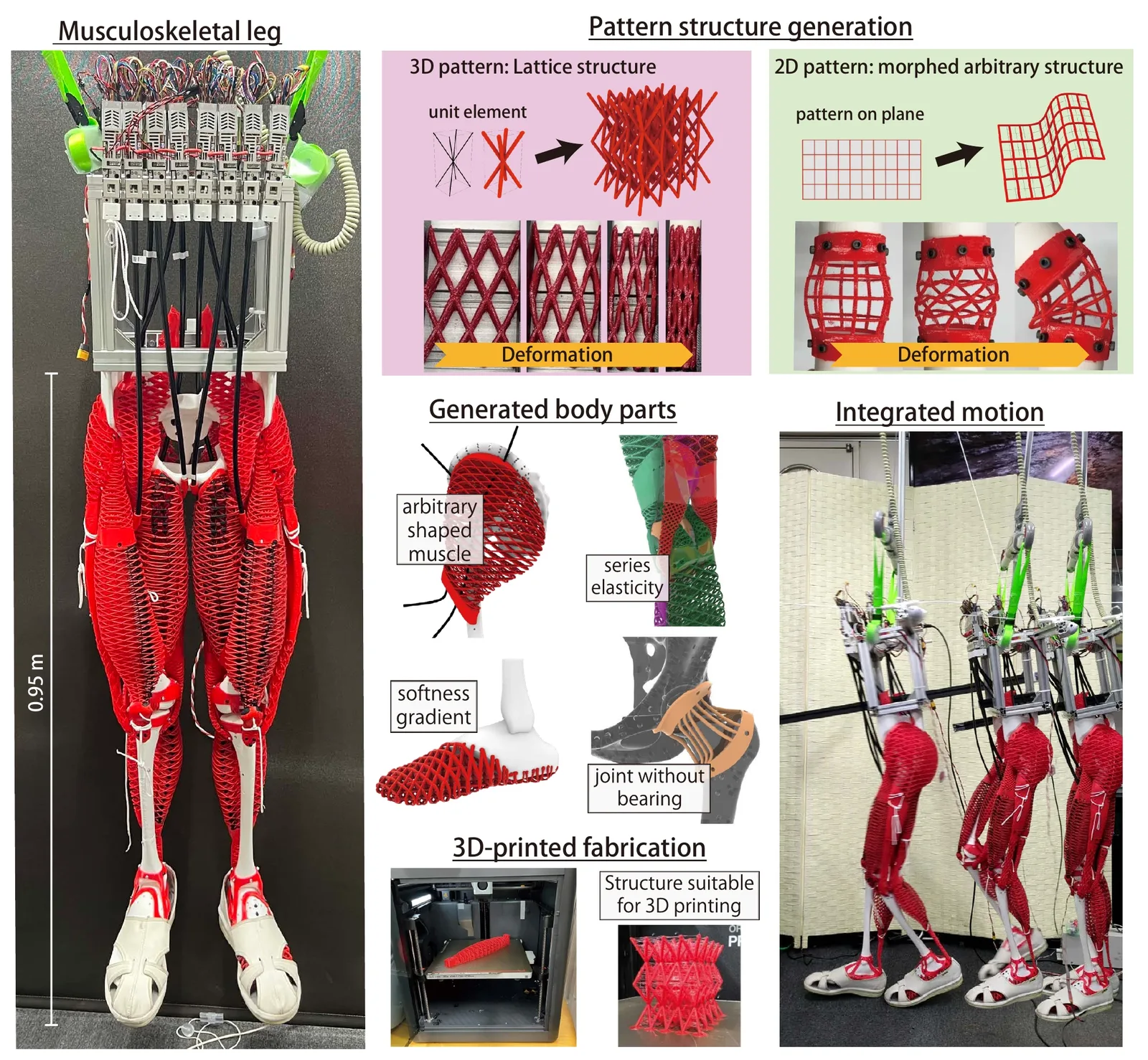
The material is TPU 95A, a flexible thermoplastic polyurethane, printed on a Prusa XL. Only the bones are PLA. Each soft part gets its behavior from its internal geometry rather than from a second elastomer, so nothing needs a mold.
Many musculoskeletal robots, which move a skeleton by pulling on artificial muscles, take a shortcut. They use plain wires for tendons and rigid hinges for joints, and every new body part is designed from scratch. Shunnosuke Yoshimura, Kento Kawaharazuka and Kei Okada of the university’s Graduate School of Information Science and Technology took a different route. They describe it in an open-access paper in Advanced Intelligent Systems.
Their tool is a parametric design workflow in Rhino 8 and Grasshopper, driven by Python scripts. Lattices fill the volume of each muscle. Ligaments begin as flat grids that are projected onto the curved surface of a joint. The point, as the paper’s title puts it, is to speed up how these robots get built.
Softness comes down to the lattice. Strut thickness and cell spacing set how soft each region is, and going from 1.5 to 3 mm struts made a lattice about 28 times stiffer. That range lets a single print run from a compliant muscle to a stiff tendon. Graded lattices in the soles cushion each footstep.
Motors at the pelvis pull six main muscles through Bowden cables. At the hip, knee and ankle, printed ligaments hold the joints together, and the legs have no bearings at all.
Hung from an overhead rig that carried part of their weight, the 0.95-meter legs took alternating steps with strides of 0.4 and 0.8 meters. The hip flexed about 90 degrees and the knee about 105. Without that suspension, the legs cannot walk yet. Co-author Kento Kawaharazuka, a junior associate professor at the university, said as much in a post on X. “It can actually walk, albeit with external suspension!” he wrote, calling it the dawn of a new era for musculoskeletal humanoids.
🎉It can actually walk, albeit with external suspension!
This marks the dawn of a new era of musculoskeletal humanoids! https://t.co/hJXmPrgeRk pic.twitter.com/fncqHFiV91— Kento Kawaharazuka / 河原塚 健人 (@KKawaharazuka) November 4, 2026
Durability is mixed. The printed structures survived 999 loading cycles without rupturing, but their stiffness drifted along the way. Print orientation and creep, the slow deformation of a viscoelastic material like TPU under load, both play a part. The design rules are still empirical and hold only for TPU 95A under the tested printing conditions.
Print time is the slow part. A single life-sized muscle takes 20 to 40 hours. The payoff for skipping molds is that a worn muscle can simply be printed again at low cost.
Whole-body humanoids and embedded sensing come next, according to the paper. That would take the design from a pair of suspended legs to a full body.
Source: Advanced Intelligent Systems