Blue Origin unveiled Northstar, a new booster engine that is more than 65 percent additively manufactured.
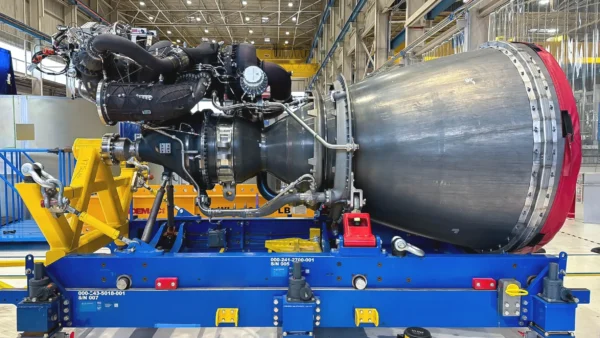
Northstar burns liquid oxygen and liquefied natural gas and is rated at 715,000 pounds of thrust. That is up from 640,000 pounds-force on BE-4, Blue Origin’s existing booster engine. Against BE-4, the new design cuts mass by 30 percent and parts count by 50 percent. Manufacturing changes also shorten the build, with assembly now possible in less than a day.
More than 65 percent of the engine is produced through Blue Origin’s in-house large-scale additive manufacturing. The additive share is the headline manufacturing figure in the November 5 news note. The note does not list which parts are printed or which processes run on the shop floor. It does state that Northstar keeps the liquefied natural gas-fueled, oxygen-rich staged combustion cycle and single-shaft turbopump architecture that underpins Blue Origin propulsion work.
Those architecture choices matter because they reuse a cycle already proven on BE-4 rather than starting from a blank sheet. The printed share then becomes a way to pull mass and part count out of a familiar thermodynamic layout. The thrust bump sits on top of that, so the engine is not only lighter. It also pushes harder than the booster engine it joins in the catalog.
Liquid oxygen with liquefied natural gas is the same propellant family BE-4 uses. Keeping that pairing, plus the oxygen-rich staged combustion path and the single-shaft turbopump, keeps Northstar on a known stack. It is an evolution, not a parallel chemistry experiment. Additive manufacturing is framed as the lever that makes the lighter, fewer-part version buildable at speed.
Moving from program approval to development testing took 11 months. Eleven months is short by large rocket-engine standards. Blue Origin highlights the pace as evidence it can iterate propulsion hardware quickly. Northstar becomes the second booster engine in the lineup, joining BE-4 beside upper-stage and in-space engines already in the portfolio.
Source: Blue Origin