
Researchers at Seoul National University of Science and Technology have developed 3D-printed porous foot pads for walking robots that reduce battery power consumption by up to 6.2%, according to a study published May 5, 2026, in the International Journal of Precision Engineering and Manufacturing-Green Technology.
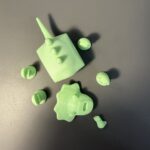
The foot pads use triply periodic minimal surface (TPMS) metastructures, lightweight porous geometries that compress on impact and spring back during push-off, storing and releasing mechanical energy with each step. Dr. Keun Park and Dr. Jung-Yup Kim, both from the School of Mechanical System Engineering, tested three hemispherical TPMS geometries: primitive, gyroid, and diamond. The diamond design at 60% relative density outperformed the others, offering the best combination of flexibility, energy absorption, and low energy loss.
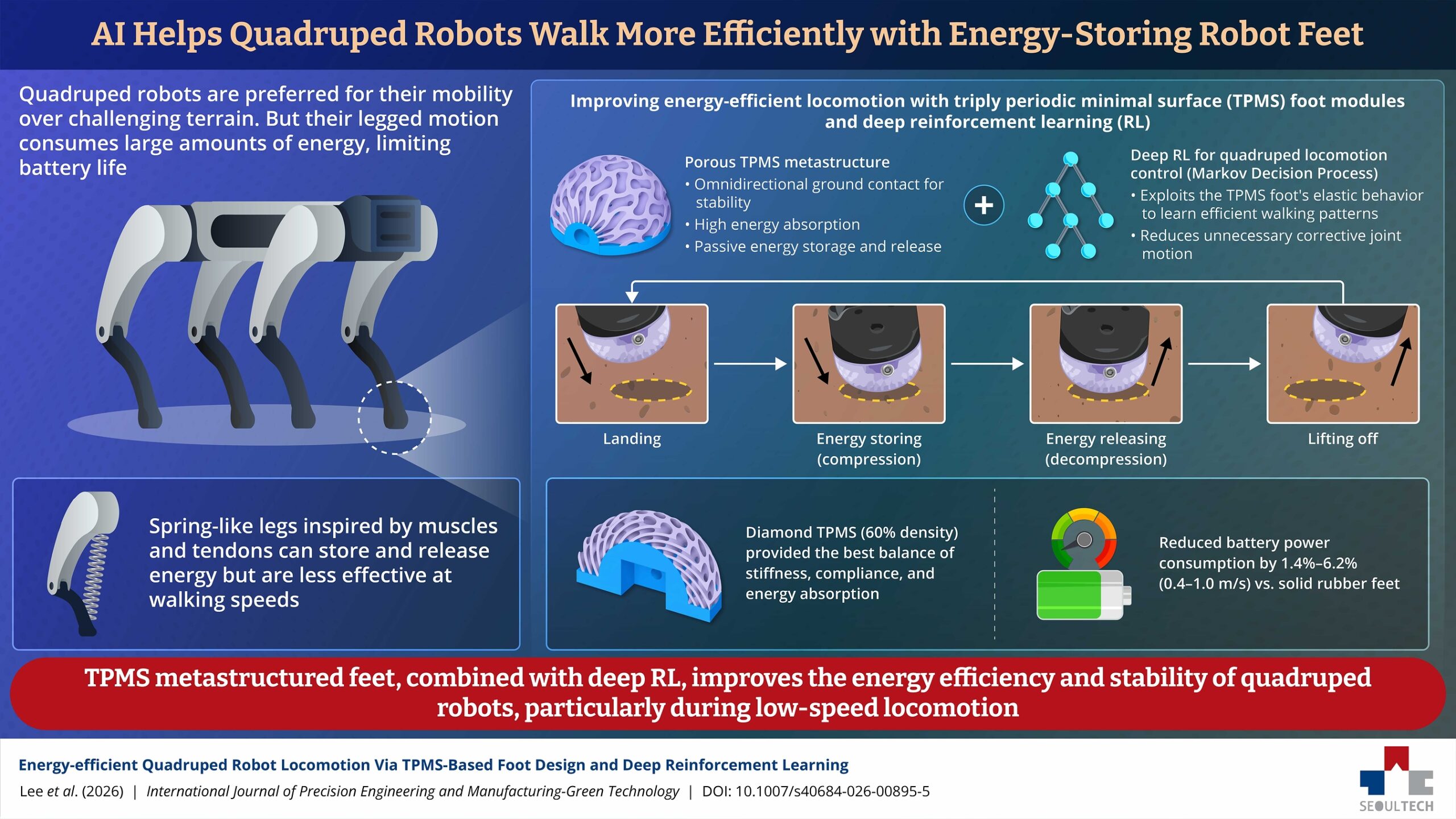
The foot pads alone aren’t enough. At low walking speeds, elastic components tend to dissipate stored energy rather than return it usefully, which can actually destabilize a robot. To solve that, the researchers paired the TPMS feet with a deep reinforcement learning controller that trained the robot to time its gait movements to match the feet’s compression and rebound cycle, reducing the work demanded from the motors.
Testing on a commercially available quadruped robot, the system delivered power savings between 1.4% and 6.2% across walking speeds from 0.4 to 1.0 meters per second, while the robot maintained stable locomotion throughout.
“By modulating foot stiffness and leveraging passive energy absorption and release, the proposed approach offers a practical alternative to conventional leg-mounted spring mechanisms,” said Dr. Park.
Dr. Kim added: “These results demonstrate that TPMS metastructures, when properly modeled and exploited through learning-based control, can serve as effective energy-shaping components for energy-efficient quadruped locomotion.”
The TPMS geometry has already found use in airless tires and soft robotic grippers. The researchers say this application could help produce quieter, longer-running quadruped robots for indoor service, inspection, and logistics deployments.
Source: eurekalert.org