
QIDI’s new large format machine adds 18 percent more build volume in the same footprint, a hotter chamber, and cleaner air, and it stays under $750.
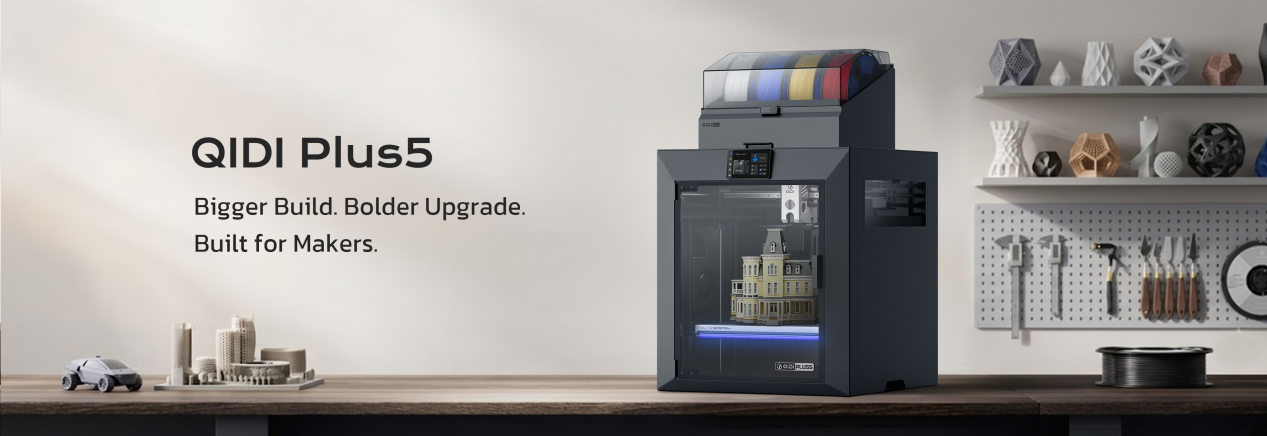
QIDI has announced the global launch of the QIDI Plus5, a large format FDM 3D printer that arrives as the company’s headline mid-year launch. The QIDI Plus5 builds directly on the Plus4, keeping that machine’s cabinet and footprint while upgrading the motion system, chamber heating, onboard safety features, and software ecosystem.
The headline numbers: roughly 18 percent more build volume in the same enclosure, a 65°C actively heated chamber on 37.5 percent more heating power, and a price of $749, with the Plus5 Combo at $899.

QIDI Plus5
Large format FDM | 320 x 320 x 300 mm | 65°C actively heated chamber
Plus5 Combo available for $899
The QIDI Plus5 keeps the Plus4’s cabinet and upgrades nearly everything inside it. The X axis moves to high-precision linear rails and a 9 mm wide 1.5GT belt, bed leveling uses a nozzle-contact sensor for zero-offset measurements, and the third generation of QIDI’s active chamber heating reaches 65°C on 550 W of power. An AI camera watches for print failures, the heated bed signals its status at a glance, and a three-stage filtration module cleans the air on the way out. It is a machine built for large engineering-grade prints that still prices like a consumer printer.
Best for: Makers stepping up to large format printing who want engineering filaments, a heated chamber, and air filtration without a professional-tier budget.
Same footprint, 18 percent more build volume
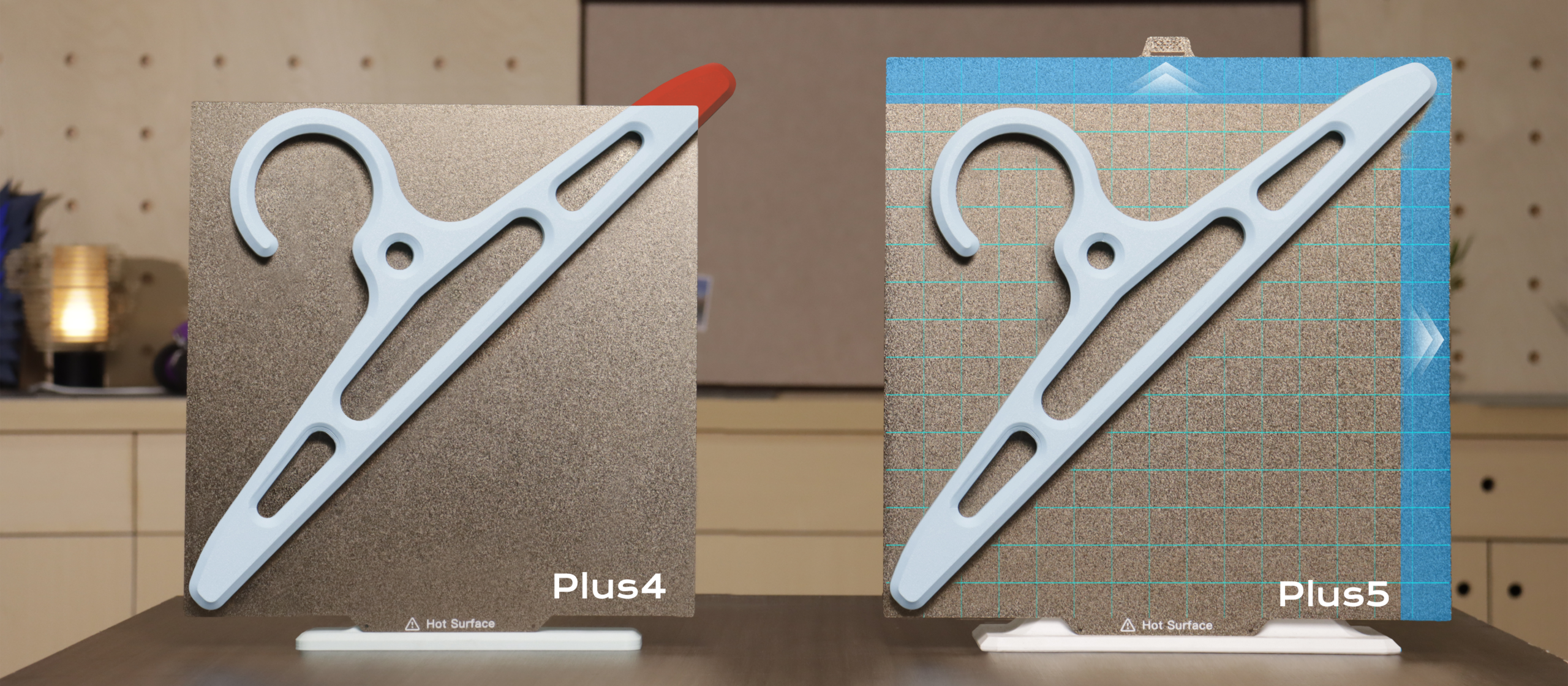
The Plus5 prints up to 320 x 320 x 300 mm, an increase of nearly 18 percent over the Plus4. QIDI managed this without enlarging the machine itself, so the printer takes up the same bench space as its predecessor. In practice, the extra volume is often the difference between printing a helmet, an RC body, or a full batch plate in one piece and splitting it into sections for gluing.
Linear rails and a wider belt
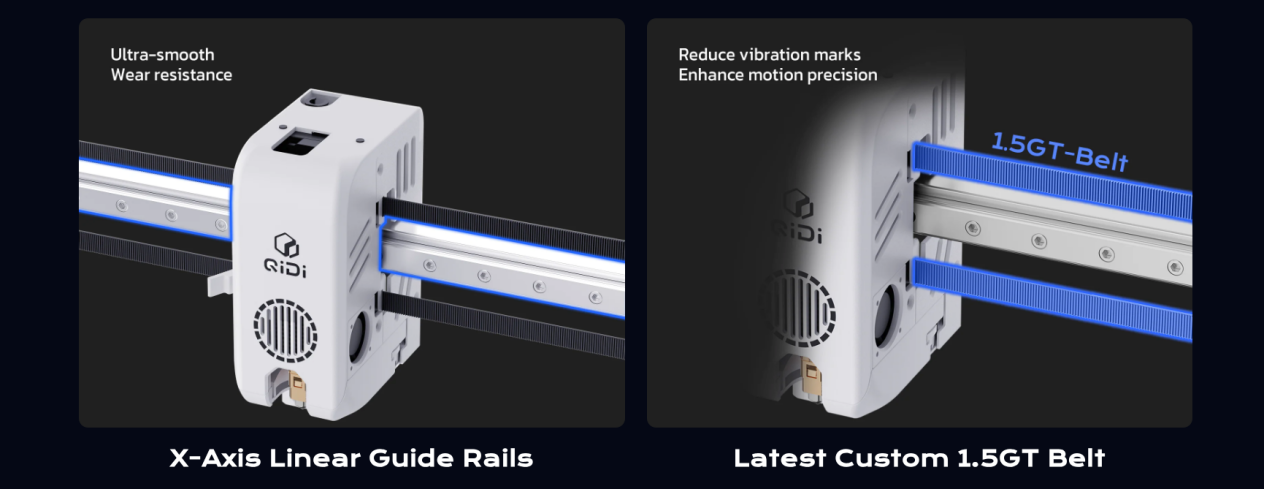
Beneath the enclosure, the QIDI Plus5 moves to a reinforced all-metal frame and a reworked motion system. The X axis now runs on high-precision linear rails, which reduce motion resistance and keep the gantry smooth and quiet at high speeds. Linear rails also resist wear and wobble over long service life, a real consideration on a machine intended for extended engineering prints.
The X axis belt is upgraded to a 9 mm wide 1.5GT belt. Compared with the 6 mm 2GT belt that is standard across the industry, the wider belt and finer tooth pitch hold tension better under rapid direction changes and start-stop moves, which QIDI says keeps dimensional accuracy tight even at speed.
Bed leveling uses the latest generation nozzle-contact sensor: the nozzle itself touches the plate for zero-offset measurements. Because the reading comes directly from the tip that lays down the plastic, it is unaffected by build plate material or ambient vibration, so first layers come out consistent from print to print.
Heating and cooling in one chamber
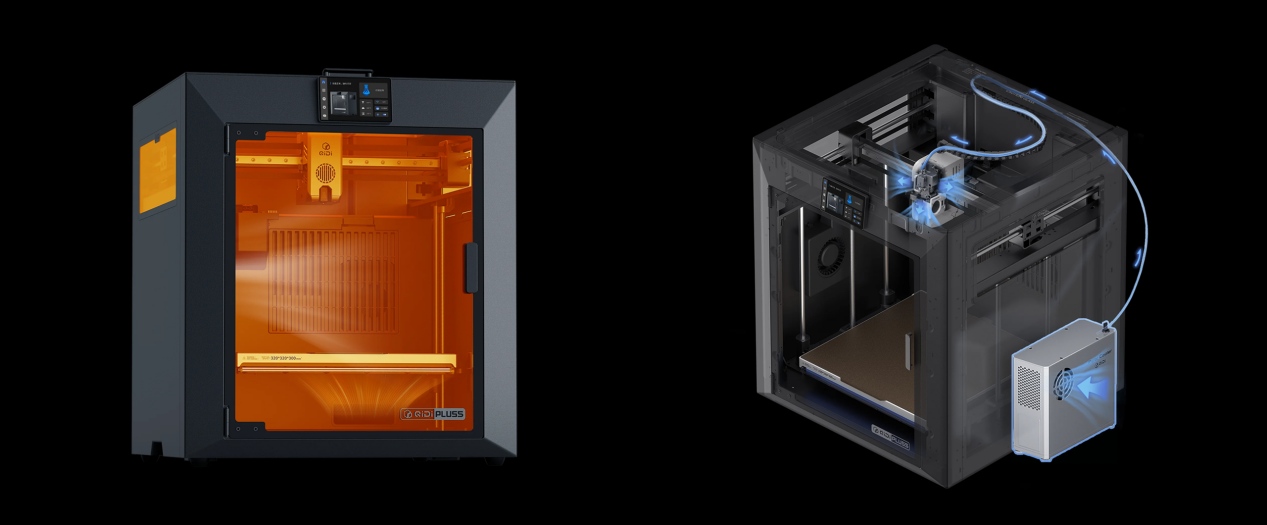
Active chamber heating has become a signature of QIDI machines, and the QIDI Plus5 carries the third generation of the system. It reaches a chamber temperature of 65°C on 550 W of heating power, a 37.5 percent increase over the Plus4, which means shorter warm-up times before large ABS or PC jobs.
The other half of the story is cooling. The QIDI Plus5 supports QIDI’s new extruder cooling system, an optional accessory sold separately, which actively cools the print head, working like an air conditioner for the extrusion path. The airflow guards against heat creep and clogging, keeping extrusion stable through long sessions.
QIDI says the combination of a hot chamber and a cooled extruder is what keeps large prints warp free across a broad range of materials, including PLA, ABS, PC, and ABS-GF. The physics support the claim: a consistent chamber temperature is the main defense against the uneven cooling that makes large ABS and PC parts lift at the corners. At 65°C the chamber sits comfortably in engineering-filament territory, though users planning exotic high-temperature materials should note it is below what dedicated industrial machines offer.
From phone to print in one tap
Alongside the printer, QIDI has launched QIDI Maker (qidimaker.com), a model platform built as an open community for 3D printing enthusiasts and designers, with a companion mobile app that is tightly linked to the site. Browse the model library on your phone, pick a design, and the app slices it in the cloud with preset parameters, then sends the job straight to the printer. There is no desktop slicer to learn and no parameter tuning required, which makes the QIDI Plus5 an easy first large format machine for beginners, while experienced users can keep their usual slicing workflow.
A watchful camera, status lights, and filtered air
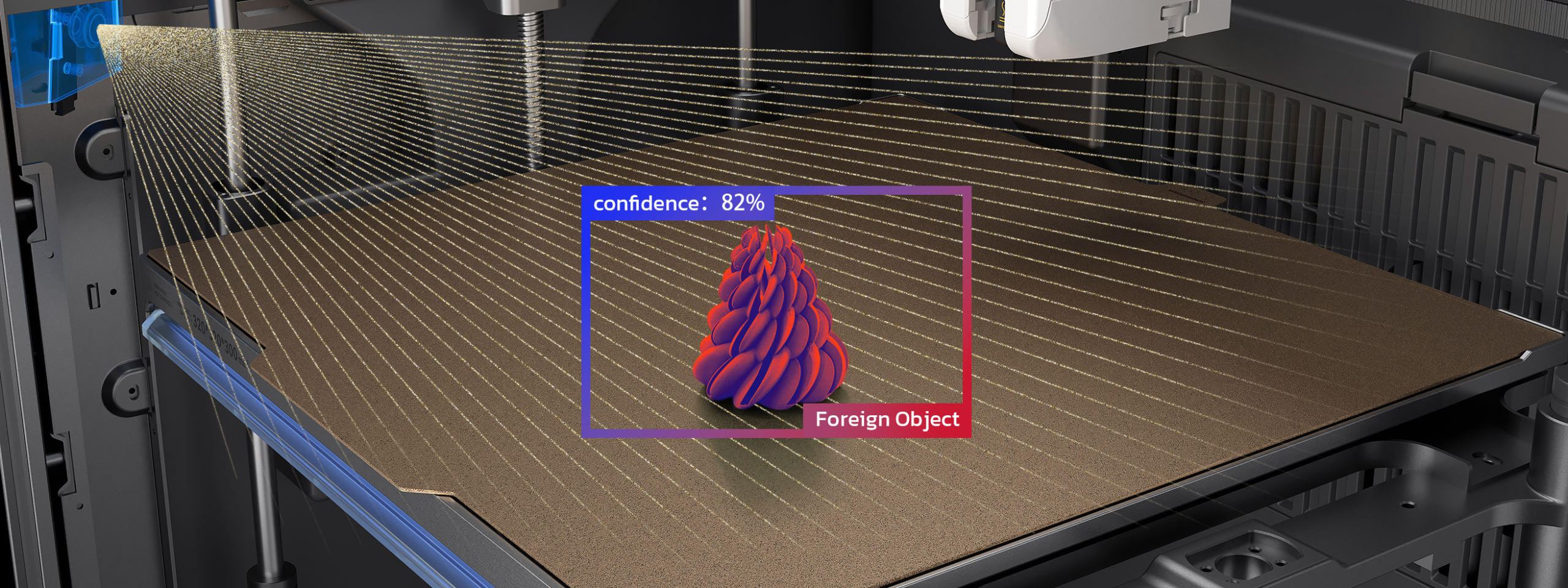
The QIDI Plus5 ships with an AI-powered camera that actively monitors for common print failures such as spaghetti errors, where a detached print turns into a tangle of loose strands. It works alongside multiple chamber sensors that provide closed-loop temperature control, and the chamber itself uses a flame-retardant design for an added layer of safety during long prints.
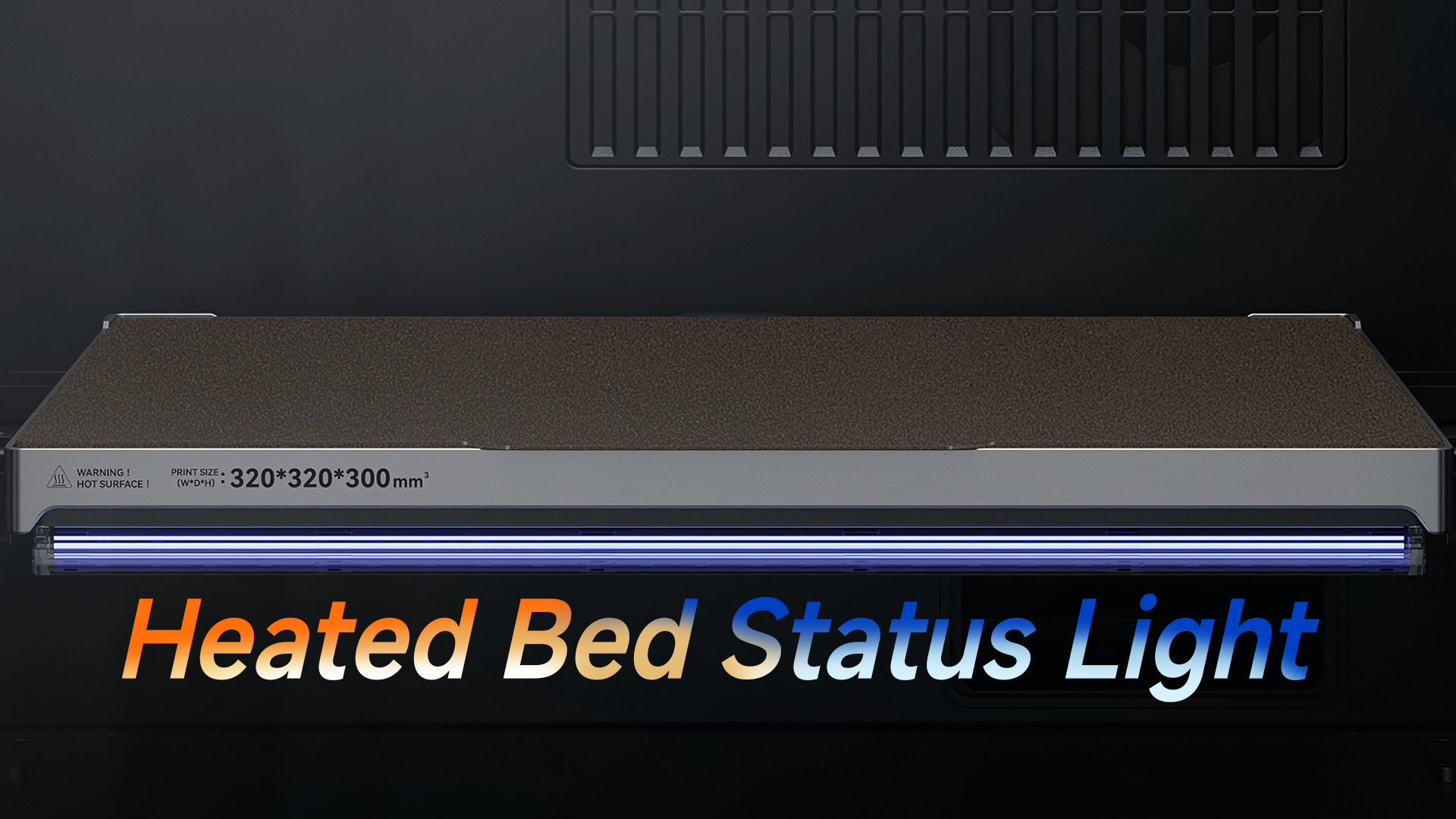
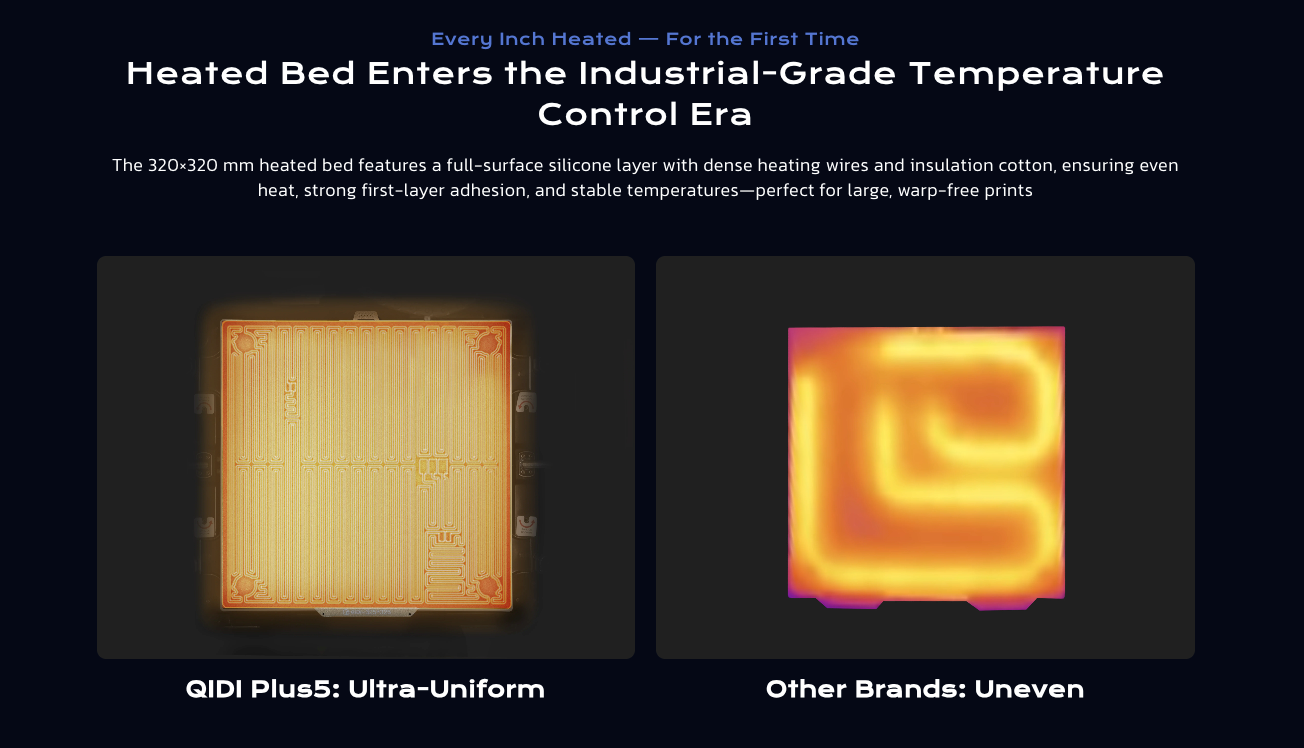
The heated bed gains a new generation of smart status indicators, so you can tell at a glance whether the machine is in Standby, Ready, or Printing. It is a small touch, but a useful one when checking on a print from across the room or running more than one machine.
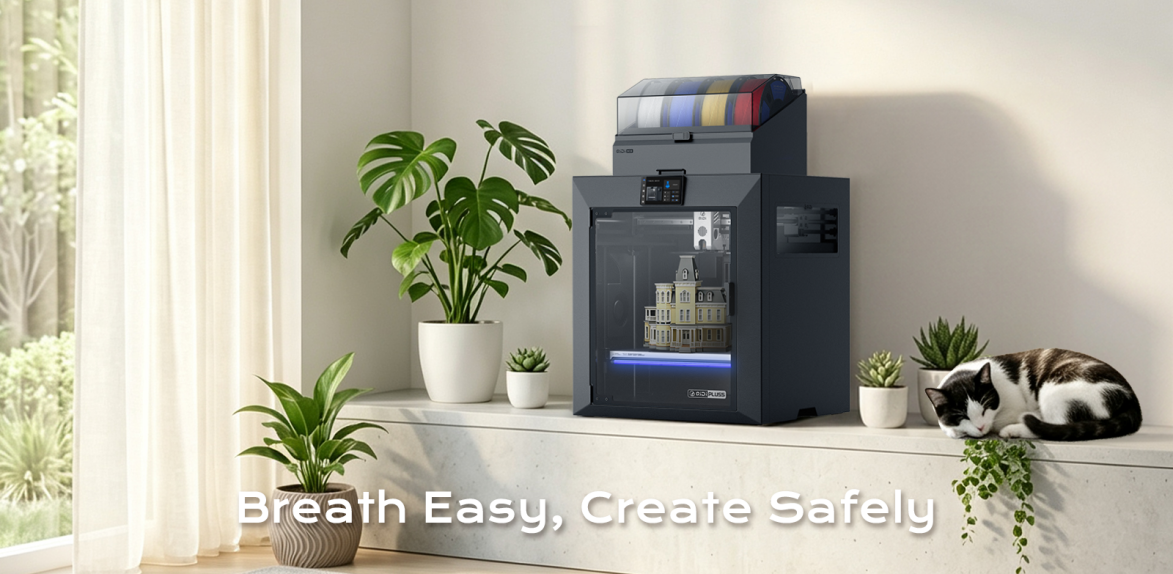
Air quality gets specific attention. An advanced air circulation system runs through a three-stage filtration module: a G3 pre-filter, an H12 HEPA layer, and activated carbon. According to QIDI, the system captures 99.5 percent of airborne particles and dust while reducing odors. For a machine built to run ABS and other engineering filaments indoors, that is a meaningful addition rather than a checkbox feature.
320 x 320 x 300 mm of printable space in the same cabinet as the Plus4. No extra bench space required.
Third-generation active heating on 550 W keeps large ABS, PC, and ABS-GF prints from warping.
An AI camera catches failures like spaghetti errors, backed by chamber sensors and a flame-retardant design.
G3 pre-filter, H12 HEPA, and activated carbon capture 99.5% of particles, per QIDI, for cleaner indoor printing.
Pricing and availability
The QIDI Plus5 is available now at the official QIDI store, in stock and ready to ship. The QIDI Plus5 is priced at $749, and the Plus5 Combo at $899.
For that money, buyers get a large format machine with a heated chamber, linear rail motion, nozzle-contact leveling, AI print monitoring, and full air filtration. On paper, that is a lot of machine for the money. For makers who want to step up to large format printing without giving up print quality, material range, or safety, the QIDI Plus5 makes a strong case for itself.
Note on pricing and availability: The $749 price for the QIDI Plus5 and the $899 price for the Plus5 Combo reflect the official US store at the time of this update. The extruder cooling system and the QIDI Box for multi-color printing are optional accessories sold separately. Check the QIDI product page for your local currency and the latest pricing and availability.
This article is sponsored by QIDI. 3DPrinting.com received compensation for placement; editorial direction was led by 3DPrinting.com.