
3D Printing

Buyer guides

  • Best 3D printers
  • For beginners
  • Multicolor
  • Resin printers
  • Budget (under $400)
  • For kids and schools
  • For miniatures
  • Large format
All printer guides

Brands and compare

  • Bambu Lab lineup compared
  • Compare printers
  • Full color 3D printers
  • Large scale and industrial

Reviews

  • Elegoo Mars 5 Ultra
  • FLSun T1 Pro
  • QIDI Tech Q1 Pro
All reviews
Best 3D Printers 2026: Buyer’s Guide

Start with the top picks

Best 3D Printers 2026: Buyer’s Guide

Twenty printers tested and ranked, from $169 to the H2D.

See the picks

Filament

  • Best PETG filament
  • Best PLA filament
  • Best TPU filament
  • Best ABS and ASA filament
  • Engineering filaments
  • Composite filaments
  • Flexible filaments
  • Bio filaments
All filament guides

Resin

  • For miniatures
  • Tough and ABS-like
  • Castable resin
  • Water-washable
  • Flexible resin
All resin guides

Accessories

  • Filament dryers
  • Printer enclosures
  • Wash and cure stations
Best Filament Dryers (2026 Guide)

Most-clicked accessory

Best Filament Dryers (2026 Guide)

Wet filament causes most failed prints; the fix costs less than a spool.

Compare dryers

Buyer guides

  • Small objects
  • Medium objects
  • Large objects
  • Professional scanners
  • Scan with your phone
All scanner guides

Software and service

  • 3D scanner software
  • Scanning service vs buying

Reviews

  • Revopoint MetroY Pro
  • Revopoint Inspire 2
  • Revopoint Trackit
All scanner reviews
3D Scanners 2026: The Complete Buying Guide

Find the right scanner

3D Scanners 2026: The Complete Buying Guide

Nineteen scanners from $400 to $40,000, sorted by object size.

Open the guide

Design and AI

  • AI 3D model generators
  • 3D modeling and CAD software

Print prep and control

  • Slicers
  • STL repair tools
  • Printer host and remote control

Reviews

  • Meshy Edit
  • Tripo H3.1
  • Meshy 7.1
All software reviews
Best AI 3D Model Generators for 3D Printing (2026)

Fastest-growing guide

Best AI 3D Model Generators for 3D Printing (2026)

Type a prompt, get a printable model: the tools we tested, free tiers first.

Try the tools

Start here

  • What is 3D printing?
  • How much does it cost?
  • FDM vs resin
  • Best printers for beginners

How it works

  • What is a 3D printer?
  • How does 3D printing work?
  • Types of 3D printing
  • Metal 3D printing

How-tos and glossary

  • 3D printing glossary
  • Food-safe 3D printing
  • Setting up a school program
  • Free 3D printable models
What is 3D Printing?

Start here

What is 3D Printing?

The one-page explainer, then how much it costs and which technology to buy.

Start reading
Black FridayNEW

Latest

  • Revopoint MIRACO 2 Launches on Kickstarter: A Standalone 3D Scanner From $1,425
  • Stark Future Orders Multiple Farsoon FS4X Laser Powder Bed Fusion 3D Printers for a Series Production Line
  • Bambu Lab Launches MakerKids Beta, 3D Printing Lessons for Families in Bambu Handy App
  • Oqton Launches MOS 2.0 and Brings 3DXpert to Eplus3D LPBF 3D Printers
  • VulcanForms Orders 200 EOS M4 ONYX Laser Powder Bed Fusion 3D Printers, the Largest Single Order in EOS History
All news

Use cases

  • Dutch Machine Builder Swaps a Welded Part for One Metal 3D Printed by K3D
  • Prague Firefighters 3D Print Their Own Gear on a Prusa CORE One L
  • OECHSLER Scales Carbon Lattice Production to 40 Printers Running Around the Clock
  • Reverse Engineering Without CAD Data: How the MetroY Ultra Turns Physical Parts into Digital Designs
  • Michigan State Engineers 3D Printed Helmet Inserts to Help Quarterbacks Tackle Crowd Noise
All use cases

Industry

  • Automotive
  • Aerospace
  • Medical
  • Dental
  • Construction
  • Rapid prototyping
  • Electronics
  • Food
  • Fashion
  • Bioprinting
Revopoint MIRACO 2 Launches on Kickstarter: A Standalone 3D Scanner From $1,425

Latest

Revopoint MIRACO 2 Launches on Kickstarter: A Standalone 3D Scanner From $1,425

Revopoint launches MIRACO 2 on Kickstarter on November 18. The standalone 3D scanner handles scanning and basic editing…

Read more
Contact
  • Home
  • Products
  • Videos
  • Newsletter
  • Contact us

Buyer guides

  • Best 3D printers
  • For beginners
  • Multicolor
  • Resin printers
  • Budget (under $400)
  • For kids and schools
  • For miniatures
  • Large format
All printer guides

Brands and compare

  • Bambu Lab lineup compared
  • Compare printers
  • Full color 3D printers
  • Large scale and industrial

Reviews

  • Elegoo Mars 5 Ultra
  • FLSun T1 Pro
  • QIDI Tech Q1 Pro
All reviews

Filament

  • Best PETG filament
  • Best PLA filament
  • Best TPU filament
  • Best ABS and ASA filament
  • Engineering filaments
  • Composite filaments
  • Flexible filaments
  • Bio filaments
All filament guides

Resin

  • For miniatures
  • Tough and ABS-like
  • Castable resin
  • Water-washable
  • Flexible resin
All resin guides

Accessories

  • Filament dryers
  • Printer enclosures
  • Wash and cure stations

Buyer guides

  • Small objects
  • Medium objects
  • Large objects
  • Professional scanners
  • Scan with your phone
All scanner guides

Software and service

  • 3D scanner software
  • Scanning service vs buying

Reviews

  • Revopoint MetroY Pro
  • Revopoint Inspire 2
  • Revopoint Trackit
All scanner reviews

Design and AI

  • AI 3D model generators
  • 3D modeling and CAD software

Print prep and control

  • Slicers
  • STL repair tools
  • Printer host and remote control

Reviews

  • Meshy Edit
  • Tripo H3.1
  • Meshy 7.1
All software reviews

Start here

  • What is 3D printing?
  • How much does it cost?
  • FDM vs resin
  • Best printers for beginners

How it works

  • What is a 3D printer?
  • How does 3D printing work?
  • Types of 3D printing
  • Metal 3D printing

How-tos and glossary

  • 3D printing glossary
  • Food-safe 3D printing
  • Setting up a school program
  • Free 3D printable models
Black FridayNEW

Latest

  • Revopoint MIRACO 2 Launches on Kickstarter: A Standalone 3D Scanner From $1,425
  • Stark Future Orders Multiple Farsoon FS4X Laser Powder Bed Fusion 3D Printers for a Series Production Line
  • Bambu Lab Launches MakerKids Beta, 3D Printing Lessons for Families in Bambu Handy App
  • Oqton Launches MOS 2.0 and Brings 3DXpert to Eplus3D LPBF 3D Printers
  • VulcanForms Orders 200 EOS M4 ONYX Laser Powder Bed Fusion 3D Printers, the Largest Single Order in EOS History
All news

Use cases

  • Dutch Machine Builder Swaps a Welded Part for One Metal 3D Printed by K3D
  • Prague Firefighters 3D Print Their Own Gear on a Prusa CORE One L
  • OECHSLER Scales Carbon Lattice Production to 40 Printers Running Around the Clock
  • Reverse Engineering Without CAD Data: How the MetroY Ultra Turns Physical Parts into Digital Designs
  • Michigan State Engineers 3D Printed Helmet Inserts to Help Quarterbacks Tackle Crowd Noise
All use cases

Industry

  • Automotive
  • Aerospace
  • Medical
  • Dental
  • Construction
  • Rapid prototyping
  • Electronics
  • Food
  • Fashion
  • Bioprinting
Contact
Blog
  • Latest News
  • Use Cases
  • Reviews
  • 3D Printers
  • 3D Printing Metal
Featured Industries
  • Automotive
  • Aerospace
  • Construction
  • Dental
  • Environmental
  • Electronics
  • Medical
  • Military
  • Fashion
  • Art
Company Information
  • What is 3D Printing?
  • Advertise with us
  • Media Kit
  • Nederland 3D Printing
Home / Tips and Tricks / How 3D Printed Lattice Structures Improve Mechanical Properties
creality header

How 3D Printed Lattice Structures Improve Mechanical Properties

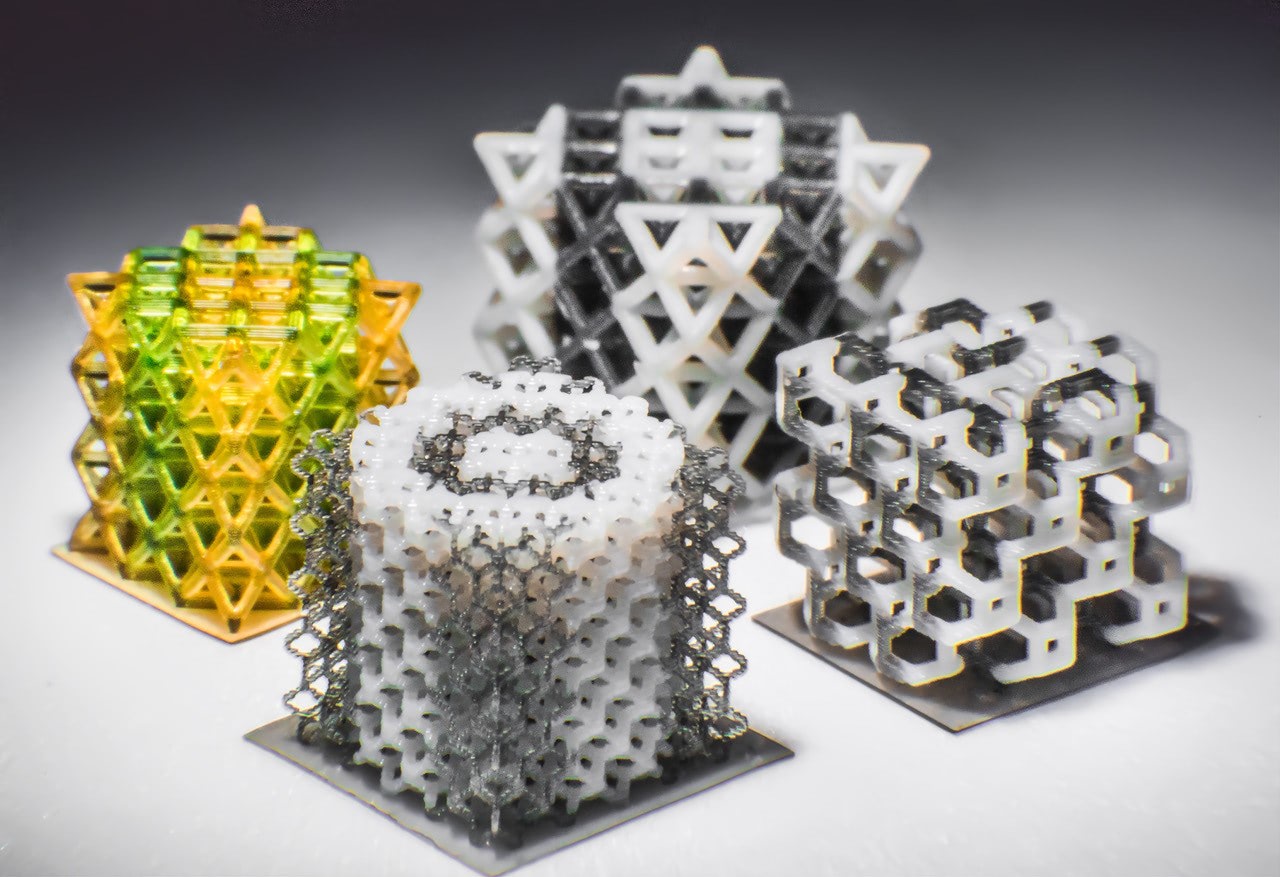
3D printing allows for users to create some very intricate forms quite easily. By tinkering the internal geometries of printed parts they can achieve some pretty impressive mechanical properties. One of the best ways to achieve good strength-to-weight ratios, desirable shock and sound absorption and larger surface areas is to print objects with lattice structures.

Why Lattices?

What makes lattices unique is how they lay out materials into design elements to form an ideal structure that comprise of micro-architectures with a network of nodes and beams or struts. This format dramatically reduces weight while retaining structural integrity and giving a larger degree of control over certain characteristics. These interlinking portions can enhance various areas of performance and even use up less material without weakening the object or compromising its integrity.

Lattices have always been present in nature, from the internal structure of bones to metal crystallography. It has also made a splash in architecture from the Eiffel Tower to Shigeru Ban’s work for the Aspen Art Museum (which consists of triangular lattice resin-infused paper that can support the roof despite its very low weight while providing a clear view of the semi-translucent roof above).

Lattices are also a large part of the visual appeal of such types of objects or architecture, opening up spaces with thin nodes or beams as opposed to solid blocks of material. Thus, they maximize transparency between the structural aspects of the various buildings, ceilings, furniture or towers. Landmarks like the Eiffel tower are mostly open air, yet still showcase a high strength-to-weight ratio.

They are also common in engineering items like heat exchangers or batteries, where transmission of energy needs to be optimal. The structure allows for covering a large surface area with minimal interfering parts, so it’s also great for objects that need to be see-through or semi-permeable.
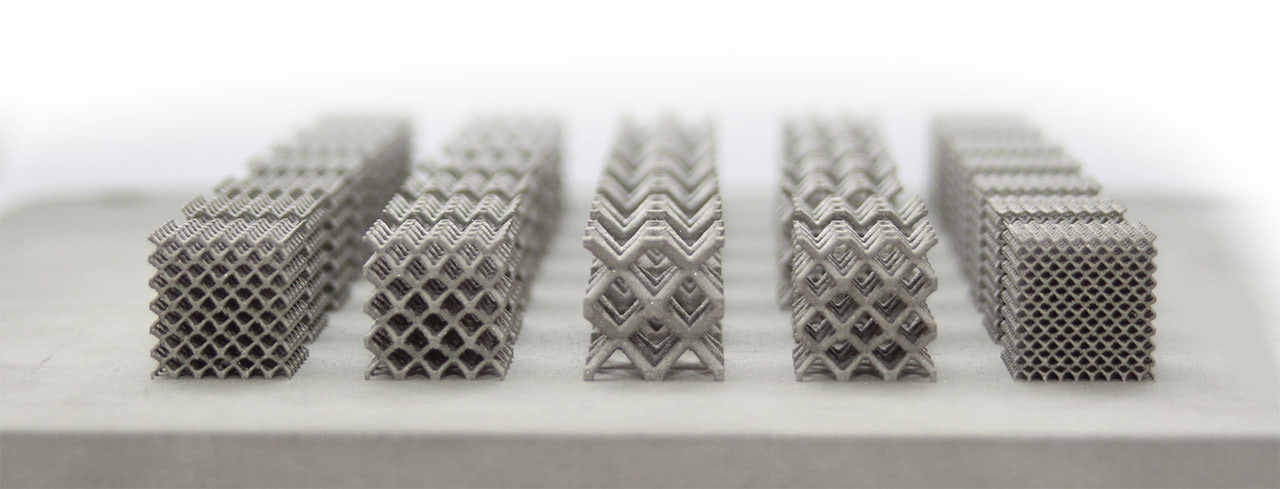
renishaw metal 3d printed lattices
Lattice test structures built on Renishaw AM250 metal AM system at The University of Nottingham, as part of the Aluminium Lightweight Structures via Additive Manufacturing (ALSAM) project.

Why 3D Printed Lattices?

3D printing has given lattices new levels of accessibility. 3D printed lattice structures are far easier to produce due to the amount of control over internal geometry the technology offers. It’s not just the hardware either. Topology optimization software, for example, have made it even easier to map out structures with precision.

Additionally, the layer-by-layer style of deposition allows greater control over hollow sections which are crucial for creating tiny nodes, beams and struts within the internal geometries of objects. Simply put, subtractive methods like CNC machining can not manage such parts by design.
Designing for Additive Manufacturing DFAM
Related Story
Designing For Additive Manufacturing (DFAM)

Structural Advantages

The main reasons to 3D print lattices are the lightweight arrangements and high strength balance it can achieve. It also has major aesthetic benefits with its open spaces, complex nodes and a lot more design possibilities. However, there are also structural benefits that go beyond just strength weight or look.

Another advantage they possess is making use of the most amount of space with a low material usage. Lattices can expand on a design to improve its overall surface area without costing much in terms of materials as they stretch across nodes with a lot of open space in between.

By adjusting the thickness and position of the nodes, beams or struts, designers can integrate some novel features related to how the component interacts with forces and sound. Using lattices gives designers far more control over shock absorption, impact control and vibration/noise dampening. Similarly, designers can reduce impact stress or employ elements that act as a sacrificial features which protect the critical components of the object.

Design Considerations

There are a lot of little details that decide how well a lattice structure operates and what characteristics it has. Here are just a few:

Cell Structure & Size

There’s a vast array of cell structures, which are individual building blocks in a lattice. Each cell represents a repeatable shape and can come in varying shapes and sizes. Usually, cell structures come in the standard shapes like cubes, stars, hexagons, diamonds and so on. However, many designers can mix and match these shapes to create specific material characteristics for a system. Not all structures are equal, so it’s important to pick which shapes recur and in what order.

The size of the cell size and how densely the shapes repeat are key factors as well. Determining the cell size also relies on adjusting the thickness and length of its members and connecting nodes. High density of repetition simply means that there are more repeating shapes within one unit of area. High densities in a low amount of area will mean more complex tinier lattices. Larger cells are easily printable but can be stiffer overall. Similarly, smaller cells allow for more consistent system responses but are limited by feature sizes, i.e. have more homogenous responses but also have size-related limitations.

Material Selection

As with all 3D printing endeavors, your print is ultimately dependent on the right material and technology. These also influence the size and density that the lattice will have, as each material has its own rigidity, weight and other material properties to consider. Elastomeric or soft materials generally require a smaller and denser cell population to reduce sag during printing. Softer, less rigid materials also ordinary require thicker members and nodes. Alternatively, lattices printed with a more rigid material generally allow a greater design range with thinner members and larger cell sizes.

Cell Orientation

The angle at which cells are printed can alter a lattice structure’s properties since it influences the amount and placement of supports required. However, one of the design advantages of a good lattice is that it can be self-supporting and stand on it’s own. Certain designs also allow for easier printing at other angles. A large cubic truss, for example, printed directly on the build platform will find its horizontal members unsupported. However, if the structure is simply rotated 45 degrees, the members are now self-supporting.

Additive Manufacturing Design Examples

A lightweight aluminium structure with a triply periodic minimal surface (TPMS) lattice – image courtesy of Functional Lattices for Automotive Components (FLAC).

Vehicle Manufacturing

Various manufacturing industries have been leveraging the ability of 3D printers to lighten metallic structures. This is especially useful for automotive, aerospace and aviation, where vehicles have to be as light as possible to maintain speed and fuel efficiency. Sometimes this allows companies to reduce the weight of components by up to 70%.

The University of Nottingham focused on 3D printing complex metal lattice structures. In doing so, they reduced the weight of automobile components by decreasing their density. These new structural components would then allow the vehicle to weigh less overall, therefore becoming more fuel-efficient.

Similarly, the Nanyang Venture 8 was an electric car created by students and staff at the Nanyang Technological University. The car features over 150 3D printed parts, including the instrument cluster, various grills, door latches, but most crucially the outer shell and body consist of a honeycomb structure that enhances its strength.

Architecture
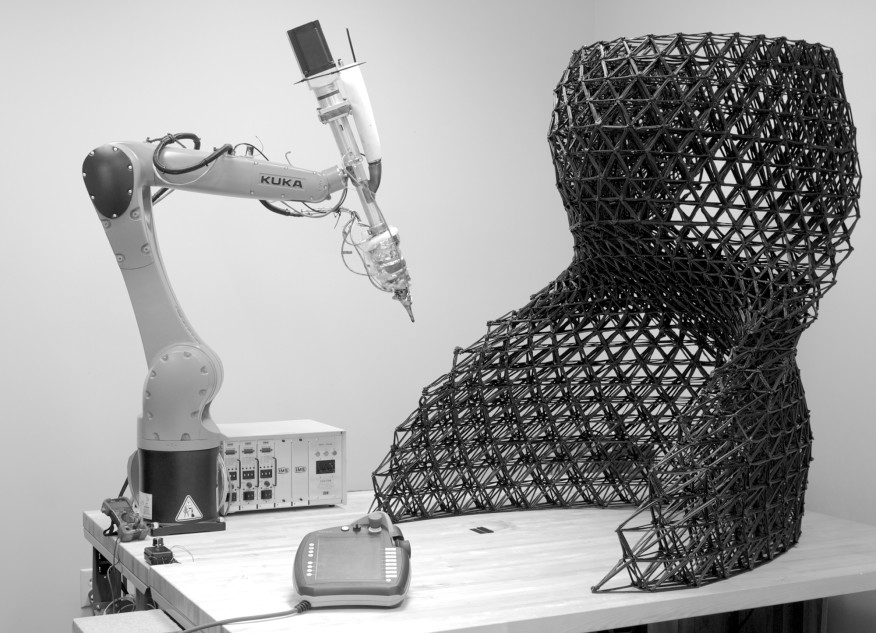
Architecture Design Lattice
Image courtesy of Branch Technology

Various firms all over the world have been using 3D printed designs for all sorts of architecture and exhibits. At the Milan Design Week in 2019 fashion brand COS commissioned Conifera, a lattice-based installation using sustainable bioplastics. It was one of the largest 3D printed structures in the world, particularly among ones consisting of bioplastic. Part of this is the lattice structure that allowed it capture a much larger surface area, while using minimal materials.

Related Story
Conifera: COS Commissions Sustainable Bioplastic Structure

Companies like Branch Technology have also been experimenting with lattice elements within architecture. They invented a 3D printed open-matrix lattice made from carbon-fiber reinforced ABS plastic that can serve as the core of a modular wall system that integrates common building materials like spray-foam insulation, spray-applied concrete, and cladding. It is light-weight and durable as well.

Sportswear

Image courtesy of Carbon

There are many examples of 3D printed lattices in sportswear, especially footwear midsoles. New Balance’s work with the Triple Cell platform or Carbon and Addidas’ Futurecraft 4D shoes. Both projects integrated a 3D printed lattice design directly into the structure of the shoes. The material could thus achieve a soft, bouncy quality while maintaining high strength and strong lattice structures. This makes the shoe design ideal for running shoes.

It’s also being used for sports equipment manufacturing. Unstrung Customs would originally develop tennis handles with traditional manufacturing methods and fill them with polyfoam. Now, the company has switched to SLS, and ditched traditional molding. The weight-balance they achieved owes to the internal lattice structure of the 3D printed handle. Weight-balancing can be crucial for modern sports equipment, giving 3D printing an advantage over traditional manufacturing methods. 3D printing is very efficient at creating optimized internal structures for better aerodynamics, weight-balance and also to improve strength.

Similarly, football players are famously prone to on-field injury, particular head trauma. Carbon has tried to mitigate such injuries by 3D printing helmet liners for Riddell’s smart helmets. They manufactured it using their “Diamond technology”, creating lattice design pads out of resin, custom fitting the player’s dimensions and position.

Related Story
Fully Customizable Tennis Racket Handle

Research & Engineering

UConn 3d printed lattics structures
Image courtesy of UConn

As mentioned previously, lattices have been used for a range of engineering purposes, most notable batteries. Lattice structures provide channels for effective transportation of electrolyte inside the volume of material, while for the cube electrode, most of the material will not be exposed to the electrolyte.

In normal batteries, 30-50% of the total electrode volume is unutilized. Our method overcomes this issue by using 3D printing where we create a microlattice electrode architecture that allows the efficient transport of lithium through the entire electrode, which also increases the battery charging rates.” Rahul Panat, associate professor of mechanical engineering at Carnegie Mellon University.

Researchers 3D Print High Efficiency Batteries With Complex Geometries
Related Story
Researchers 3D Print High Efficiency Batteries With Complex Geometries

Research into the materials and characteristics possibilities of 3D printing has been major advent for universities. Among these have been breakthroughs in how stiff and powerful internal geometries can be.

Research teams from ETH Zurich and MIT developed and fabricated material architectures that are equally strong in all three dimensions, and that are simultaneously extremely stiff. They were able to show that it’s possible to determine mathematically in theory just how stiff materials with internal voids can become. A characteristic feature of the design is that the stiffness in the material’s interior is achieved through plate-lattices rather than trusses.

ETH Zurich were also able to formulate the stiffest possible internal structure allowed by physical laws. Using intricate networks of trusses, girdles and arches, the researchers not only maximised stiffness, but also achieved this high strength printout using plastic. The print they designed also measures precisely equally in all 3 directions.

Related Story
ETH Zurich Print World’s Stiffest Material
Share:
WhatsApp Twitter Facebook LinkedIn Buffer Reddit E-mail

Rawal Ahmed

Rawal Ahmed is a freelance journalist and politics correspondent with an avid interest in futurism, science and technology.

Join our newsletter

Our newsletter is free & you can unsubscribe any time.

Latest posts

Revopoint MIRACO 2 Launches on Kickstarter: A Standalone 3D Scanner From $1,425

Revopoint launches MIRACO 2 on Kickstarter on November 18. The standalone 3D scanner handles scanning and basic editing without a PC, and Revopoint... read more »

News
Revopoint MIRACO 2 Launches on Kickstarter: A Standalone 3D Scanner From $1,425

Stark Future Orders Multiple Farsoon FS4X Laser Powder Bed Fusion 3D Printers for a Series Production Line

Stark Future is buying multiple Farsoon FS4X metal 3D printers to build a series production line for selected motorcycle parts.

3D Printing Metal
Stark Future Orders Multiple Farsoon FS4X Laser Powder Bed Fusion 3D Printers for a Series Production Line

Bambu Lab Launches MakerKids Beta, 3D Printing Lessons for Families in Bambu Handy App

Bambu Lab's MakerKids beta offers project-based 3D printing lessons for parents and children, grouped by age, in Bambu Handy and on MakerWorld.

News
Bambu Lab Launches MakerKids Beta, 3D Printing Lessons for Families in Bambu Handy App

Oqton Launches MOS 2.0 and Brings 3DXpert to Eplus3D LPBF 3D Printers

Oqton released MOS 2.0 production software for industrial 3D printing, and its 3DXpert is now a standard option on Eplus3D metal printers.

News
Oqton Launches MOS 2.0 and Brings 3DXpert to Eplus3D LPBF 3D Printers

VulcanForms Orders 200 EOS M4 ONYX Laser Powder Bed Fusion 3D Printers, the Largest Single Order in EOS History

VulcanForms is adding 200 EOS M4 ONYX metal 3D printers in Devens, Massachusetts, growing its fleet of the machines from 35 to 235.

News
VulcanForms Orders 200 EOS M4 ONYX Laser Powder Bed Fusion 3D Printers, the Largest Single Order in EOS History

Prusa Introduces CORE One L+ Zero-Trace, an FDM 3D Printer That Keeps No Files After Power-Off

Prusa’s CORE One L+ Zero-Trace has no USB, Wi-Fi, camera or file storage. Prusa also launched Connect Local, turnkey print farms and a... read more »

3D Printers
Prusa Introduces CORE One L+ Zero-Trace, an FDM 3D Printer That Keeps No Files After Power-Off

Anycubic Shows Thingiverse Models and AnyLab AI 3D Creation Tool Alongside FDM and Resin 3D Printers at Formnext 2026

Anycubic is showing multicolor-ready Thingiverse models and AnyLab, an AI tool still in development that turns text or images into 3D models.

Events
Anycubic Shows Thingiverse Models and AnyLab AI 3D Creation Tool Alongside FDM and Resin 3D Printers at Formnext 2026

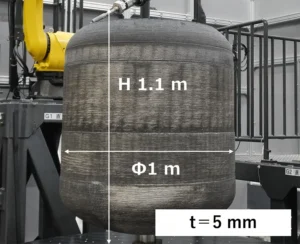
Shimizu Uses Robotic WAAM Metal 3D Printing to Build a One-Piece 1-Meter-Class Rocket Propellant Tank

Working with JAXA, Shimizu used two robot arms and wire arc additive manufacturing to print a one-piece rocket tank that withstood 1.7 MPa.

3D Printing Metal
Shimizu Uses Robotic WAAM Metal 3D Printing to Build a One-Piece 1-Meter-Class Rocket Propellant Tank

Continuum Powders Unveils Argos Plasma Melting and Gas Atomization Platform for 3D Printing Metal Powder

Continuum Powders unveiled Argos, a cold-hearth plasma melting and inert gas atomization platform designed to make over 4 metric tons of metal powder... read more »

3D Printing Metal
Continuum Powders Unveils Argos Plasma Melting and Gas Atomization Platform for 3D Printing Metal Powder

Polymaker Launches G-Flex PETG, an Elastic PETG and TPU Blend That Prints Like PETG

Polymaker has launched G-Flex PETG, an elastic filament made from a blend of PETG and TPU that the company says prints like PETG... read more »

Materials
Polymaker Launches G-Flex PETG, an Elastic PETG and TPU Blend That Prints Like PETG

Social

  • Facebook Facebook 3D Printing
  • Linkedin Linkedin 3D Printing
longer
Join our newsletter

Our newsletter is free & you can unsubscribe any time.

revopoint bf sidebar

Tripo

Free to $110/mo
  • 60% off Tripo Pro with code 3DPRINTING.
Tripo
View at Tripo tripo3d.ai

Creality K1C

$499
  • Creality describes a CoreXY motion system, printing up to 600 mm/s, a clog-free extrude…
Creality K1C
Buy Now store.creality.com

Anycubic Photon Mono 4

~$219
  • The cheapest credible resin printer with 10K resolution on a 7-inch screen and a small…
Anycubic Photon Mono 4
Buy Now anycubic.com

Raise3D Pro3 Plus HS

~$7,000-$7,600
  • A production-grade IDEX machine with a 300 × 300 × 605 mm build volume, Hyper FFF tec…
Raise3D Pro3 Plus HS
Buy Now matterhackers.com

Anycubic Kobra 3 Max Combo

~$700
  • Offers the most build volume per dollar in 2026 with a 420 x 420 x 500 mm envelope, 600…
Anycubic Kobra 3 Max Combo
Buy Now anycubic.com

Bambu Lab A1

~$320
  • The cleanest first-printer story in 2026 with a 15-minute setup wizard, full auto-calib…
Bambu Lab A1
Buy Now bambulab.com

Phrozen Sonic Mighty Revo

~$720
  • The premium reliability pick with an aerospace-grade aluminum frame, dual linear rails,…
Phrozen Sonic Mighty Revo
Buy Now phrozen3d.com

Phrozen Sonic XL 4K Plus

~$3,500
  • Designed specifically for dental labs and clinics producing crowns, bridges, removable…
Phrozen Sonic XL 4K Plus
Buy Now phrozen3d.com

Site footer

The 3DPrinting.com newsletter

The week’s best reviews, buyer’s guides and deals. One email every Friday, no spam.

By subscribing you agree to our privacy policy. Unsubscribe anytime.

3D PRINTING.COM

Independent reviews, buyer’s guides and news about 3D printers, materials, scanners and software.

Reviews

  • All reviews
  • 3D printers
  • Filament & materials
  • 3D scanners
  • Software
  • Compare products

Buyer's guides

  • Best 3D printers
  • Best resin 3D printers
  • 3D printers for beginners
  • Best PLA filament
  • Best slicers
  • Best pro 3D scanners

Learn & news

  • Latest news
  • Deals
  • What is 3D printing?
  • FDM vs resin
  • Use cases by industry
  • Glossary

Company

  • About us
  • Contact us
  • Advertise with us
  • Media kit
  • Nederland 3D Printing

© 2026 3DPrinting.com · Strikwerda en Dehue

  • Privacy policy
  • Terms of use
  • Affiliate disclosure
  • RSS