

CGTrader’s 2026 market report shows a booming print market, a brutal quality premium, and one number the AI industry will not be quoting: only 1 in 25 print buyers says AI generated 3D works well.
AI generated 3D models now make up about one in six uploads on CGTrader, one of the world’s largest 3D model marketplaces, yet they earn only about one dollar in every ninety of revenue. That is the headline finding of 3D Model Market Trends 2026: Growth Raised the Bar, the annual report CGTrader launched at SIGGRAPH 2026, covering marketplace data from June 2025 through May 2026. And buried in the print section is a sharper number still: per CGTrader’s buyer survey, only around 1 in 25 3D print buyers says AI generated 3D works well, the lowest approval of any buyer group in the dataset.
The reason, as anyone who has watched a print fail at 90 percent completion already suspects, is physics.
All figures: CGTrader marketplace data and buyer survey, June 2025 to May 2026.
3D printing is outgrowing CG
First, the good news for our corner of the market. Demand for printable models on CGTrader grew 7.5 percent year over year, twice the 3.7 percent pace of CG models, and nine of ten print categories grew.
The volume core remains familiar: miniatures at about 104,000 units sold (up 4 percent), art at 87,000 (up 1 percent), jewelry at 85,000 (up 8 percent), games and toys at 58,000 (up 13 percent), and hobby and DIY at 35,000 (up 14 percent). But the fastest growers tell the more interesting story. Gadgets grew 35 percent, fashion 28 percent, house items 23 percent, and science models 21 percent, all categories where people print things to use rather than to display. Functional, personal use printing is the engine of this market now, a shift worth remembering next time you browse the free 3D model repositories for something beyond another benchy.
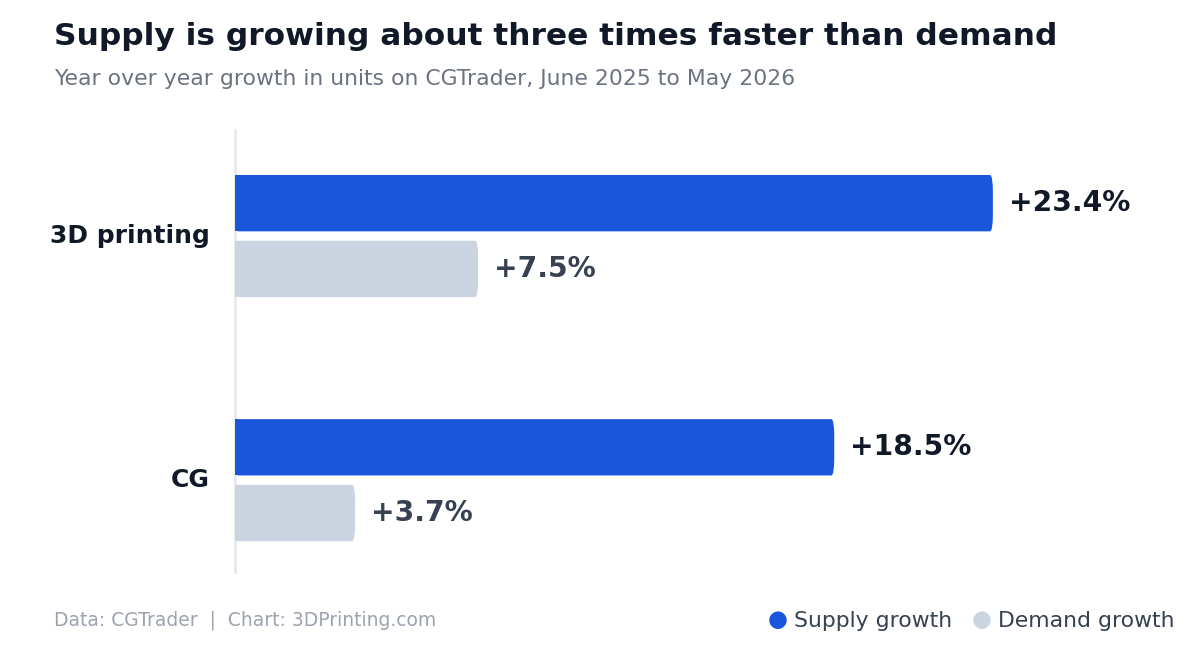
Print demand is growing twice as fast as CG, but supply is growing faster still. Data: CGTrader.
The catch sits in the same chart. Print supply grew 23.4 percent, three times faster than print demand and the widest gap anywhere on the marketplace. Across CGTrader as a whole, supply grew about 3.6 times faster than demand and average prices fell 9.7 percent.
Quality takes nearly all the money
When supply floods in, buyers get picky, and CGTrader’s revenue data shows just how picky. The top rated print models take about 63 percent of print revenue on the marketplace, and models rated 6 or higher take roughly 92 percent. On the CG side the pattern is the same: the top rating tiers hold 65.4 percent of revenue, and a model rated 9 earns about 7.3 times more per model than a mid tier one. Per CGTrader’s buyer survey, print buyers rank print ready quality and technical reliability above price.
For the hobbyist designer, CGTrader CEO Dalia Lašaitė argues this is encouraging rather than intimidating.
“You don’t need a professional studio or an extensive catalogue to produce work that buyers value. One of the top-selling print designers on our marketplace, for example, has fewer than five models in their store. A single model that meets a clear demand has become a consistent seller month after month.”
Dalia Lašaitė | CEO, CGTrader, speaking to 3DPrinting.com
The AI paradox
Now the strange part. AI generated 3D models accounted for 17.6 percent of uploads on CGTrader over the year, and 24.1 percent in the latest month, up from 14.8 percent a year earlier. Yet they drew only 2.6 percent of purchases and 1.1 percent of revenue.
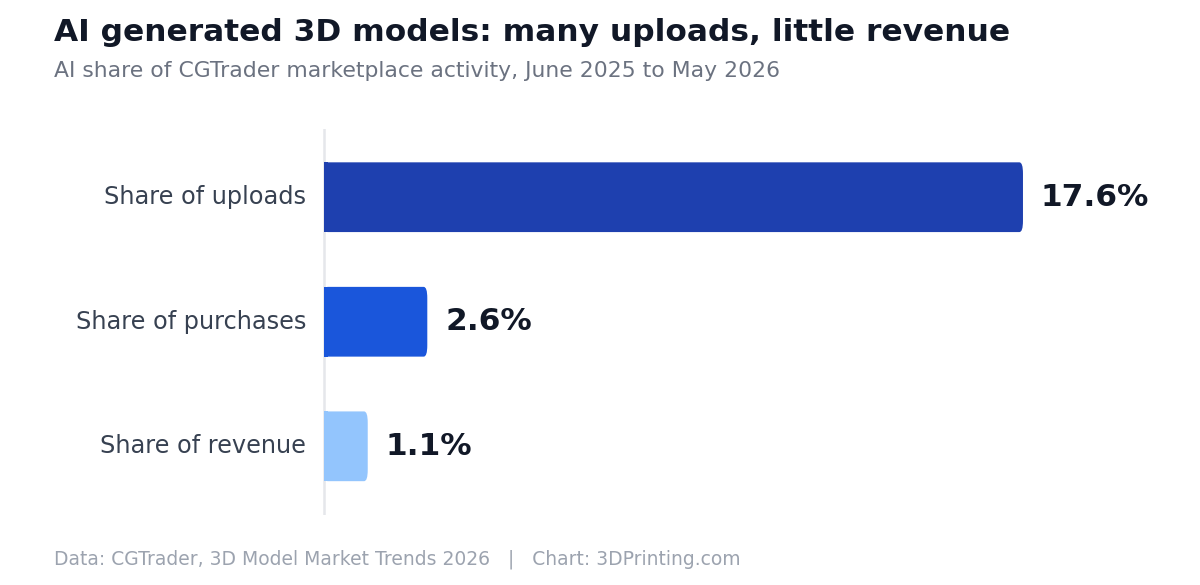
AI models flood the upload queue but barely register at the checkout. Data: CGTrader.
This is not a case of buyers never giving it a chance. In CGTrader’s survey of CG buyers, 20 percent tried AI generated models and found them not good enough, 7 percent use them only with heavy editing, and just 5 percent say they work well. Among 3D print buyers the approval falls to about 4 percent, and some 72 percent have not adopted AI generated models at all.
Why print buyers are the hard case
A CG model with a flipped normal or a hole in the mesh still renders. A print file with the same flaw fails on the plate, wasting hours and material. A printable model must be watertight, manifold, and correctly scaled, and current generative tools clear that bar far less often than their demo reels suggest, a gap we dig into in our guide to AI 3D model generators.
Lašaitė is precise about where the gap sits.
“The gap today is as much about trust as it is about technical capability. Producing a file that can technically be printed and producing one that a buyer is willing to pay for are two different standards.”
Dalia Lašaitė | CEO, CGTrader
Her survey measures the second standard, and she points out that progress toward it is uneven: “We’re seeing progress with areas such as figurines and props, while functional parts that need to fit precisely or withstand load present a higher technical bar.” That matches the growth data above. The fastest growing print categories are the functional ones, and those are where AI output is weakest today.
What would change buyers’ minds? Not better demos, she argues, but “a consistent track record of reliable, print-ready files. As the tools become more capable and consistent, I expect adoption among print buyers to follow.”
The counterpoint
Read quickly, all this looks like proof that AI is failing. The trend line says otherwise. AI models’ share of purchases on CGTrader more than tripled over the year, from about 1 percent to about 3.5 percent, and the upload share keeps climbing. Buyers are punishing unedited AI output, not AI assisted workflows. The report’s own advice to sellers is to use AI as a tool to raise output quality, not to flood the market, and the purchase curve suggests buyers can tell the difference. If that curve keeps its slope, next year’s report will read differently.
What this means if you sell print models
If you sell on any marketplace, the supply numbers are the ones to sit with. With print supply growing three times faster than print demand and models rated 6 or higher taking 92 percent of revenue on CGTrader, uploading more average models is a strategy that mathematically cannot work.
“Simply increasing the volume of models isn’t enough. With supply growing considerably faster than demand, adding more average-quality assets makes it increasingly difficult to stand out.”
Dalia Lašaitė | CEO, CGTrader
Reliable printing, correct scale, and clear previews and specifications remain essential, but she notes they are no longer what wins. “Increasingly, those technical requirements are the baseline rather than the differentiator. The designers capturing the largest share of revenue combine technical quality with a strong idea and a clear understanding of the market.” The same logic applies when you buy. Price matters, she says, but a well prepared, print tested file “can save considerably more in time and materials than choosing on price alone.”
About the data
The figures come from CGTrader’s internal marketplace data for June 2025 through May 2026, plus a buyer survey whose sample size CGTrader has not yet disclosed. CGTrader puts its catalogue at about 2.9 million models and its community at 13 million users, which makes this report an unusually large window into the paid 3D model market. Still, it is one marketplace with a CG heavy buyer base, and parts of the report use indexed values rather than absolutes. Treat every number here as “on CGTrader” rather than as the whole industry.
Where to look next
Two signals are worth watching for next year. Real time formats grew fastest of all on CGTrader, with USD and USDZ up 40 to 48 percent, a hint about where 3D content is actually being used. And the print market’s shift toward functional categories shows no sign of slowing. We will cover next year’s edition the day it lands; sign up for the newsletter and it will be in your inbox that morning.
Frequently asked questions
Can AI generate 3D printable models?
Yes, but reliability is the problem. A printable file must be watertight, manifold, and correctly scaled, and per CGTrader’s 2026 buyer survey only about 4 percent of 3D print buyers say AI generated 3D models work well for them today. Results are best for decorative pieces such as figurines and props, and weakest for functional parts.
Why do AI generated 3D models fail to print?
Common failures include non manifold geometry, holes in the mesh, walls too thin to print, and incorrect scale. A CG model with these flaws still renders on screen, but a printer turns them into failed prints, wasted filament, and lost hours, which is why print buyers are the most skeptical group in CGTrader’s data.
Is the 3D printing model market growing?
Yes. On CGTrader, demand for printable models grew 7.5 percent year over year in the 2026 report, twice the pace of CG models, with functional categories such as gadgets (up 35 percent) and fashion (up 28 percent) growing fastest.