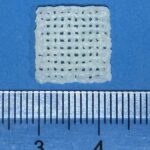

Researchers at Harbin Institute of Technology have 3D-printed a cement device that stores and releases electricity while still carrying a structural load.
Earlier cement storage devices stack the electrodes, so charged ions have to travel through the thickness of the part. That path gets longer as the piece gets thicker. This one prints the two electrodes as interlocking fingers inside a cement separator. The ions only have to cross the short gap between neighboring fingers.
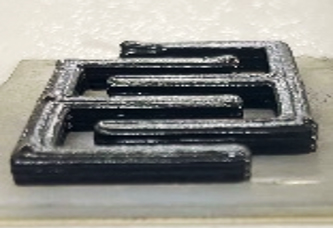
Haiping Wu and Jing Zhong at Harbin made the device with Wencai Ren of the Institute of Metal Research. They mixed carbon nanotubes and carbon black into cement to make a printable ink, then deposited it on a small concrete slab. As the cement set, water and ions filled the pores and carried charge between the fingers.
The printed piece stored 162 millifarads of charge per square centimetre, measured at 0.46 milliamps per square centimetre, across a 1-volt window. Its compressive strength was 23 megapascals, which the American Chemical Society compared with commercial concrete used for slabs and stairs. Three devices printed on the same slab and wired together lit a small row of LEDs.
The device kept working through moderate heat and cold. At about minus 18 degrees Celsius the electrolyte began to freeze and performance dropped sharply. The researchers say the next work is to make the devices hold up in freezing conditions.
“If renewable energy is available to recharge the supercapacitors frequently enough, they could meet some energy needs through repeated charging and discharging,” said Jing Zhong, the corresponding author.
The study, “Monolithic 3D-Printed Interdigitated Cement-Based Supercapacitors for Structural Energy Storage,” appeared in ACS Nano on 17 August 2026. The American Chemical Society issued this release on 1 October. Funding came from Guangdong Hailong Construction Technology, part of China State Construction International Holdings.
Source: eurekalert.org