
3D Printing
News Back to school deals Contact us
Home / News / Using Marigold In a Text-to-3D Printing AI Workflow
qidi

Using Marigold In a Text-to-3D Printing AI Workflow

December 21, 2023

There have been numerous attempts to use AI to create 3D printable models based on a simple text input over the last year, with varying results. One of the more famous examples is from LumaAI, and you may recall this project from OpenAI earlier this year.

In this article we will take a look at another method of AI-powered text-to-3D, this time using a program called “Marigold”, which according to its website, “repurposes Diffusion-Based image generators for monocular depth estimation”. Because generating AI art is one thing, but giving it actual depth, which is needed for 3D printing is an entirely different game altogether. But the creators of Marigold seem to have done just that.

What is Marigold?

Marigold was designed by researchers at ETH Zürich, and its function is to generate depth information from a 2D image. Originating from the Stable Diffusion framework, Marigold utilizes synthetic data for fine-tuning, enabling it to transfer knowledge to unfamiliar data efficiently. This approach has led Marigold to surpass the previously leading method, LeRes, in this field.
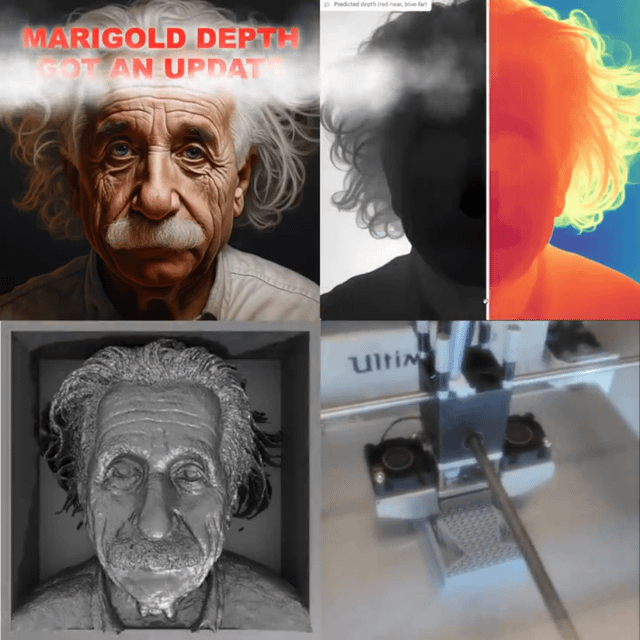
Using Marigold In a Text-to-3D Printing AI Workflow
Source data and Marigold depth info overlaid. (Image Credit: Marigold)

The model’s functionality hinges on fine-tuning the U-Net component of the Stable Diffusion setup. The process involves encoding both the image and depth into a latent space using the original Stable Diffusion VAE, followed by optimizing the diffusion objective relative to the depth latent code. A notable aspect is the modification of the U-Net’s first layer to accept concatenated latent codes, enhancing the depth estimation capability.

During inference, Marigold encodes an input image into a latent code, which is then concatenated with a depth latent. This combination is processed through the modified, fine-tuned U-Net. After several denoising iterations, the depth latent is decoded into an image, and its channels are averaged to derive the final depth estimation.

Comparative studies have shown Marigold’s superior performance in both indoor and outdoor settings against other state-of-the-art affine-invariant depth estimators. This is particularly notable as Marigold achieves these results without prior exposure to real depth samples. For a comprehensive understanding of Marigold’s methodologies and benchmarks, the detailed paper provides in-depth (no pun intended) information.

So because Marigold is an image-to-3D solution, it means that you can use AI generated images as the source. And that is exactly what one Redditor has done, as you can see below.

DallE-to-3D

Using the the DallE text-to-image AI found on Bing, Redditor “fredandlunchbox” entered a prompt to generate an image of a plastic picture frame with modern features, hanging on a wall.

DallE outputted the image that you can see below.
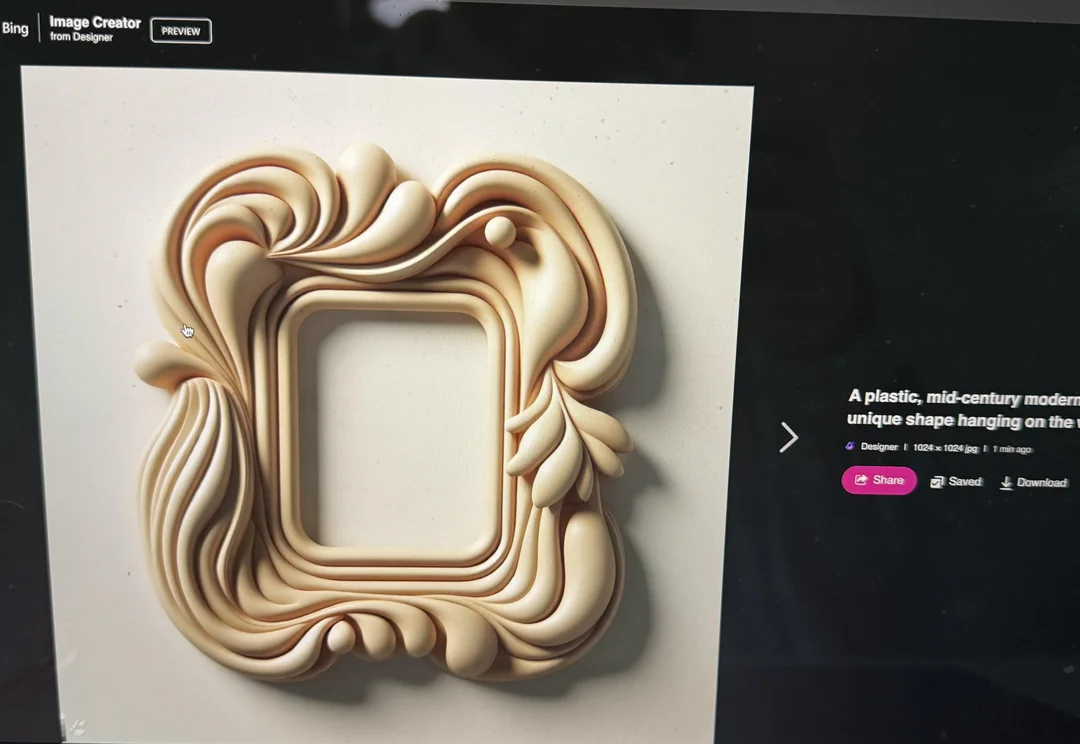
DallE concept
DallE concept. (Image Credit: u/fredandlunchbox)

The Redditor used Marigold to create a depth map, before having the depth map rendered in Cinema4D, and then did some extra manual tidying up in Blender and Fusion360. When the model was complete, he exported it as an STL, and printed it. The whole process from DallE text-prompt to final printed object happened in under 24 hours, and you can see the final printed part in the image below.
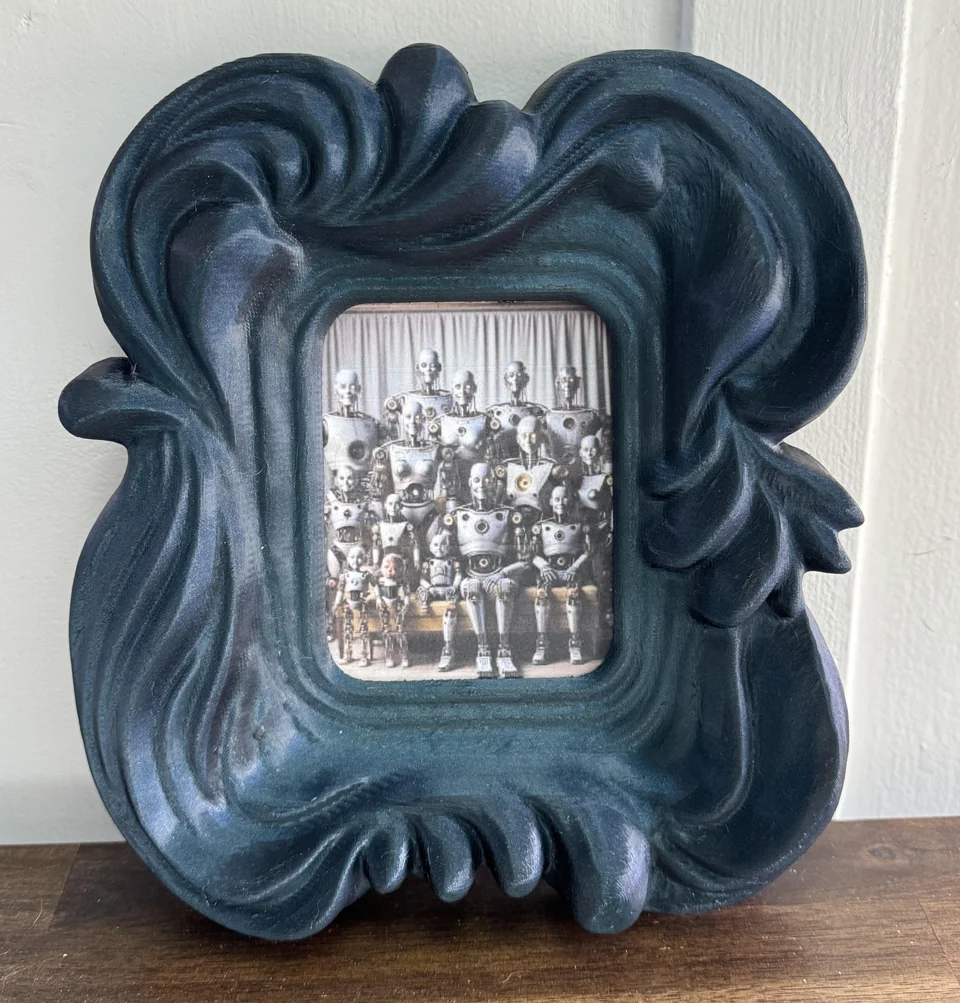
The final 3D printed version
The final 3D printed version. (Image Credit: u/fredandlunchbox)

The Redditor notes that the process is not automatic, but the creators of Marigold have recently announced an update that “allows the user to produce a watertight STL ready for printing.”

How watertight that is exactly, remains to be seen, but it sounds like something fun to experiment with over the holiday season.

If you would like to experiment with the depth estimation and 3D printing features of Marigold, you can head on over to the web-based GUI over at the program’s Hugging Face space over at this link.

Come and let us know your thoughts on our Facebook, X, and LinkedIn pages, and don’t forget to sign up for our weekly additive manufacturing newsletter to get all the latest stories delivered right to your inbox.

Share:
WhatsApp Twitter Facebook LinkedIn Buffer Reddit E-mail
About the author | Phillip Keane
Phillip is an aerospace engineer from UK. He is a graduate of Coventry University (UK), International Space University (France) and Nanyang Technological University (Singapore), where he studied Advanced Manufacturing at the Singapore Centre for 3D Printing.
Join our newsletter

Our newsletter is free & you can unsubscribe any time.

Latest posts

Kansas State Tests Off-Site 3D-Printed Concrete Storm Shelter Modules

A Kansas State researcher is printing full-size 4-by-4-foot concrete modules off-site, then assembling them as storm-shelter blocks meant to take tornado winds and... read more »

Construction
Reese Greenlee

LLNL Team Prints Ceramic Waveguide Lasers By Direct Ink Writing

A Livermore team 3D-printed an all-ceramic waveguide by extruding ytterbium-doped yttrium aluminum garnet filaments within an undoped garnet matrix and then drying, sintering,... read more »

News
LLNL Team Prints Ceramic Waveguide Lasers By Direct Ink Writing

Heidelberg Team Designs Recyclable Polymer for Light-Based 3D Printing

A Heidelberg University team has designed a light-curable 3D printing polymer that a chemical trigger can take apart at room temperature. Printed parts... read more »

Materials

Best Budget 3D Printers 2026: What $169 to $399 Actually Buys

The best budget 3D printer conversation changed character in the last three years. Auto bed leveling, direct-drive extruders, and 250 to 600 mm/s... read more »

3D Printers

MIT turns pine-cone mechanics into 3D-printable adaptive materials

An MIT team used category theory to break a pine cone's humidity response into independently validated building blocks, mixed some of those blocks... read more »

Materials
MIT turns pine-cone mechanics into 3D-printable adaptive materials

Only 1 in 25 3D Print Buyers Trust AI Generated 3D Models

CGTrader's 2026 market report shows a booming print market, a brutal quality premium, and one number the AI industry will not be quoting:... read more »

News

Tel Aviv Team Creates Bioactive Ink for Precise 3D Printing

Researchers at Tel Aviv University have developed a bioactive 3D-printing ink that pairs high printing precision with enhanced cell adhesion and antibacterial activity.... read more »

Bioprinting
Tel Aviv Team Creates Bioactive Ink for Precise 3D Printing

EPFL 3D-prints tiny drones that fly on sound alone

Engineers in EPFL's MICROBS Lab have 3D-printed hollow cavities that convert sound waves into thrust. The cavities power miniature boats and ultralight drones... read more »

News
EPFL 3D-prints tiny drones that fly on sound alone

3D Printed Coral-Inspired Scaffold Reprograms Immune Cells to Heal Bone Disease

Researchers have developed a 3D-printed scaffold that reprograms immune cells to repair bone damaged by steroid-induced osteonecrosis of the femoral head (SONFH), a... read more »

Medical
3D-Printed Coral-Inspired Scaffold Reprograms Immune Cells to Heal Bone Disease

Social

  • Facebook Facebook 3D Printing
  • Linkedin Linkedin 3D Printing
Join our newsletter

Our newsletter is free & you can unsubscribe any time.

Featured Industries

  • Automotive
  • Aerospace
  • Construction
  • Dental
  • Environmental
  • Electronics
  • Fashion
  • Medical
  • Military
  • Qidi Q2

    • - Print size: 270 x 270 x 256 mm
    • - enclosed heated chamber up to 65°C
    More details »
    $580.00 Qidi
    Buy Now
  • Flashforge Guider 3 Ultra

    • - Print size: 330 x 330 x 600 mm
    • - dual extruder system
    More details »
    $2,999.00 Flashforge
    Buy Now
  • Creality Hi Combo

    • - Print size: 260 x 260 x 300 mm
    • - up to 16-color printing
    More details »
    $399.00 Creality
    Buy Now
  • Snapmaker U1

    • - Print size: 270 x 270 x 270 mm
    • - multi-color printing with SnapSwap
    More details »
    $849.00 Snapmaker
    Buy Now
  • Creality K2 Plus

    • - Print size: 350 x 350 x 350 mm
    • - multi-color printing
    More details »
    $1,199.00 Creality
    Buy Now
  • Qidi Max 4

    • - Print size: 390 x 390 x 340 mm
    • - active cooling air control
    More details »
    $1,219.00 Qidi
    Buy Now
  • Flashforge Adventurer 5M

    • - Print size: 220 x 220 x 220 mm
    • - 600mm/s travel speed
    More details »
    $299.00 Flashforge
    Buy Now
  • Anycubic Kobra S1 Combo

    • - Print size: 250 x 250 x 250 mm
    • - budget multicolor printing
    More details »
    $429.00 Anycubic
    Buy Now
  • Anycubic Photon Mono M7

    • - Print size: 223 x 126 x 230 mm
    • - 10.1 inch 14K screen
    More details »
    $279.00 Anycubic
    Buy Now
  • Flashforge AD5X

    • - Print size: 220 x 220 x 220 mm
    • - dual extrusion system
    More details »
    $399.00 Flashforge
    Buy Now

Company Information

  • What is 3D Printing?
  • Contact us
  • Join our mailing list
  • Advertise with us
  • Media Kit
  • Nederland 3D Printing

Blog

  • Latest News
  • Use Cases
  • Reviews
  • 3D Printers
  • 3D Printing Metal

Featured Reviews

  • Anycubic Photon Mono M5s
  • Creality Ender 5 S1
  • The Mole 3D Scanner
  • Flashforge Creator 3 Pro

Featured Industries

  • Automotive
  • Aerospace
  • Construction
  • Dental
  • Environmental
  • Electronics
  • Medical
  • Military
  • Fashion
  • Art
2026 — Strikwerda en Dehue
  • Home
  • Join our mailing list
  • Contact us
Blog
  • Latest News
  • Use Cases
  • Reviews
  • 3D Printers
  • 3D Printing Metal
Featured Industries
  • Automotive
  • Aerospace
  • Construction
  • Dental
  • Environmental
  • Electronics
  • Medical
  • Military
  • Fashion
  • Art
Company Information
  • What is 3D Printing?
  • Contact us
  • Join our mailing list
  • Advertise with us
  • Media Kit
  • Nederland 3D Printing