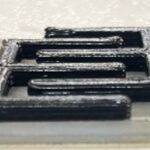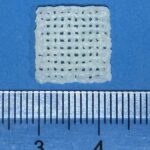

Researchers at EPFL have built a holographic 3D printing system that’s 70 times more energy-efficient than previous techniques, and they’ve used it to print a life-sized human ear — a potential step toward bioprinted implants for reconstructive medicine. The results were published May 21 in Light: Science & Applications.
The team, from EPFL’s Laboratory of Applied Photonic Devices (LAPD), built on earlier work in tomographic volumetric additive manufacturing (TVAM), a method that fires laser light into a rotating vial of photosensitive resin to harden it into a desired shape. Their new platform is the first to directly control the phase of a light beam in a volumetric 3D printing system. That phase control, rather than adjusting brightness as older approaches did, preserves far more of the laser’s power.
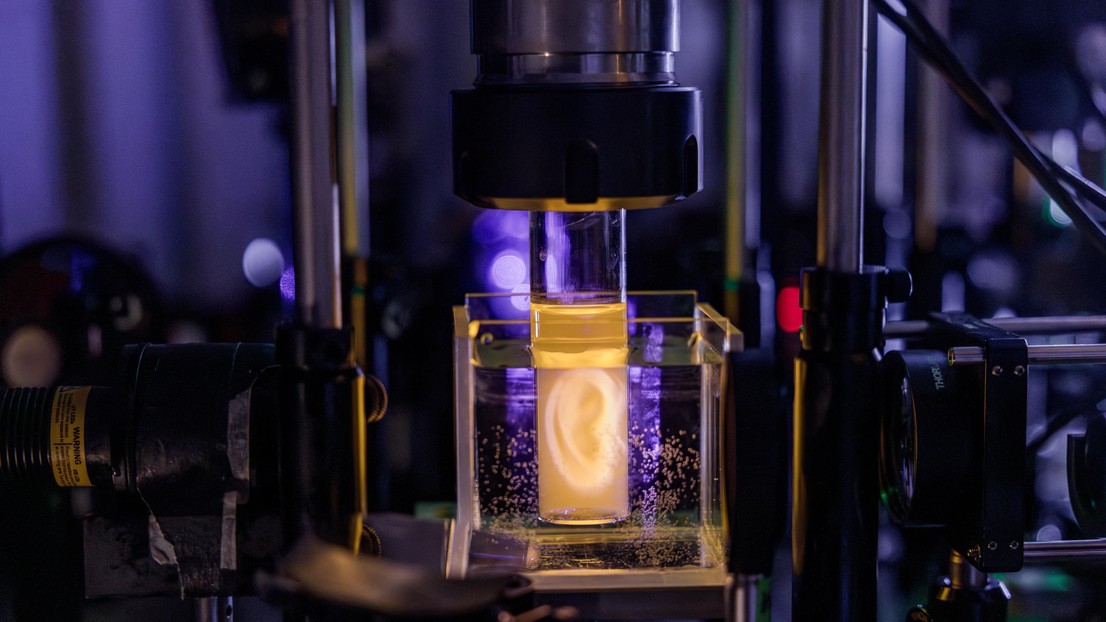
The efficiency gains translate into speed. Using a 150-mW laser diode, the researchers solidified millimeter-scale objects within seconds and centimeter-scale objects within minutes. Critically, the method works in light-scattering media containing living cells. In one test, a 64-cubic-millimeter construct with embedded cells was examined after six days; the cells were still viable and had formed organized networks.
“Our method’s demonstrated efficiency and precision finally makes it possible to bioprint tissue-like structures at near-clinical scale,” said LAPD head Christophe Moser. “We have printed structures substantially larger than those achieved with previous holographic approaches, despite increased light scattering caused by the embedded cells.”
The system also incorporates a new strategy for reducing speckle, the random light interference that produces grainy surfaces on printed objects. Lead author and LAPD PhD student Maria Alvarez-Castaño said the approach “brings volumetric printing closer to real-scale implants, and biologically compatible manufacturing using low-power laser sources.”
Future work will focus on improving projection fidelity and testing the limits of beam shaping at high cell densities. Separately, the team is developing methods to print directly onto or around existing objects, and a technique that can fabricate objects simply by projecting a hologram onto a stationary vial of resin, with no rotation required.
Source: actu.epfl.ch