
Formlabs has announced the Fuse X1, a large-format selective laser sintering 3D printer that starts at $84,999 — less than a third of comparable industrial SLS systems — and delivers production-quality parts in under 24 hours at 50% less cost and three times the throughput of competing machines.
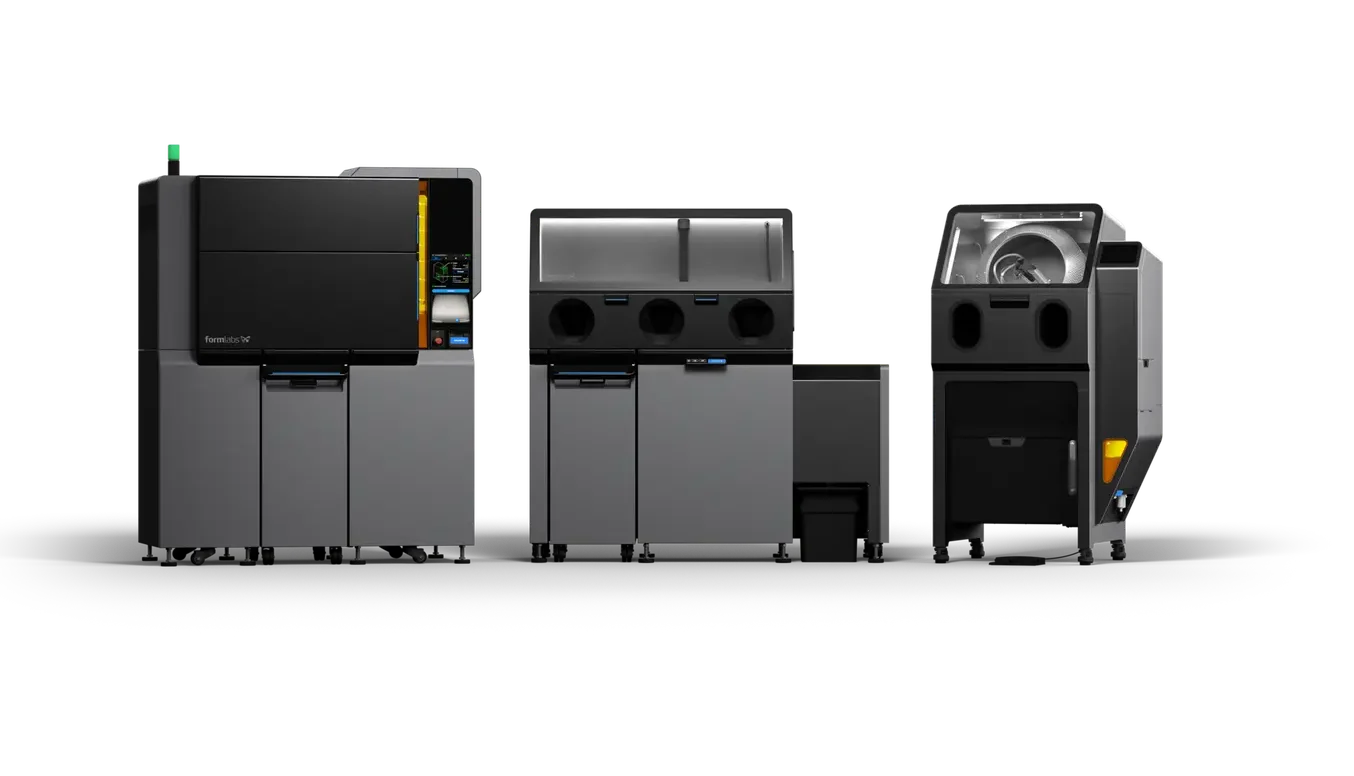
The Fuse X1 features a 330 × 330 × 565 mm build volume, which is 7.5 times larger than the company’s own Fuse 1+ 30W, with a maximum part length of 713 mm. Its footprint is 1.3 square meters, less than half that of legacy industrial printers like the EOS P3 Next or HP MJF 5210. Formlabs says the printer can be rolled through a standard door and set up in under an hour, requiring only single-phase power and external nitrogen — no facility retrofit needed.
A key technical feature is what Formlabs calls Adaptive Thermal Control, an architecture that processes 700 times more thermal data per second than the Fuse 1+ 30W and drives 13 independent thermal zones. That precision allows the Fuse X1 to achieve volume packing densities above 30% — compared to roughly 20% for legacy large-format SLS printers and 8-10% for HP Multi Jet Fusion systems. Higher packing density means more parts per build and lower cost per part.
The printer is already in use at several major manufacturers. At Tesla Giga Nevada, Engineering Technician Cody Jepson said the machine changed the economics of the operation. “With the increased throughput and decreased costs, Fuse X1 has completely changed our perspective on what kinds of projects our lab can support versus what we would have traditionally moved to an injection mold,” Jepson said. His team prints between 10,000 and 20,000 non-marring shims per month, and the reduced cost per part on Fuse X1 means those parts may never need to move to injection molding at all.
At contract manufacturer Autotiv, which runs over 200 printers around the clock to deliver 10,000 parts per week, CEO Evan LaBelle compared the Fuse X1 directly against a Farsoon SS403P that takes roughly 70 hours to cycle. “The Fuse X1 has returned on investment about five times faster than comparable SLS systems that we already own and are evaluating, thanks to about half the upfront cost and about double the throughput,” LaBelle said. With a cycle time of roughly 24 hours, Autotiv can run two or three Fuse X1 builds in the same time one Farsoon build completes.
Radio Flyer product development engineer Agostino LoBello found the machine cut prototyping time for a cargo ebike frame from two weeks to two days. Previously, the Flyer Loop bicycle frame required 19 separate print builds that then had to be glued together. With Fuse X1, the entire frame fits in a single build. “I can iterate three times as often with nine times less labor, that’s a super appealing value proposition,” LoBello said.
The Fuse X1 ships with support for Nylon 12 Powder at launch. Nylon 11 Powder settings are expected by the end of 2026, with Nylon 12 GF Powder and TPU Powder both targeted for Summer 2027. The printer includes AI-powered Print Intelligence, a suite of five subsystems covering failure detection via computer vision, thermal management, motion control, systems health monitoring, and optics control. A Production Service Plan covers a five-year warranty and onsite technician support within 48 hours.
Visit Formlabs Fuse X1 at formlabs.com