
University of Amsterdam physicists have developed a way to 3D print structures out of ice that need no extra supports and melt back into clean water.
Ordinary printers need supports for overhangs. The Amsterdam team prints ice pillars at angles as small as 14 degrees with the surface by changing print speed, so shapes such as a human face profile can stand without being held up from below.
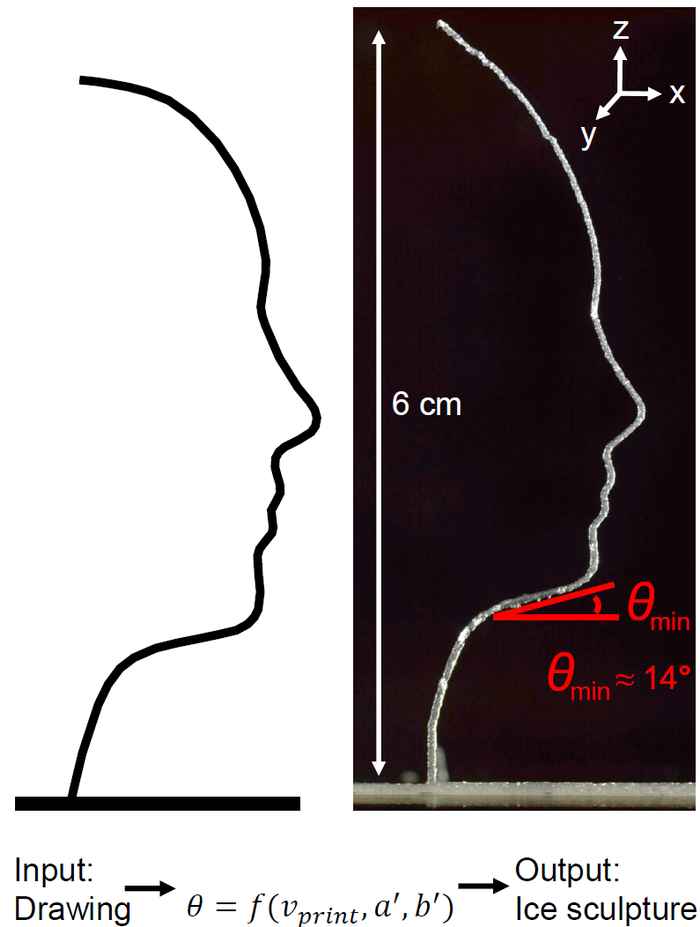
The method uses evaporative cooling in a low-pressure vacuum chamber. Water evaporates quickly even at room temperature. Each molecule that leaves takes a little heat, so the remaining water supercools below 0 degrees Celsius while still liquid. A stream 16 micrometres across, thinner than a human hair, freezes as soon as it hits ice that is already there.

Menno Demmenie, Stefan Kooij, and Daniel Bonn first drew notice with an ice Christmas tree last December. The PNAS paper this week shows the angled-pillar work. When the vacuum pump is switched off, the print melts into clean water. The authors say pure ice could serve as scaffolding for tissue, or as a mold for microfluidic channels that appear once the ice is gone.
The paper, Three-Dimensional Printing of Ice Structures via Evaporative Cooling in Vacuum, appears in the Proceedings of the National Academy of Sciences.
Source: iop.uva.nl