
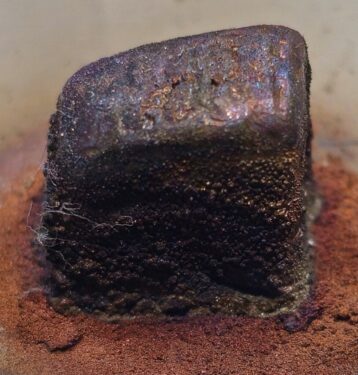
Washington State University researchers used AI to find process settings that 3D print GRCop-42, a NASA copper-chromium-niobium alloy used in rocket engine combustion chambers, on printers that usually cannot handle it.
The alloy stays strong at high heat and conducts heat well, but printing it has required a lot of laser power on specialized machines. Researchers had already failed at the lower wattages common printers use. Trying every option by hand was not realistic: more than 100 million configurations exist, a single print can cost hundreds of dollars, and checking quality can take days.
“Ninety percent of commercial printers cannot print this metal alloy, so given that we were able to find these feasible process parameters, it allows us to use those commercial printers, and we are essentially democratizing the printing of this alloy,” said Jana Doppa, Huie-Rogers Endowed Chair Professor of Computer Science, who led the work.
The team started from 37 failed configurations tested in WSU’s School of Mechanical and Materials Engineering. An AI model estimated which untried settings might work, then picked small batches that mixed likely winners with uncertain cases meant to improve the model. Over three months and 40 experiments, they found six successful settings at different laser powers, including the first prints of the alloy at 500 watts.
“Sometimes they printed a certain configuration, and the product just melted,” said Azza Fadhel, first author and a PhD student in computer science. “It wasn’t really printable, and even with time and money, they wouldn’t be able to try all 100 million options.”
Printing partners included Nathaniel Zuckschwerdt, Susmita Bose, and Amit Bandyopadhyay in mechanical and materials engineering. Aryan Deshwal of the University of Minnesota also collaborated. The paper appeared in the Proceedings of the AAAI Conference on Artificial Intelligence and received the group’s Innovative Deployed Application Award.
Source: news.wsu.edu