
Large-object scanning means capturing something bigger than the scanner’s field of view: a car body panel, a sofa, a sculpture, an architectural element, or a whole person, in one clean aligned mesh. The deciding factors are not just headline accuracy; it is scan range and field of view to cover ground quickly, reliable marker-free tracking so the scan does not drift over a large surface, and ideally photogrammetry or global-accuracy control so error does not stack up across a big part. This guide ranks 14 scanners from accessible handhelds to standalone metrology units, plus a separate tier for long-range and metrology systems that handle rooms, vehicles, and architectural pieces.
Independently researched. 14 years of 3D printing and 3D scanning coverage at 3DPrinting.com, including hands-on reviews of the MIRACO, Einstar VEGA, Mole, and Revopoint Trackit. Some of the links on this page are affiliate links, and we never recommend a scanner we would not buy ourselves. Prices shown are approximate (the ~$ figure), researched on 2026-05-28, and vary by bundle, sale period, and region; click through to the manufacturer for current pricing.
Our top picks
The fast answer by job. Tap a card for the full breakdown below.
How large-object scanning actually works
No handheld scanner sees a whole car or sofa at once. It captures a small patch (the field of view), then stitches thousands of patches together as you move. Two things make or break that on a large object. The first is tracking: the scanner has to know where each frame sits relative to the last. Marker-free tracking (using geometry or texture) is fast and convenient, but on big, smooth, featureless surfaces like a car door it can lose its place and drift. That is why some large-object scanners use coded targets (stick-on reference dots, the standard professional way to guarantee accuracy on a big part), or optical tracking (a separate camera base that watches the scanner), to hold alignment across a large surface without relying on geometry alone.
The second is global accuracy. Small local error is fine on a coffee cup, but across a 4-metre object that error compounds, so the far end of the scan drifts off true. The best large-object scanners counter this with photogrammetry: you shoot reference photos with coded targets first, building an accurate skeleton the scan locks onto, so a big part stays dimensionally correct end to end. When you read the comparison table, that is why the “volumetric accuracy” figure (the X mm + Y mm/m) matters more than the headline accuracy on anything large.
Revopoint
Revopoint covers large objects two ways: the standalone MIRACO Plus with built-in photogrammetric metrology, and the Trackit, which brings optical tracking, the marker-free technique once reserved for $60,000 systems, to a prosumer price. Its July 2026 sibling, the Trackit SR, takes the same optical tracking fully wireless; the full breakdown lives on our professional scanners page.
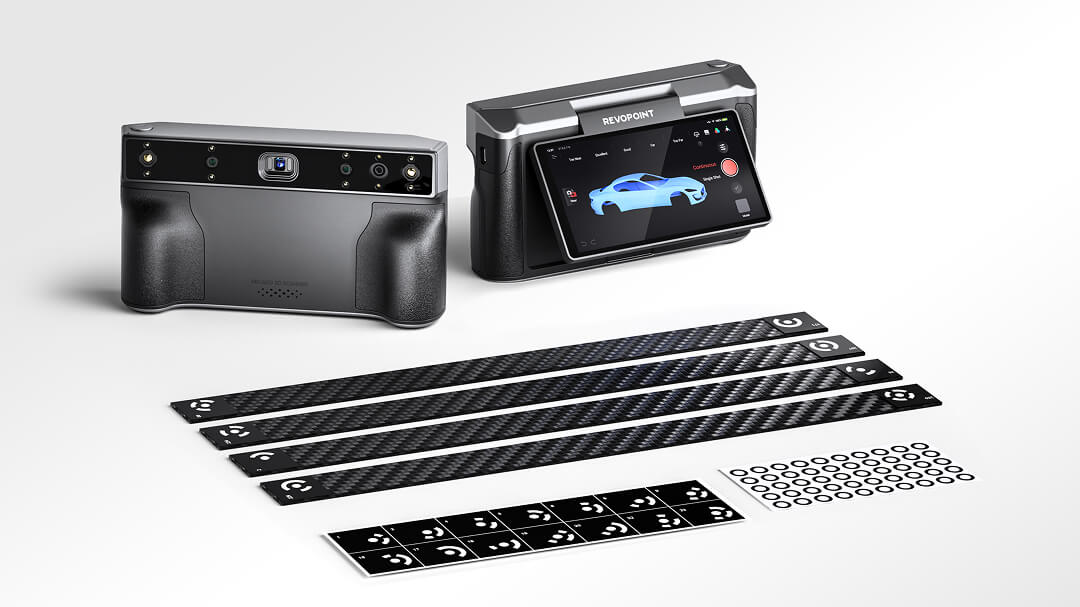
Revopoint MIRACO Plus
Best for: a do-everything large-object scanner that needs no laptop. The MIRACO Plus is a fully standalone unit with a 6.4-inch AMOLED touchscreen and onboard processor, combining a quad-depth camera array with photogrammetric metrology for a max scan volume of 4 x 4 x 4m and volumetric accuracy of 0.02mm + 0.05mm/m. It scans small objects just as happily, which makes it the most versatile all-rounder in the Revopoint range.
Price: ~$2,200 (approximate; varies by bundle, sale period and region, click through for current pricing)
- Volumetric accuracy 0.02mm + 0.05mm/m; photogrammetric metrology
- Max object 4 x 4 x 4m; single capture 975 x 775mm at 1m
- Standalone (no PC); 750g; 20fps
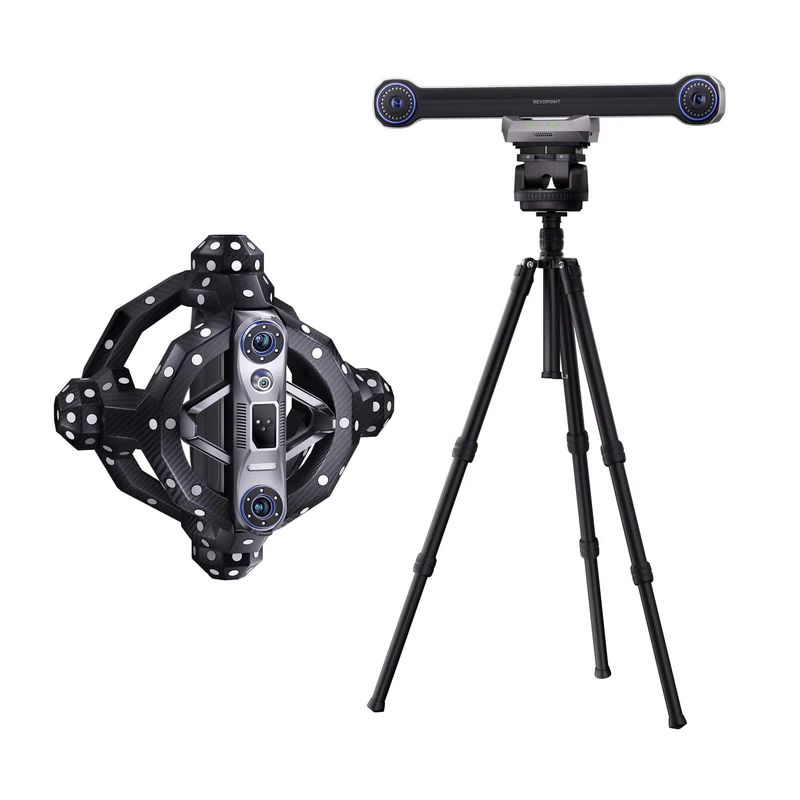
Revopoint Trackit
Best for: large objects you do not want to cover in markers. A dual-camera base station tracks the scanner’s position in real time, so you can scan a coin or a 6m vehicle with no targets on the surface. The base leapfrogs around big objects using anchor blocks to keep the whole scan aligned as it grows. It needs a capable PC (RTX 3060, 32GB RAM minimum), but for marker-free large-object work it is in a class consumer scanners cannot match.
Price: ~$4,980 (approximate; varies by bundle, sale period and region, click through for current pricing)
- Accuracy 0.02mm; volumetric 0.02mm + 0.04mm/m
- Object range 10mm to 6,000mm; optical marker-free tracking
- Auto-calibrating gimbal; PC-dependent (RTX 3060 / 32GB)
3DMakerpro
3DMakerpro spans the widest price range here. The Lynx is the budget volume king (objects up to 5m for around $460), the Mole is a compact NIR entry point, and the Whale is the pro-grade dual-NIR unit built for big flat panels.
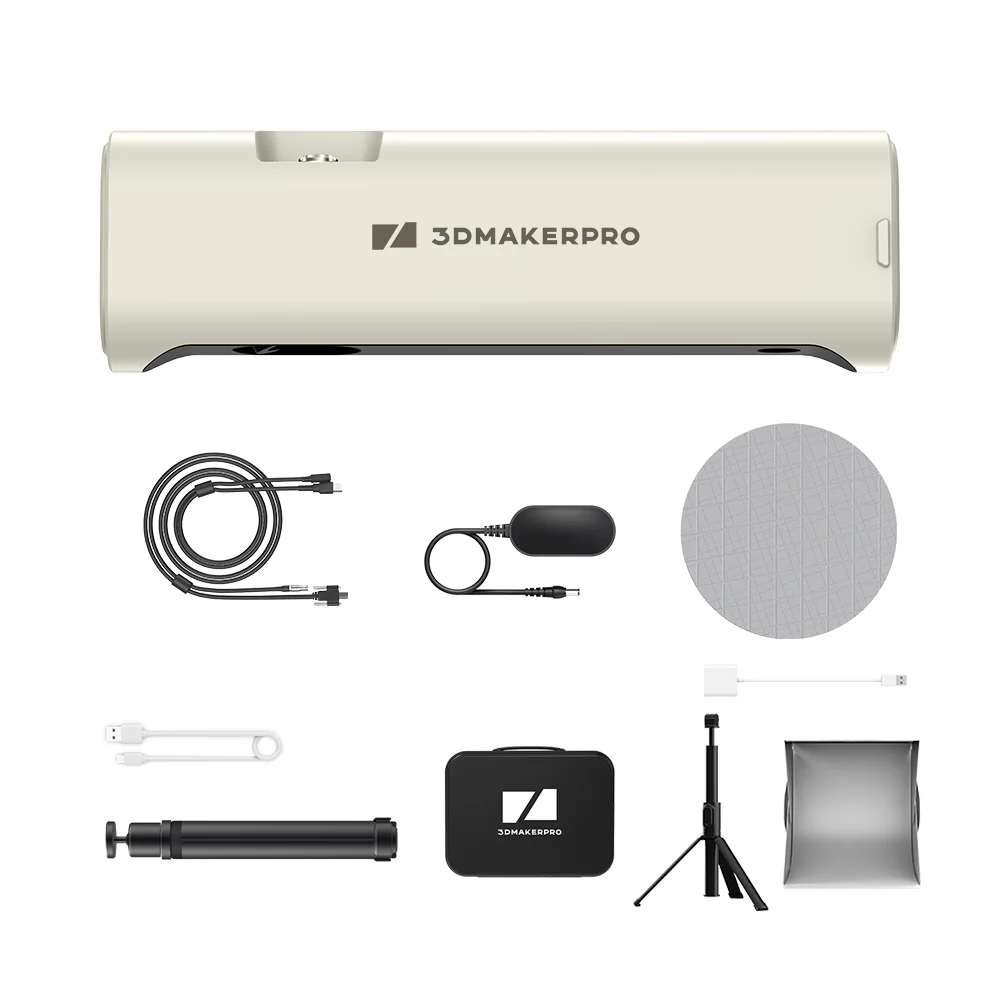
3DMakerpro Lynx
Best for: the most scan volume per dollar. The Lynx captures objects up to 5m with a 400 x 250mm single-capture area, an optical stabilizer and visual tracking that hold large scans aligned without markers, even on organic shapes, at up to 2 million points per second. Accuracy is a modest 0.1mm and there is no photogrammetry or optical tracking, so treat it as a way to capture the shape of big objects for visualization or 3D printing, not for dimensionally accurate large parts. Within that limit, for furniture, sculptures, and people on a tight budget, nothing else gets this big this cheaply.
Price: ~$460 (approximate; varies by bundle, sale period and region, click through for current pricing)
- Accuracy 0.1mm; objects 100 to 5000mm; up to 2M pts/s
- 400 x 250mm capture; optical stabilizer; markerless
- Around $460, the budget large-format pick

3DMakerpro Mole
Best for: makers who occasionally need to go large. The Mole covers objects from 15mm up to 1500mm using a near-infrared light source that is safe around people and animals, with the free JMStudio software handling alignment and mesh export in a straightforward workflow. At 1500mm max it is really a small-to-medium tool that just stretches into the lower end of this list, so for more options at that size see our scanners for medium-sized objects guide.
Price: ~$649 (approximate; varies by bundle, sale period and region, click through for current pricing)
- Accuracy 0.05mm; resolution 0.1mm; objects 15 to 1500mm
- NIR light source; markerless; color (Luxury kit)
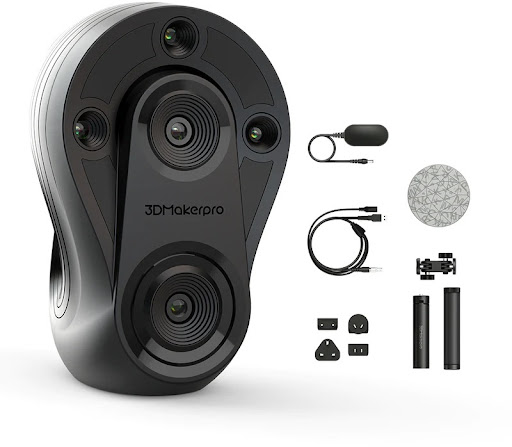
3DMakerpro Whale
Best for: big flat panels, car doors, bonnets, and bumpers. A wide 530 x 370mm single capture and dual-core NIR architecture, with AI visual tracking that reads surface texture so you can scan large flat objects marker-free. It works in direct sunlight and handles completely black surfaces without spray, and the color kit supports DSLR and mirrorless cameras for 8K texture. On a truly bare, featureless panel even AI tracking can lose its place, so for inspection-grade results keep a few targets on hand.
Price: ~$7,200 (approximate; varies by bundle, sale period and region, click through for current pricing)
- Accuracy 0.05mm; 530 x 370mm single capture; dual-core NIR
- Marker-free (AI tracking); outdoor and dark surfaces; 8K color
Einstar / Shining3D
Shining3D brings over 20 years of professional scanning to three strong large-object options: the wireless standalone VEGA for fast field capture, and the EinScan Rigil pair (regular and Lite), a tri-mode blue-laser flagship that also runs fully standalone.
Einstar VEGA
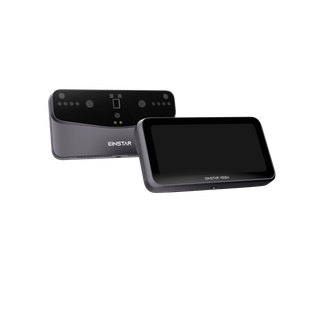
Best for: fully wireless large-area capture with no laptop. The only fully standalone wireless scanner here, with a 6.4-inch 2K OLED touchscreen, 32GB RAM, 512GB storage, and an 8-core processor, so the whole scan-to-mesh workflow runs in your hand. VCSEL Fast mode covers large areas at working distances up to 1500mm and performs in direct sunlight; MEMS HD mode adds finer detail up close. We ran a full hands-on review and were impressed by its tracking stability and outdoor performance.
Price: ~$1,999 (approximate; varies by bundle, sale period and region, click through for current pricing)
- VCSEL Fast (to 1500mm, sunlight) + MEMS HD modes; 20fps
- Fully standalone wireless; 48MP color; Wi-Fi 6; 535g
EinScan Rigil
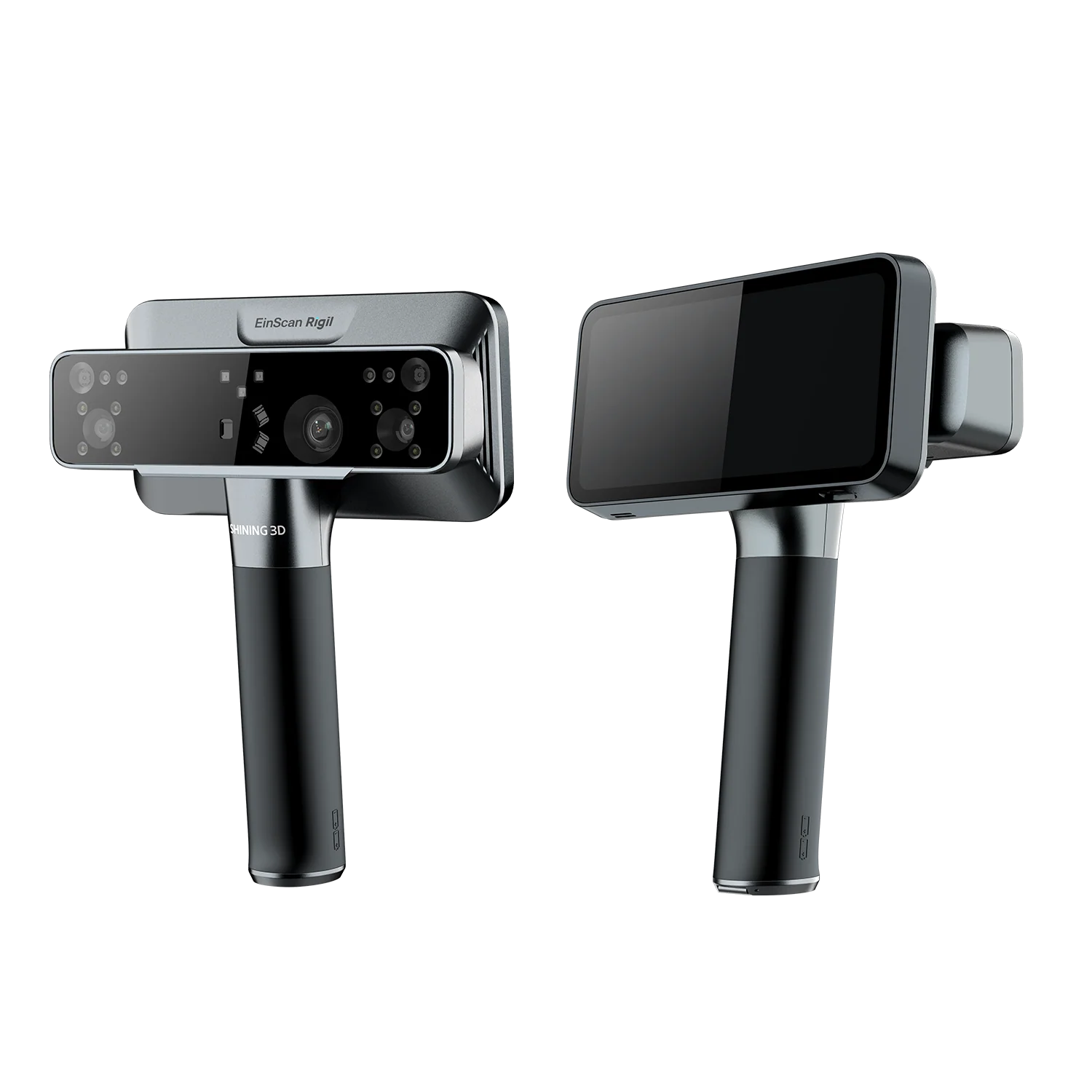
Best for: large-object work that also needs blue-laser precision. Three light sources cover everything: crossed blue laser for dark and reflective surfaces at up to 4.8M pts/s, parallel laser for fine detail, and an IR VCSEL rapid mode with a 1500mm working distance for sweeping car bodies and architectural panels. Fully standalone (32GB DDR5, 1TB SSD, AMOLED screen), marker-free in hybrid mode, and good for objects from ~50mm up to 5m.
Price: ~$4,999 (approximate; varies by bundle, sale period and region, click through for current pricing)
- Laser accuracy 0.04mm + 0.06mm/m; tri-mode laser + IR
- Up to 5m; IR work distance to 1500mm; marker-free hybrid
- Fully standalone; 2 x 6,000mAh batteries (3.5 to 4 hrs)
EinScan Rigil Lite
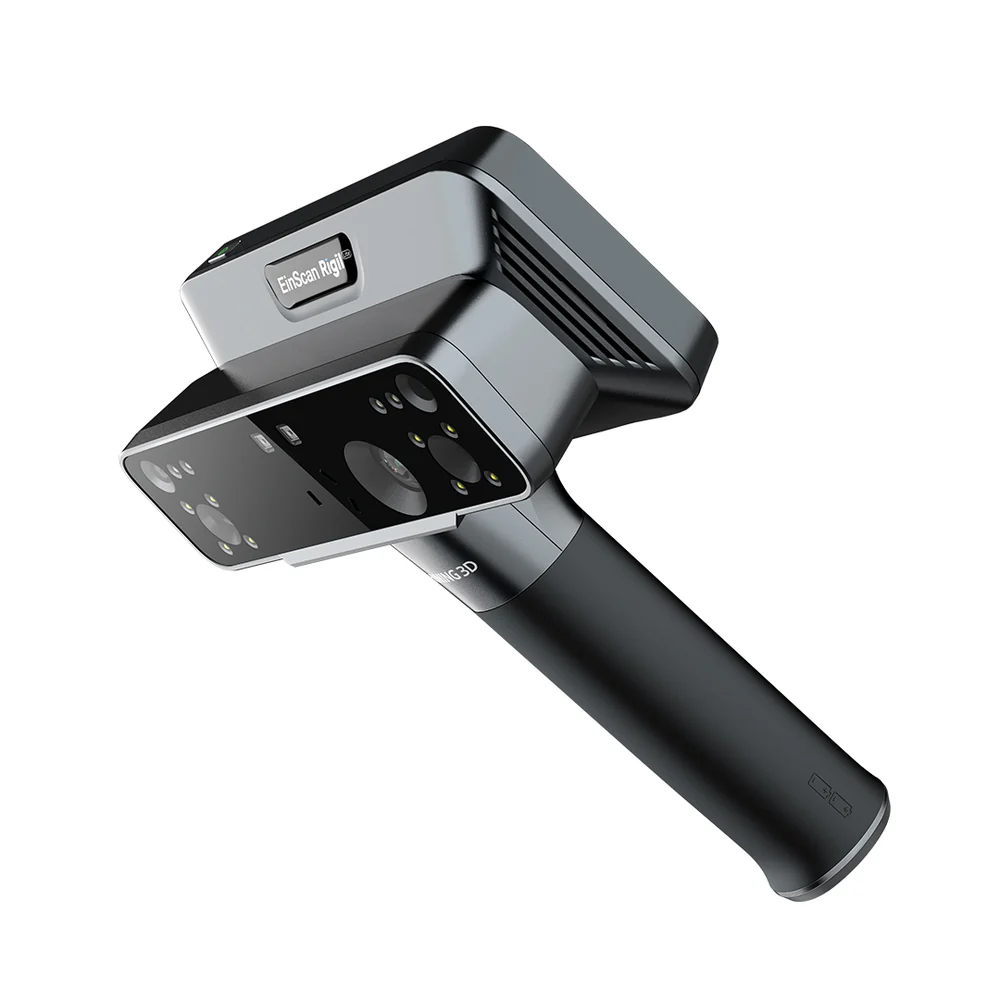
Best for: the Rigil workflow at a lower entry price. The Rigil Lite keeps the integrated touchscreen, dual-battery operation, and three modes (standalone, wireless PC, wired PC), but trims the spec sheet to 17 + 17 crossed blue laser lines and 24GB DDR5 / 512GB SSD. For large-object outdoor work the IR Rapid mode goes to 16M points per second with a 1500mm working distance. A 32GB / 1TB Limited Edition Hardware variant is offered at ~$4,199.
Price: ~$3,499 (approximate; varies by bundle, sale period and region, click through for current pricing)
- Laser HD resolution 0.05mm; IR Rapid up to 16M pts/s; IR distance 1500mm
- 17+17 crossed blue laser + 7 parallel + IR VCSEL; marker-free hybrid
- Standalone (24GB DDR5, 512GB SSD, 6.4-inch 2K AMOLED); dual battery
Creality
Creality’s scanner line has grown into a serious contender. The CR-Scan Otter and CR-Scan Raptor cover the value bracket with metrology-grade blue-laser performance; the new RaptorX brings 41 laser lines plus NIR on a wireless handheld, and the Sermoon X1 takes it to industrial precision with built-in photogrammetry for large outdoor work.
Creality CR-Scan Raptor
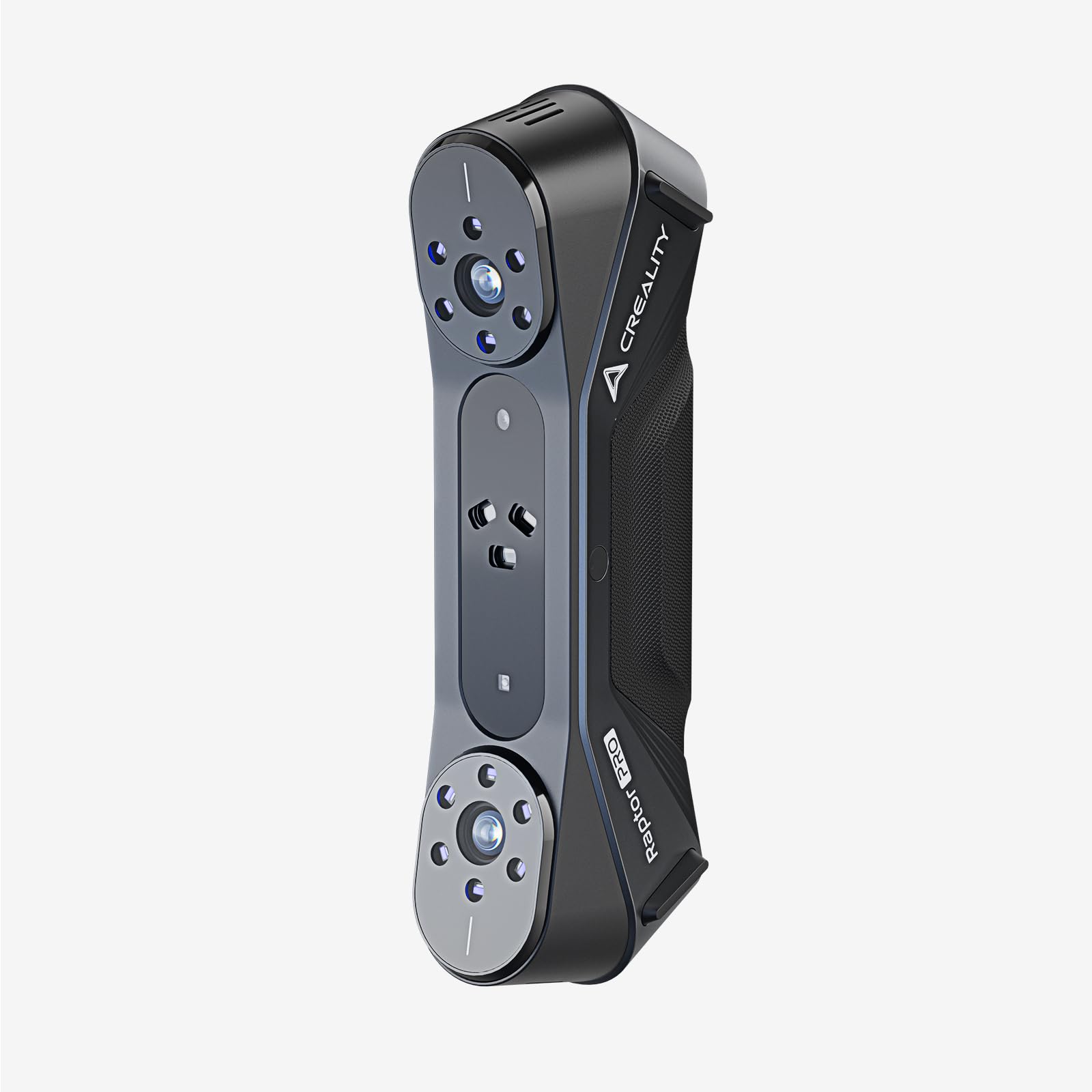
Best for: the most capability per dollar in large-format. Blue laser delivers metrology-grade precision and handles dark or reflective surfaces without spray, while NIR mode opens a wide 630 x 550mm field of view for rapidly covering large areas. With a 4 x 4 x 4m max volume, 0.02mm accuracy, and up to 60fps, it is the most capable large-format scanner in the Creality lineup, at around $999. That 0.02mm is a local figure, though: on a full car or other big featureless part you will still want a few stick-on targets to keep the far end of the scan true, because the Raptor has no photogrammetry or optical tracking to control global accuracy.
Price: ~$1,099 (approximate; varies by bundle, sale period and region, click through for current pricing)
- Accuracy 0.02mm (blue laser); up to 60fps; objects 5 to 4000mm
- Blue laser FOV 397 x 290mm; NIR FOV 630 x 550mm; 24-bit color

Creality CR-Scan Otter
Best for: medium-to-large work in one device. A four-lens dual stereo system with separate long and short focal pairs covers different size ranges, hitting 0.02mm accuracy and a 2 x 2 x 2m max volume. No spray needed on dark or metallic surfaces, and anti-shake keeps results clean with an unsteady hand. It sits closer to a medium-object tool than a true large-format one, so if a metre or two is your real range, see our scanners for medium-sized objects guide.
Price: ~$899 (approximate; varies by bundle, sale period and region, click through for current pricing)
- Accuracy 0.02mm; resolution 0.05mm; up to 20fps
- Max 2 x 2 x 2m; no spray; 24-bit color; 390g
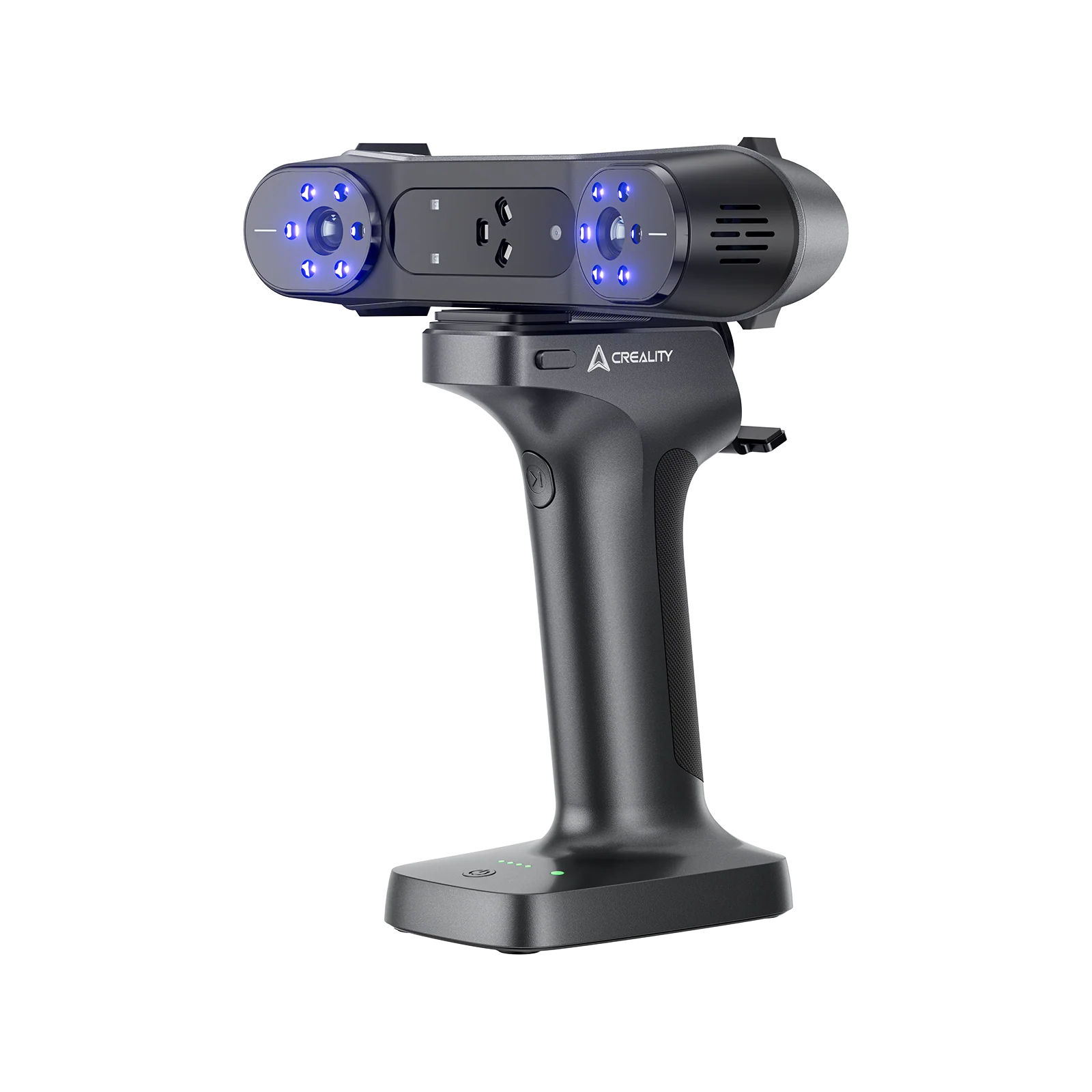
Creality RaptorX
Best for: wireless large-object work that needs more laser power than the Raptor. 41 blue laser lines total (34 crossed for fast medium-to-large capture, 7 parallel at 0.1mm for HD detail) plus NIR structured light at 1.02M points per second cover everything from a 5mm detail to a 4m vehicle. 0.02mm accuracy, 60fps in laser mode and 30fps in NIR, Wi-Fi 6 AX6000 (4.7 Gbps) or USB-C, and spray-free on dark and metallic surfaces.
Price: ~$3,599 (approximate; varies by bundle, sale period and region, click through for current pricing)
- Accuracy 0.02mm; 5 to 4000mm range; 41 blue laser lines (34 cross + 7 parallel)
- NIR mode 1.02M pts/s; laser up to 60fps, NIR up to 30fps
- Wi-Fi 6 AX6000 (4.7 Gbps) or USB-C; spray-free on dark and metallic
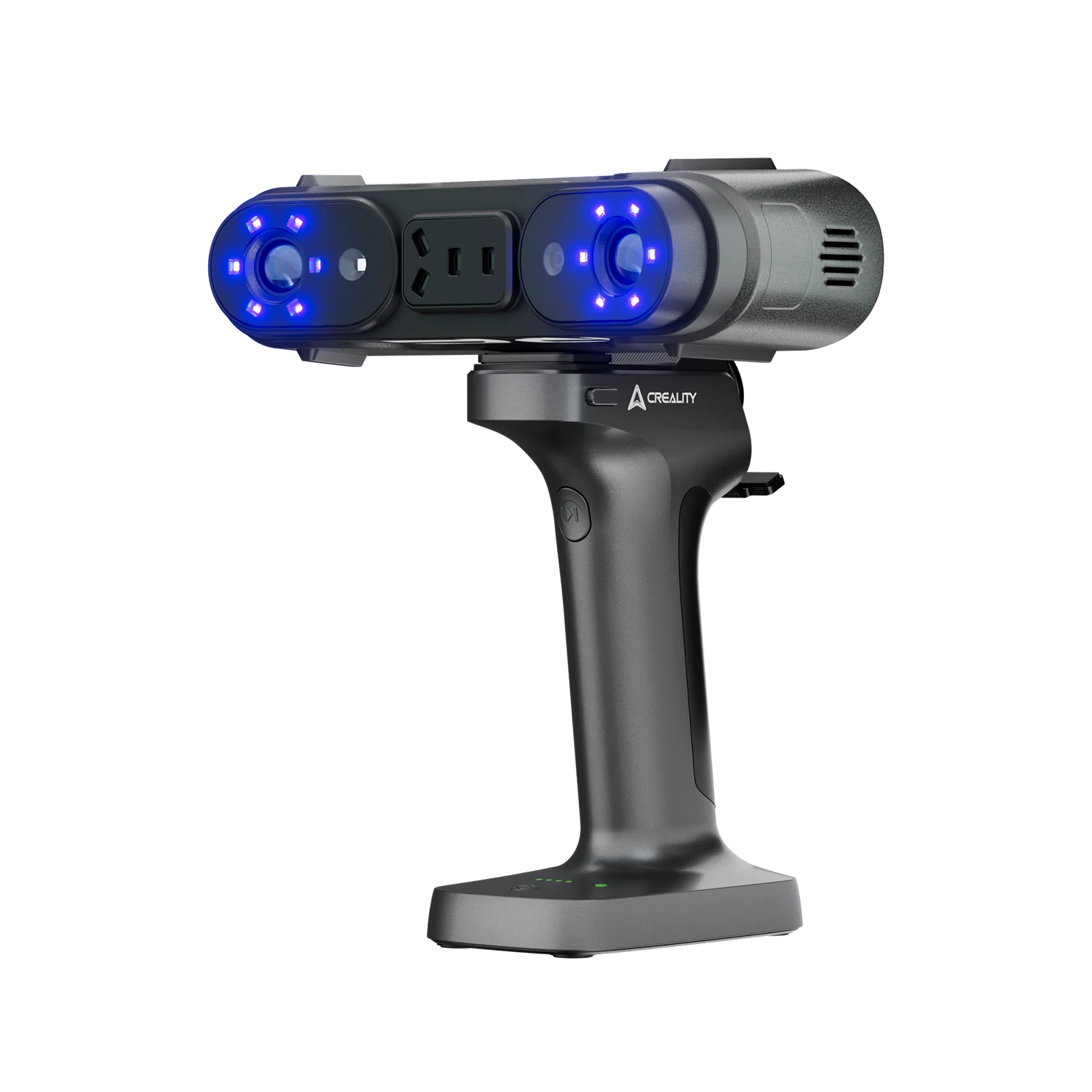
Creality Sermoon X1
Best for: large-object scanning at industrial-grade accuracy, including outdoor work. Built-in photogrammetry with two scale bars holds volumetric accuracy at 0.02mm + 0.03mm/m on big parts. Four-light hybrid (1 + 7 + 34 blue laser lines plus NIR structured light) covers everything from deep holes to a 4m vehicle, with a 17% reduction in markers per unit area on featureless surfaces. Wi-Fi 6 wireless with a 4+ hour battery and CNC unibody construction. Works outdoors in sunlight up to 100,000 lux on cross-line mode.
Price: ~$5,999 (approximate; varies by bundle, sale period and region, click through for current pricing)
- Volumetric 0.02mm + 0.04mm/m (0.02 + 0.03 with scale bars); 5mm to 4m
- 4-light hybrid + built-in photogrammetry; 17% fewer markers
- Wi-Fi 6, 4+ hr battery; CNC unibody; outdoor to 100,000 lux
Artec 3D
Artec is the professional reference for large-object and organic scanning. The Leo is the smoothest fully standalone workflow on the market, at a price that reflects it.
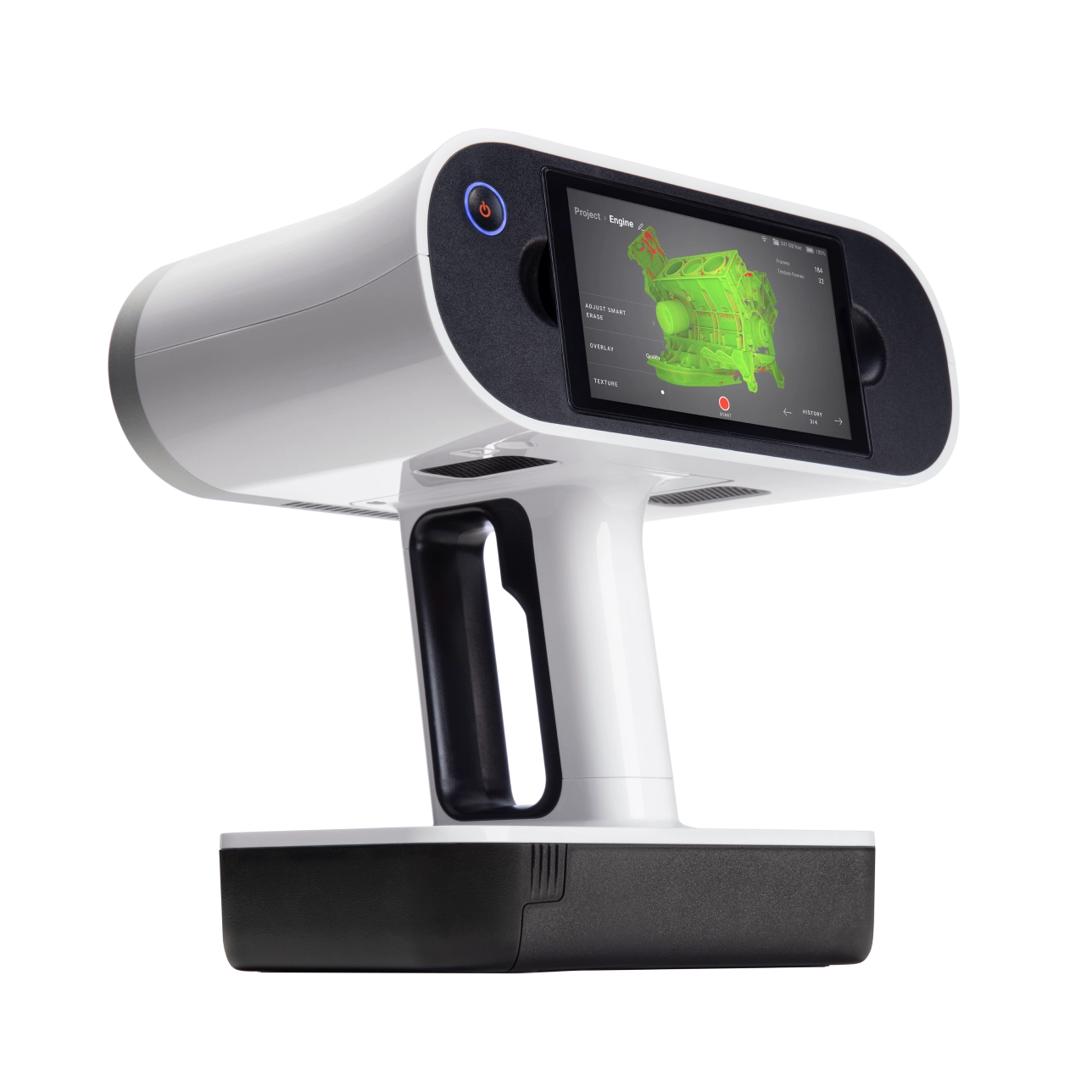
Artec Leo
Best for: studios and professionals who scan large and organic objects all day and want zero friction. A self-contained wireless handheld with onboard processing, touchscreen, and battery, so the 3D model builds in real time in your hand with no laptop or cables. Marker-free structured light at up to 80fps makes it fast on big organic shapes. It is expensive, but for a working studio the time saved is the point.
Price: ~$38,300 (approximate; varies by bundle, sale period and region, click through for current pricing)
- 3D point accuracy 0.1mm; resolution up to 0.2mm; up to 80fps
- Structured light (VCSEL); marker-free; fully standalone
Scanology
Scanology (formerly Scantech) makes the iReal line, infrared color scanners purpose-built for large objects and the human body, where comfort and safe light matter as much as coverage.
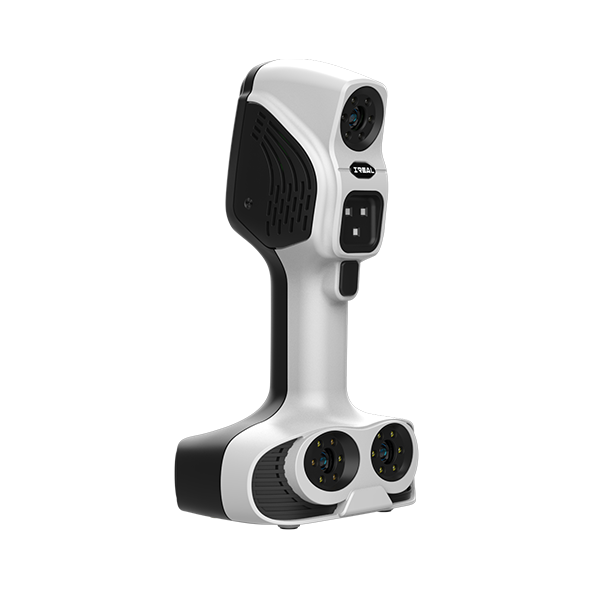
Scanology iReal 2E
Best for: full-body capture and medium-to-large color scanning. Infrared VCSEL structured light makes it safe and comfortable to scan people, and it is genuinely good at capturing dark colors and smooth textures like hair, where many scanners struggle. A wide 580 x 550mm field of view with a 720mm depth of field covers ground fast, and smart tracking removes most body-shake artifacts. Four alignment modes (feature, texture, marker, mixed) handle big featureless surfaces.
Price: ~$3,890 (approximate; varies by bundle, sale period and region, click through for current pricing)
- Accuracy 0.1mm; alignment 0.3mm/m; resolution 0.2mm
- 580 x 550mm FOV; 720mm depth of field; 1.2M pts/s
- Infrared VCSEL color; built for large objects and bodies; ~$3,890
Large-object scanners compared
Every pick on the specs that decide large-object work. Scroll sideways on a phone. Prices are approximate and vary by bundle, sale period and region; click through for current pricing.
How to read the accuracy column: a single figure is local (single-frame) accuracy under ideal conditions, while a figure with a “+ X mm/m” term is volumetric, the error that builds up across distance and is what actually matters on a large object. All numbers are manufacturer specs and vary in the real world with operator, surface, and registration method.
When your “large object” is a room or a full vehicle
Everything above is a handheld or standalone scanner you walk around the object. Once the thing you are scanning is a building, a room, or a full vehicle measured to inspection tolerances, you cross into a different and more expensive class of tool. Most readers will never need these, but a complete picture should name them.
For automotive and aerospace metrology, Creaform’s HandySCAN and MetraSCAN lines (the latter paired with a C-Track optical tracker) are the working standard for full-vehicle and large-part inspection, holding accuracy across several metres. They are five-figure systems aimed at engineering and QC teams, not hobbyists.
For rooms, building facades, and large architectural elements, the right tool is a long-range laser or LiDAR scanner rather than a handheld: the Artec Ray II for large objects and vehicles captured at distance, or terrestrial scanners like the FARO Focus, Leica BLK360, and Matterport for whole spaces. They measure from metres away instead of up close, and many professionals pair one with a handheld from the list above to add fine detail where it counts.
How to choose a large-object scanner
Start with what you are scanning and how big it really is. For objects up to a metre or two (furniture, props, a torso), a wide-FOV consumer scanner like the Raptor, Otter, or Lynx covers it cheaply. If your real ceiling is closer to a metre than a few metres, our companion guide to scanners for medium-sized objects is the better fit for that bracket. For full vehicles, rooms, or anything past ~3m where accuracy must hold end to end, you want photogrammetry or optical tracking (MIRACO Plus, Trackit, Rigil) so error does not stack up.
Then weigh tracking and surface. Big flat panels (car doors, bonnets) defeat geometry-only tracking, so look for strong marker-free texture/AI tracking (Whale) or optical tracking (Trackit), and blue laser if the surface is dark or shiny. Scanning people favours infrared light for comfort and good capture of hair and skin (iReal 2E, VEGA, Mole).
Finally, decide standalone versus PC and where you will work. Field and on-site jobs reward standalone units (VEGA, MIRACO Plus, Rigil, Leo) that need no laptop; bench and studio work can use a PC-tethered scanner happily. Then look hard at the software, because on a large object it decides as much as the hardware does; our 3D scanner software guide maps the options end to end. Check how well the global registration holds thousands of frames together without drift, what mesh editing and file formats you get, and whether you can take the scan where it needs to go next: clean STL or OBJ for printing, or scan-to-CAD and deviation analysis (Geomagic, Control X) for reverse engineering and inspection. Some of it is free and genuinely capable (Revopoint Revo Scan, 3DMakerpro JMStudio, Creality’s suite); professional packages such as Artec Studio are paid or subscription, so fold that into the real cost.
Where to go next
For the full picture across all brackets and price tiers, start with our complete 3D Scanner Buyer’s Guide 2026. Scanning smaller objects or industrial-grade work? Companion bracket guides: small-format and budget, medium-sized objects, and professional and industrial. For the software side of large-object workflows (capture, mesh cleanup, scan-to-CAD), see our 3D scanner software guide; for the buy-or-hire decision (which matters most on large objects), see 3D scanning service vs buying a 3D scanner. Hands-on impressions in our Revopoint Trackit, Einstar VEGA, and Revopoint MIRACO Plus reviews. Planning to print what you scan? Start with the best 3D printers of 2026.
Frequently asked questions
How do I scan an object bigger than the scanner’s field of view?
You move the scanner across the object and it stitches many overlapping frames into one mesh. The key is tracking, the scanner knowing where each frame sits. On large objects, marker-free tracking can drift, so the best large-object scanners add markers, optical tracking, or photogrammetry to hold alignment across the whole part.
Do I need markers for large objects?
Not always. Feature-rich objects track fine marker-free. But big, smooth, featureless surfaces (car panels, walls) often need help: either stick-on targets, AI texture tracking (like the Whale), or optical tracking (like the Trackit) that watches the scanner from a fixed base so no markers touch the surface.
What keeps a big scan dimensionally accurate end to end?
Global accuracy, expressed as the “+ X mm/m” volumetric figure. Small local error compounds across a large object, so the far end drifts. Photogrammetry (shooting reference targets first to build an accurate skeleton) and metrology-grade tracking counter this, which is why scanners like the MIRACO Plus and EinScan Rigil hold up on big parts.
Can I scan outdoors or in direct sunlight?
Some scanners here are rated for it: the Einstar VEGA, 3DMakerpro Whale, and EinScan Rigil all work in direct sunlight, which matters for automotive and architectural work. Many infrared structured-light scanners struggle outdoors, so check the lux rating if you scan in the field.
What is the best scanner for scanning a car or body panels?
For dark, shiny, or flat automotive surfaces you want blue laser or strong marker-free tracking that works in sunlight. The 3DMakerpro Whale and Creality CR-Scan Raptor are strong value picks; the Revopoint Trackit (optical tracking) and EinScan Rigil are the step up for full vehicles without markers.
Standalone or PC-tethered for fieldwork?
For on-site and field jobs, standalone scanners (VEGA, MIRACO Plus, EinScan Rigil, Artec Leo) are far more practical, no laptop to carry or power. PC-tethered scanners can be faster on heavy datasets but tie you to a workstation, which is fine for bench and studio work.
What if I need to scan a whole room or building?
That is a different job. Handheld and standalone scanners are built for objects you can walk around, up to a few metres. For rooms, building interiors, and facades, use a long-range laser or LiDAR scanner such as the Artec Ray II, FARO Focus, Leica BLK360, or Matterport, which capture a whole space from a fixed position. Many professionals combine the two, a terrestrial scanner for the space and a handheld for the detailed objects within it.