
MIT’s Computer Science and Artificial Intelligence Laboratory has revived a rejected 1985 invention to create the “Y-zipper,” a three-sided fastener that’s 3D printed from plastic and can snap camping gear, medical braces, and robots between soft and rigid states in seconds.
The origin story is unusual. William Freeman, now an MIT professor, was working as an electrical engineer at Polaroid when he spotted an ad in Scientific American offering up to $10,000 for clever textile prototypes. He submitted a triangular zipper design, a device with three belted strips of narrow wooden “teeth” and a slider that could be moved up to fasten them into a rigid triangular tube. The proposal was rejected. Freeman patented it anyway and stored it in his garage, where it sat for nearly four decades.
CSAIL researchers built an automated software tool that lets users customize the fasteners, selecting the length of each strip, the angle at which it’ll bend, and one of four motion “primitives” — straight, bent, coiled, or twisted — before a 3D printer produces the device automatically using polylactic acid or thermoplastic polyurethane. When unzipped, a Y-zipper splays out like a squid’s tentacles. Zip it closed and it compresses into a compact rod or other rigid form.
The speed gains are real. Pitching a tent manually can take up to six minutes. With a Y-zipper attached to each side and supporting the canopy from the top, that drops to one minute and 20 seconds. The team also wrapped one around a wrist cast so patients could loosen it during the day and tighten it at night, and they attached a motor to automate the zipping process entirely, building a quadruped robot whose legs could extend or compress on demand.
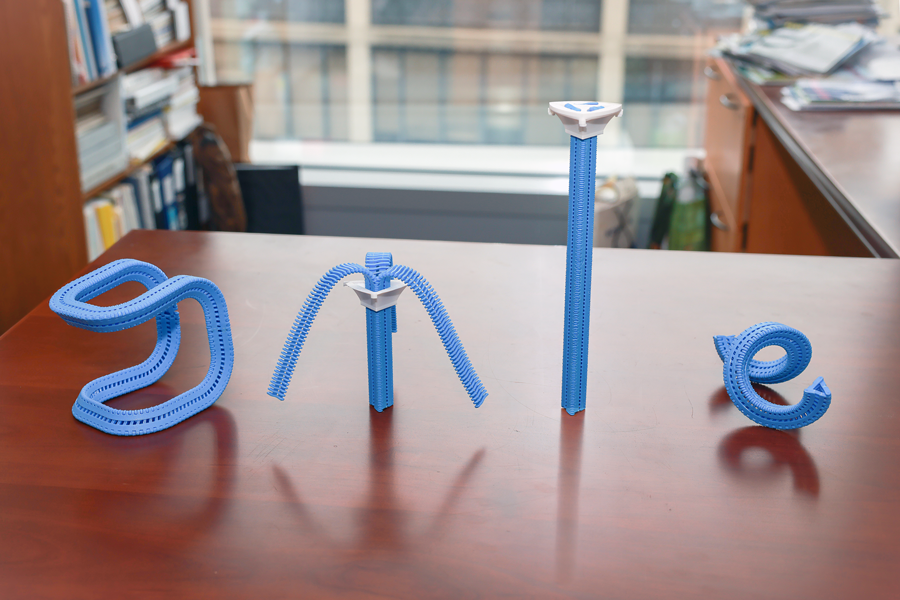
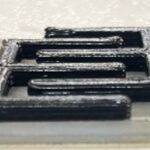
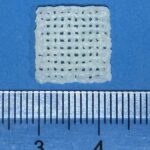
Durability testing put the devices through 18,000 consecutive open-and-close cycles before they finally broke. The team tested both PLA and TPU plastics using a bending machine, finding PLA handles heavier loads while TPU is more pliable. 3D simulations showed the Y-zipper’s elastic structure distributes stress across the device, which is why it lasts.
“A regular zipper is great for closing up flat objects, like a jacket, but Freeman ideated something more dynamic. Using current fabrication technology, his mechanism can transform more complex items,” said MIT postdoc and lead author Jiaji Li. “We’ve developed a process that builds objects you can rapidly shift from flexible to rigid, and you can be confident they’ll work in the real world.”
Li and Freeman wrote the paper with Tianjin University PhD student Xiang Chang and several MIT CSAIL colleagues, including PhD student Maxine Perroni-Scharf, undergraduate Dingning Cao, and MIT Associate Professor Stefanie Mueller, who served as senior author. The work was presented at the ACM’s Computer-Human Interaction conference in April and is available as an open-access paper.
Source: news.mit.edu