
A co-branded storage cabinet that SUNLU rates to hold up to ten 1 kg spools at 10 to 55 percent RH without heating them, using a molecular sieve that regenerates itself. Pre-orders open September 15, 2026.
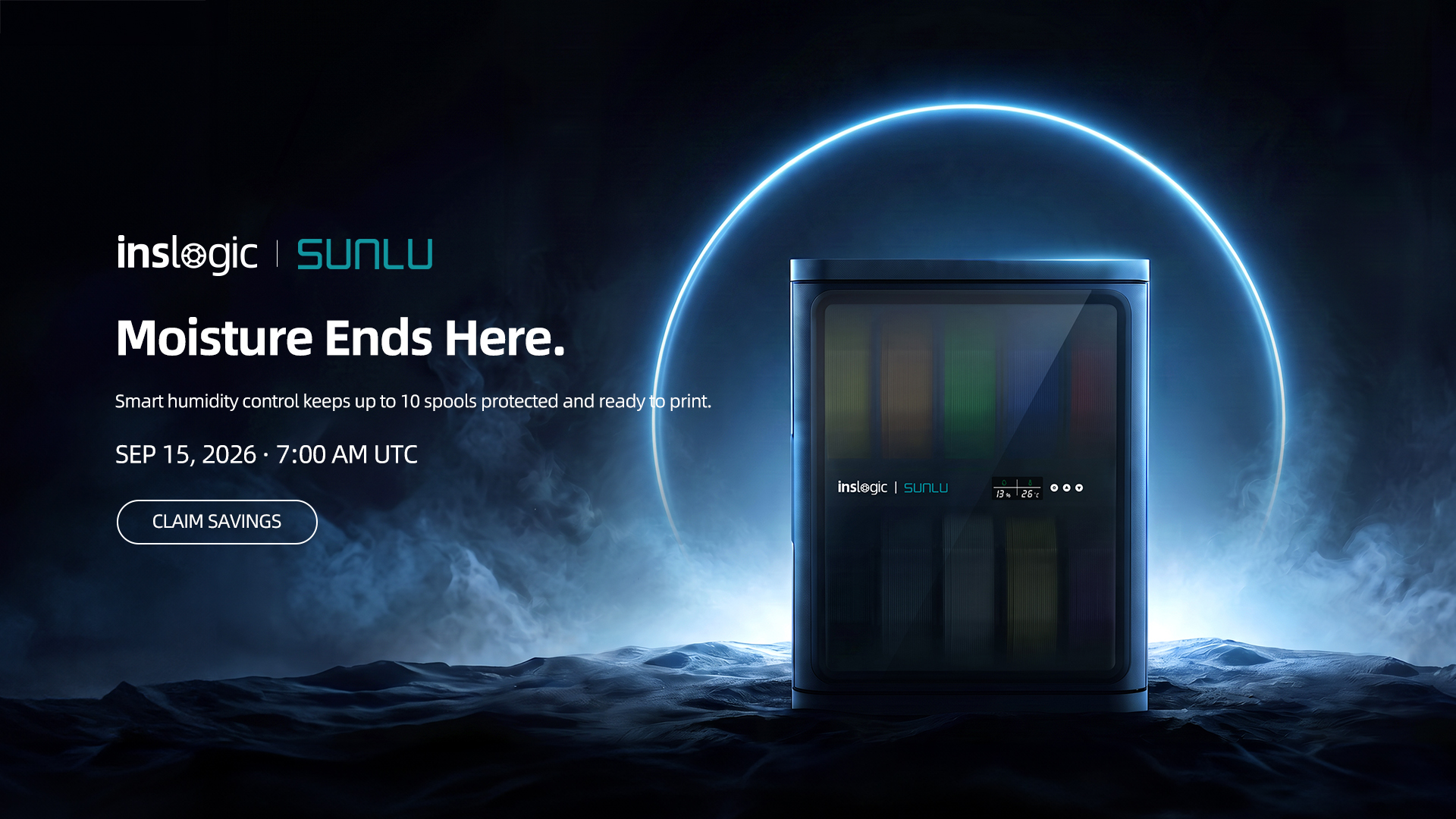
The SUNLU and INSLOGIC FilaDC i10 Filament Dehumidifying Cabinet. Image: SUNLU.
SUNLU, together with co-brand INSLOGIC, has announced the FilaDC i10 Filament Dehumidifying Cabinet, a storage unit for up to ten 1 kg spools that actively pulls moisture out of the air inside the cabinet at room temperature. Pre-orders open on September 15, 2026 through the SUNLU online store. We have not had a FilaDC i10 in our hands. The product data below is SUNLU’s own, taken from its press release, its product page, its launch imagery, and an updated specification sheet supplied in late August, and we point out where that data leaves gaps.
Why a filament dehumidifying cabinet instead of a heated dryer
Wet filament pops and strings at the nozzle, bonds poorly between layers, and can clog a hotend outright. Nylon or TPU that has sat on a desk for a week can be unprintable. Most people deal with it by baking spools in a heated dryer for a few hours before each job. SUNLU argues that heated air is a poor fit for continuous, long-term storage and for temperature-sensitive materials, since sustained heat risks deforming the filament, and it positions the i10 as a more energy-efficient alternative.
The i10 skips the heat and dries the air instead. According to SUNLU, the cabinet continuously circulates its internal air through a molecular sieve desiccant, which captures and holds water vapor, so the filament is never heated directly. SUNLU’s pitch is that you stop drying spools altogether: put them in the cabinet, take one out when you need it, put it back when you are done.
How SUNLU says the sieve regenerates itself
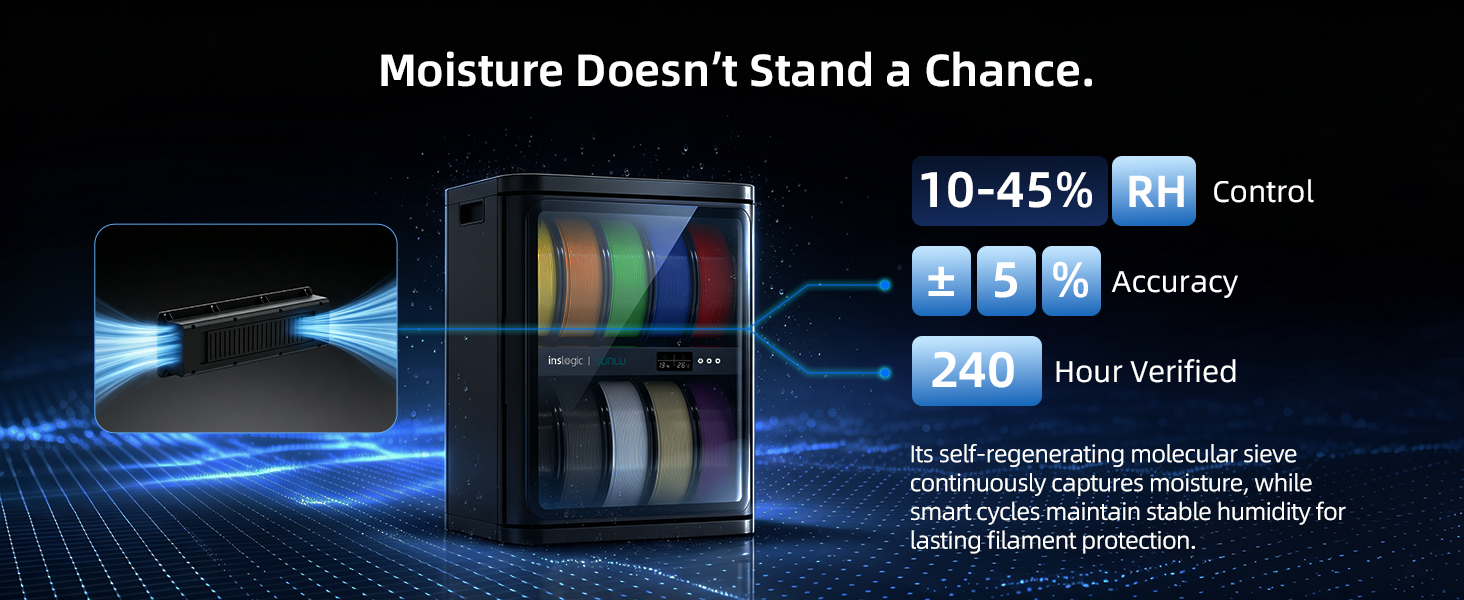
The molecular sieve module. SUNLU quotes plus or minus 5% accuracy and a “240 Hour Verified” label. Image: SUNLU.
A box of silica gel also keeps filament dry. The difference in the i10 is that the desiccant is supposed to dry itself out. Any desiccant saturates eventually, and a passive dry box needs its packets baked or swapped by hand. In the i10, SUNLU says, an integrated PTC heating module heats the sieves once they are saturated, expels the trapped moisture through the circulating system, and then returns the unit to absorption mode, with no manual intervention. SUNLU says real-time humidity sensors switch the system between the two modes. SUNLU does not say where that moisture ends up. In an enclosed cabinet it has to go somewhere, either out through a vent or back into the compartment, and none of the launch images show a vent or a door seal. This is the one engineering detail we would want answered before drawing any conclusion about the i10.
On temperature, the only published figure is a maximum product surface temperature of 30 C or lower. SUNLU has not stated the temperature inside the storage compartment during a regeneration cycle. Its launch graphic also carries a “240 Hour Verified” label without saying what was tested or under which conditions, so treat it as a company claim rather than a benchmark.
Humidity control and the front panel
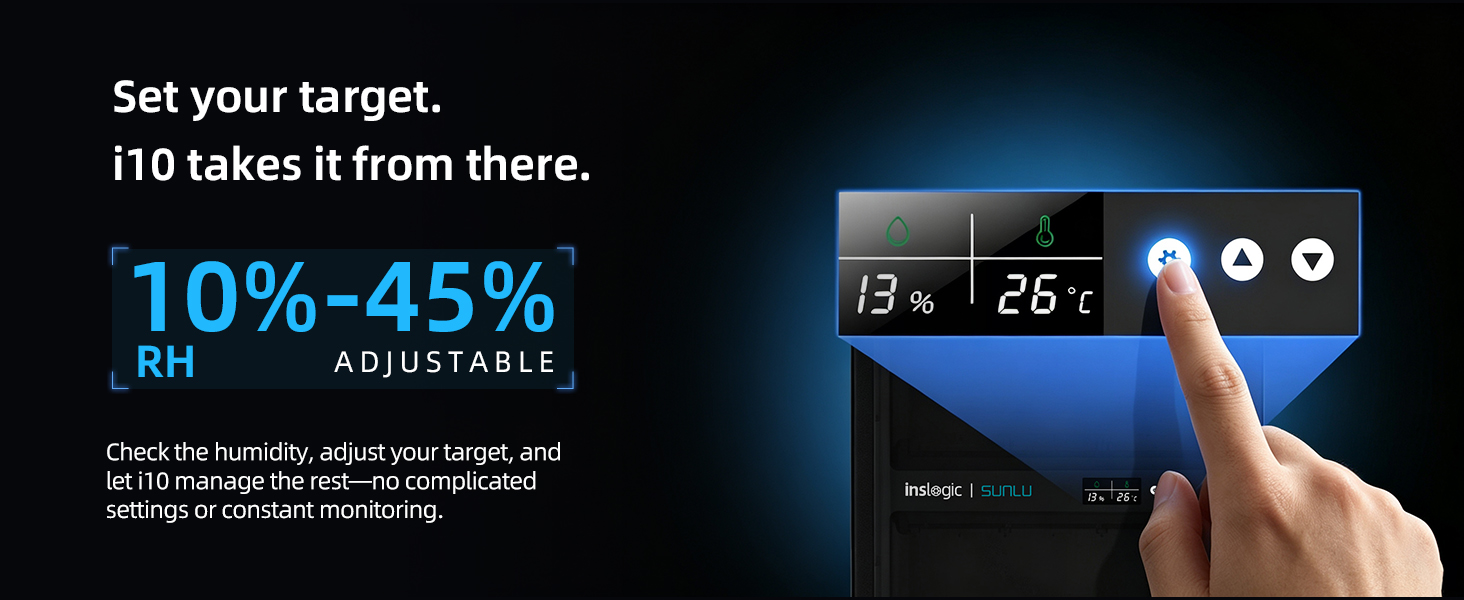
The front panel shows current humidity and temperature. The updated spec sheet lists a 10 to 55% RH setting range; this earlier graphic shows 10 to 45%. Image: SUNLU.
The target humidity is set through three buttons on the front panel, and a display shows the current humidity and temperature inside the cabinet. The updated spec sheet puts the setting range at 10 to 55 percent RH and the display range at 10 to 90 percent, both with an accuracy of plus or minus 5 percent; SUNLU’s launch imagery still shows 10 to 45 percent, so the sheet appears to be the newer figure. The cabinet is rated for rooms between 10 and 35 C at up to 95 percent ambient humidity.
SUNLU lists PLA, PETG, and engineering materials as the intended contents on its product page. It gives no pull-down time from room humidity to target, and makes no claim that the cabinet can recover a spool that is already wet. Keeping dry filament dry at room temperature is the easy part. Drying a soaked spool of PETG or nylon without heat could take days, if it works at all, and that is the number we want to see.
Capacity: ten 1 kg spools, and read the fine print on larger ones
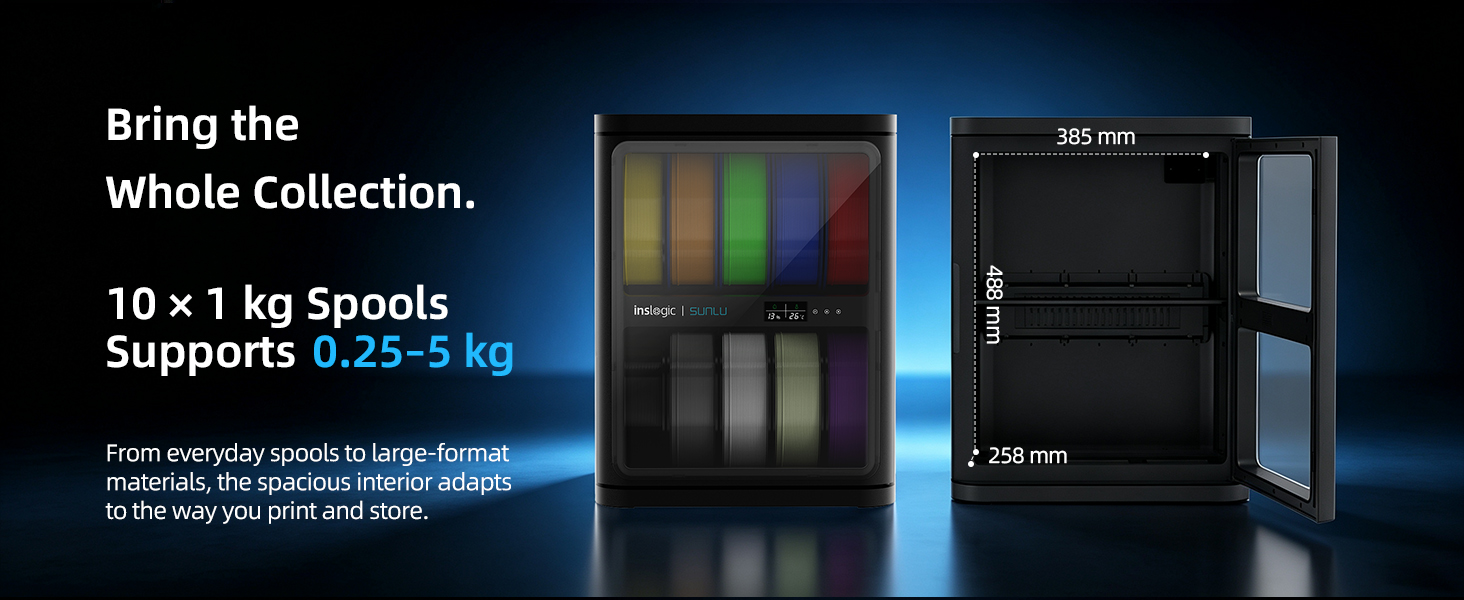
Two shelves, five spools each. The spec sheet lists the interior at 385 x 258 x 488 mm and the maximum reel at 200 x 67 mm. Image: SUNLU.
The cabinet holds spools on two shelves behind a transparent front door, with SUNLU rating it for ten standard 1 kg spools. The updated spec sheet lists the maximum reel size at 200 mm diameter by 67 mm width, which is exactly a standard 1 kg spool, inside a 385 x 258 x 488 mm interior. That sits awkwardly next to SUNLU’s launch imagery, which claims support for spools from 0.25 kg up to 5 kg: a 5 kg spool is far larger than 200 by 67 mm, so unless the shelves come out and the sheet is conservative, treat the i10 as a ten by 1 kg cabinet and ask SUNLU before planning around large-format spools. Smaller 250 g and 500 g spools fit either way.
Outside, the cabinet measures 395 x 300 x 508 mm and weighs 6.3 kg, so it takes about as much desk as a mid-size desktop printer and one person can move it. SUNLU calls it “stackable” but has not said how many units high.
Noise, heat, and safety
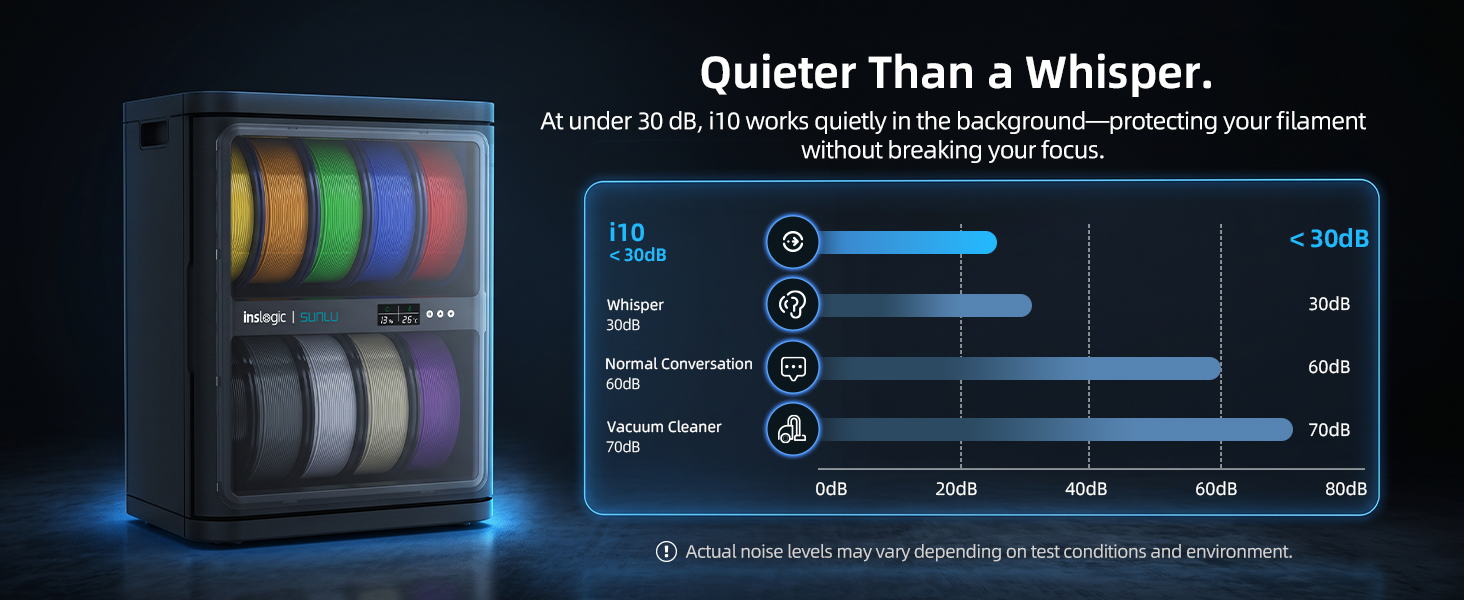
SUNLU rates the i10 at 35 dB or lower in its press release; this launch graphic claims under 30 dB. Image: SUNLU.
This cabinet runs around the clock, so a fan you would ignore for three hours in a dryer becomes a fan you live with. SUNLU’s press release puts it at 35 dB or lower; its launch graphic says under 30 dB and compares that to a whisper. SUNLU adds that measured noise varies with test conditions. The two figures should be reconciled on the final spec sheet.
On the heat side, SUNLU says the PTC regeneration module is protected by what it calls dual-layer hardware and software safeguards, and repeats the 30 C maximum surface temperature. The spec sheet also settles the running-cost question, and the numbers are the strongest part of its case: 1 W while dehumidifying, 100 W while baking the sieve dry, 500 W maximum, and 0.2 W or less on standby. Since regeneration only runs when the sieve is saturated, the i10 should cost next to nothing to leave on all year, although SUNLU has not said how often that 100 W cycle runs in a typical room. The unit comes in AC 110 V 60 Hz and AC 220 V 50 Hz versions and the sheet warns you to match your local supply, so it does not appear to auto-switch. No safety certification marks are listed yet; those normally show up on the product page before pre-orders open.
Pricing and availability
SUNLU has not yet announced the price of the FilaDC i10. Pre-orders open at 7:00 AM UTC on September 15, 2026 on the SUNLU online store, and the company says the pre-order price will be revealed on that date. We will update this article with the price as soon as it is public.
From August 14 to September 14, 2026, SUNLU is selling a 1 US dollar Early Access Pass on the product page, limited to the first 5,000 reservations. SUNLU says pass holders receive a 10 US dollar coupon against the pre-order price. The product page does not state whether the 1 dollar is refundable, whether the coupon expires, or whether it can be combined with other launch discounts, so treat it as a small bet rather than a deposit.
FilaDC i10 on the SUNLU store
Pre-orders open September 15, 2026, 7:00 AM UTC. A 1 USD Early Access Pass with a 10 USD coupon is on the page until September 14; SUNLU has not published its refund or expiry terms. Price: not yet announced. Pre-order pricing goes live September 15, 2026.
See the FilaDC i10 on the SUNLU store
This is an affiliate link. 3DPrinting.com earns a commission on purchases made through this link, at no extra cost to you.
Full specification
The figures below are taken from SUNLU’s press release, launch imagery, and updated specification sheet as of August 31, 2026. Fields marked “not published” were not available at the time of writing.
Show the full specification table▾
About SUNLU and INSLOGIC
SUNLU was founded in 2013 in Zhuhai, China, and manufactures 3D printer filament, resin, and accessories, including filament dryers. The company reports more than 270 production lines, over 25 million products sold, and more than 530 intellectual property rights. INSLOGIC is SUNLU’s co-brand partner on the FilaDC i10; SUNLU’s launch material does not describe the split of development work between the two companies. More information at www.sunlu.com.
If you run more than five or six open spools and re-dry them before every print, the FilaDC i10 is worth checking on September 15, 2026, once SUNLU has put a price on it. Until then, our guide to the best filament dryers covers the heated options that are shipping today.
FilaDC i10 Filament Dehumidifying Cabinet
Pre-orders open September 15, 2026 at 7:00 AM UTC on the SUNLU online store. Price not yet announced. Early Access Pass available until September 14.
This is an affiliate link. 3DPrinting.com earns a commission on purchases made through this link, at no extra cost to you.