
Researchers at The University of Texas at Austin have developed a 3D-printable material that replicates human tissue’s ability to sort and filter molecules, opening applications in medicine, soft robotics, and critical mineral recovery. The work was published in Nature Materials.
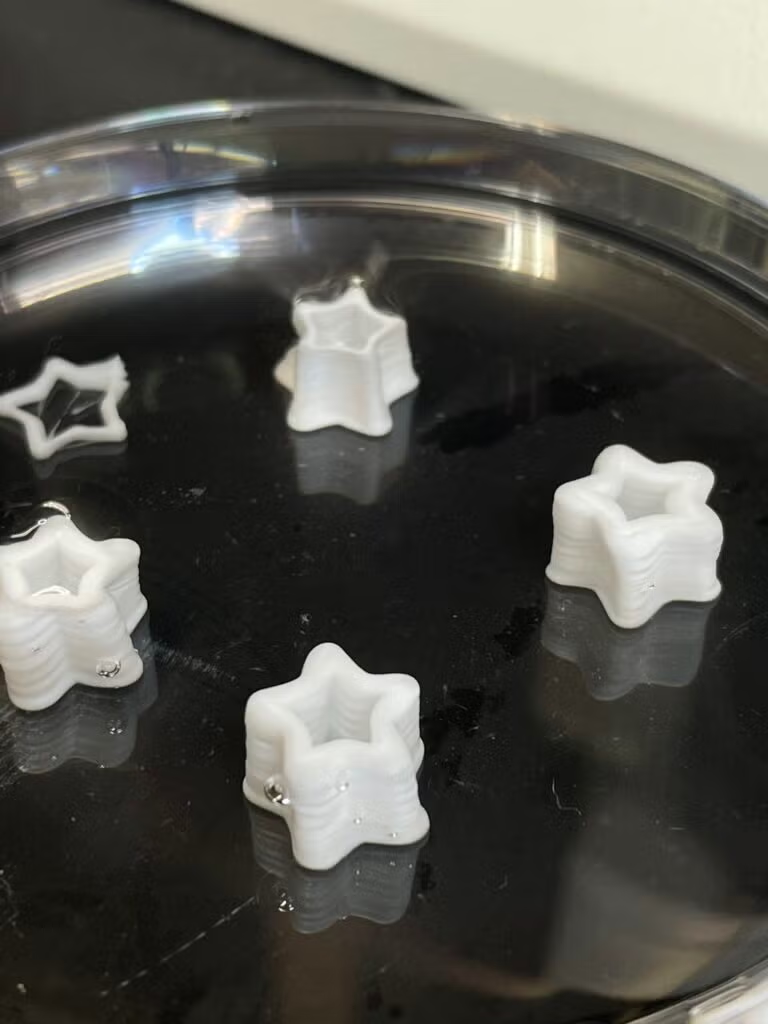
The material is built by jamming billions of tiny water droplets together using simple mixing and centrifuge techniques, forming large, tissue-like structures in minutes. Each droplet is separated by a thin membrane, and those membranes link up in the same way cells organize in human tissue. That structure allows researchers to customize it for different functions by swapping in different proteins.
“Tissues can separate and transport ions and molecules; that’s how our kidneys or intestines work, taking only what they need and leaving the rest behind,” said Manish Kumar, professor in the Cockrell School of Engineering’s Fariborz Maseeh Department of Civil, Architectural and Environmental Engineering and the McKetta Department of Chemical Engineering.
The breakthrough came from doctoral student Aida Fica, who heard an idea at a conference after years of hitting the same wall of slow formation and instability. She and the team turned to emulsification, combining two oils with different solubilities to form droplets and then compressing them with a centrifuge. Because the material is biocompatible and can be 3D printed, it can serve as a scaffold for growing new tissues or organs, and its flexibility makes it a candidate for soft robots used in surgery, search-and-rescue, or hazardous environments.
Adding certain proteins let the material conduct ion currents similar to nerve tissue, which holds promise for brain-modeled computing. In another version, a different protein allowed the material to distinguish ammonium from other ions in oil and gas wastewater and municipal wastewater, a potential tool for filtering and recycling critical minerals and nutrients.
“This technology now offers a simple, scalable process with endless applications that could be implemented in any laboratory since it only requires basic equipment,” Fica said. Kumar added: “We encourage interested researchers to try this out, and we will heartily support anybody who would like to work in this field through visits and discussions.”
The team is now working with the U.S. Department of Energy’s Advanced Research Projects Agency-Energy to adapt the technology for extracting lithium and rare-earth elements. Fica and Kumar have patented both the core technology and several downstream applications through UT’s Discovery to Impact office. Funding came from the WoodNext Foundation, the National Science Foundation, the Chilean National Agency for Research and Development, and UT’s Center for Dynamics and Control of Materials.
Source: news.utexas.edu