
Artec 3D says its new handheld blue-light scanner delivers 0.025 mm accuracy at target-anchored features only, while capturing the whole part in color at up to 0.05 mm resolution. It scans tethered or wireless and debuts this week at IMTS in Chicago.
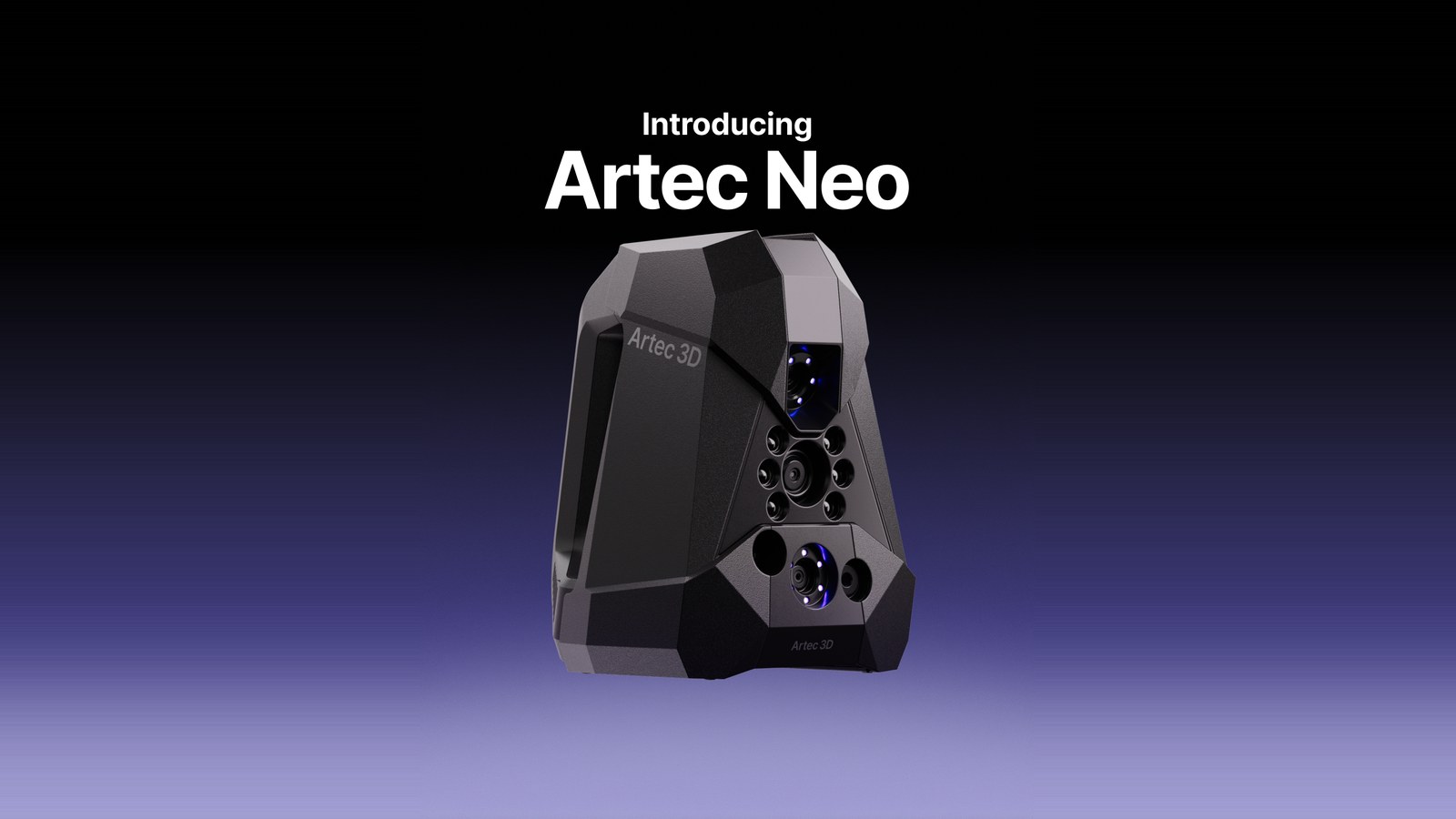
The Artec Neo. Image: Artec 3D.
Artec 3D announced the Artec Neo today, September 14, 2026, from its headquarters in Luxembourg, with the hardware on show at IMTS in Chicago this week. The company calls it the first tolerance-driven 3D scanner, a phrase it has clearly spent some time on. The pitch is at least different from the usual launch-day arithmetic of one more decimal place. We have not had a Neo in our hands. Everything below is Artec’s own data, taken from the press release and one correction Artec issued to it, and we say where that data leaves a question open.
Targets as anchors rather than wallpaper
Conventional laser scanning workflows, in Artec’s telling, have needed the whole part covered in targets to guarantee accuracy. Targets, for anyone who has avoided them so far, are small reflective stickers. They let a scanner fix its position precisely enough for a manufacturer to guarantee a figure. They also take an unreasonable amount of somebody’s afternoon to apply and peel off, including on surfaces that nobody has ever put a tolerance on.
Artec’s argument is that this contradicts the way engineers already think. A drawing does not treat every face of a part as equally important. Geometric dimensioning and tolerancing exists to say which features control fit, alignment, sealing and function, and how tightly the machinist has to hold each one. The rest of the part just has to exist. Artec Neo, according to the company, applies that same logic to scanning. Targets go only around the features with critical tolerances, where they act as metrology anchors and deliver the 0.025 mm figure. Across the rest of the part, what Artec describes as AI algorithms keep tracking from geometry, texture and color. One scan and one dataset, in Artec’s phrase, with no switching between separate scanning technologies halfway through.
The idea behind GD&T is simple. Ultimate precision is not required everywhere; control what determines whether the part works. Artec Neo applies the same principle to 3D scanning. If you have a drawing, it tells you where metrology belongs. If you’re reverse engineering, you make that decision as you reconstruct the design.
Art Yukhin
President and CEO, Artec 3D
Artec offers four ways of working with this. Cover the whole part in targets and you get full-part metrology, the way it has always been done. Place targets only around the key features and you get dimensional control with far less sticker work. For delicate or worn surfaces, put the targets on a fixture around the part instead, which anchors the accuracy without anyone touching the part. And where nobody needs metrology at all, the Neo scans with no targets whatsoever at up to 0.05 mm resolution, deep features included, in what Artec calls true-to-life color.
The numbers Artec is quoting
The headline accuracy is 0.025 mm, with volumetric accuracy of 0.025 mm plus 0.035 mm per meter, a figure Artec corrected after the release went out. Both apply, as we read the release, at the target-anchored features. Resolution across the full part is up to 0.05 mm.
Artec attributes the ability to mix the two to its proprietary blue-light optical system and to what it calls a single hybrid tracking architecture. That architecture, Artec says, is what lets targets and target-free tracking coexist in one scan.
The release is silent on two things. There is no field of view, working distance or weight. So we cannot yet tell you how it handles in the hand, or how it compares in coverage with the rest of Artec’s range. And Artec gives no accuracy figure at all for the untargeted, AI-tracked regions. The 0.05 mm it quotes for the full part is resolution, which is a different measurement. That is consistent with what the product is for, but a buyer should ask for both numbers before deciding which surfaces can safely go without stickers.
Verified on a robot, one unit at a time
Artec says it tests every Neo individually in what it describes as its independent metrology and calibration laboratory before shipping. Each one leaves the building with its own verification certificate. The lab, in the release’s words, operates “according to ISO/IEC 17025 principles” and uses test methods per VDI/VDE 2634 Part 3, the German guideline for optical 3D measuring systems. Robots run the tests, which Artec says removes operator influence and keeps results repeatable across the whole measurement volume.
Operating according to ISO/IEC 17025 principles is not the same as holding ISO/IEC 17025 accreditation, and the release uses the former wording. A metrologist will notice the difference, and if accredited traceability matters for your quality system it is a question for Artec or its reseller. Artec has at least named a test method, which is more than many handheld spec sheets bother with.
One scanner for inspection and reverse engineering
The Neo runs on Artec Studio, the company’s own capture and processing software, which Artec says produces data ready for inspection and reverse engineering with the essential editing tools included. For the heavier lifting, it integrates with SOLIDWORKS, Geomagic and PolyWorks. The release does not say whether the scanner comes with an Artec Studio license or whether you buy one separately. On professional hardware that is not a small line item.
The industries Artec has in mind are the ones where a few surfaces matter enormously and the rest is context. In automotive that means measuring flush and gap while capturing the surrounding bodywork. In aerospace maintenance, repair and overhaul it means measuring a critical interface while digitizing the wider build around it. For defense and industrial maintenance, the pitch is reconstructing legacy parts for which the drawings or CAD no longer exist. On most shop floors that means they left with whoever drew them. And in retrofit and installation work, the scanner captures connection points and interfaces together with everything they connect to.
Cable optional
The Neo works tethered or fully wireless over Wi-Fi, with what Artec quotes as up to 50 minutes of continuous battery-powered scanning. Artec’s list of where that should get you runs to inside machinery, around large assemblies, at height, in confined spaces and on the factory floor. A cable helps with none of those. Whether 50 minutes covers a shift depends on how many batteries ship with the scanner, which Artec has not said. Artec describes a companion app for iOS and Android as coming soon, one that turns any smartphone into the Neo’s display. The wording suggests it is not shipping at launch.
Price and availability
Artec has not put a price in the release, which is customary for this class of instrument and mildly maddening for everyone trying to budget for one. The scanner is available now through Artec 3D’s global reseller network, and the company points inquiries to its nearest reseller or to sales@artec3d.com.
If you happen to be in Chicago this week, the Neo debuts at IMTS 2026, which runs September 14 to 19 at McCormick Place. Artec is at Booth 134246, East Building, Level 3, with its full scanning range and, it says, partners and in-house experts on hand throughout the week. If the target-light tracking works as described, the demo will be the more interesting thing on the stand.
Full specification
All figures are Artec 3D’s own, from the launch press release of September 14, 2026. Fields marked “not published” were not available at the time of writing.
Show the full specification table▾
If you are weighing the Neo against the rest of the field, our guide to the best professional 3D scanners covers the handheld metrology options shipping today. We will add the Neo once there is a price to put beside it.
About Artec 3D
Artec 3D develops and manufactures professional 3D scanning hardware and software from its headquarters in Luxembourg. It describes itself as a leader in AI 3D reconstruction, computer vision and digital twins, with customers in engineering, manufacturing, healthcare, science, art and design, and cultural heritage. More at www.artec3d.com.
This is an unpaid news item. 3DPrinting.com has not tested the Artec Neo. Specifications and images: Artec 3D. Last reviewed September 14, 2026.