
Researchers at Eindhoven University of Technology (TU/e) have built a computer model that predicts how food pastes flow through a 3D printer.
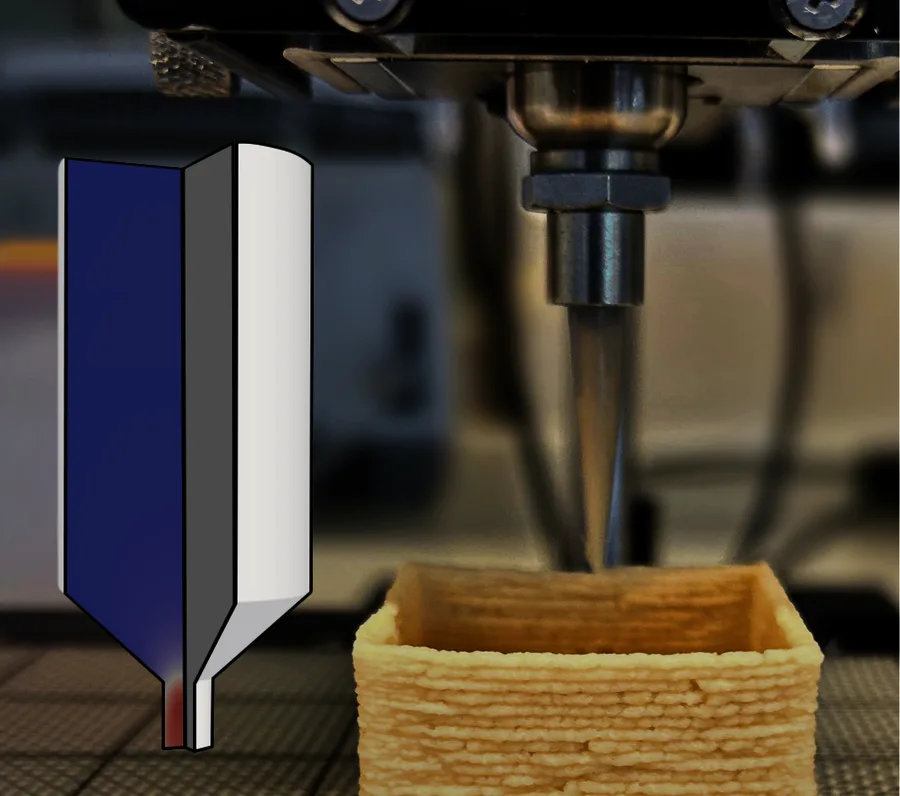
The Dutch university described the work in a 26 November newsroom post. Researcher Yagmur Bugday and colleagues at TU/e built the model with Wageningen University & Research. They used it to estimate how easily a food ink can be extruded, a property known as extrudability. The study appears in Physics of Fluids, where it was selected as an Editor’s Pick.
Food printing is already being explored for restaurant dishes and for meals tailored to special diets. The paste-like inks have to stay firm enough to hold their shape after they leave the nozzle, yet flow once pressure is applied. That balance is hard to predict, which has made it difficult to know in advance whether a given formulation will print cleanly. The findings are meant to help engineers develop better food inks and printers. One target is healthcare, where meals often need a set nutrient mix or a texture patients can eat more easily.
Bugday’s team simulated how the inks move through the narrowing nozzle of a printer syringe, including the contraction where the paste is forced into a smaller opening. They compared the force, or pressure drop, those simulations predicted with measurements from physical experiments. The model treats the materials as solid-like at rest and fluid-like once they are pushed. The researchers ran it on two inks, one rich in protein and one made mostly of fiber.
The model accurately predicted the extrusion force for the protein-rich ink. It overestimated the force needed for the fiber-based ink, which pointed to another effect inside the syringe. The team suspects wall slip. That happens when a thin layer of water forms between the paste and the syringe wall, so the ink slides along the surface rather than flowing as the model expects. The effect can change the force needed to push the material out.
The next step is to build wall slip into the simulations, along with changes in the material over time, including how its structure may break down during a print. Doing so should make the model more accurate and better suited to different food inks. Engineers could then use it to design nozzles, set the operating limits of a printer, and adapt formulations to a given machine. The research is part of the PRINTYOURFOOD project.