
A Karlsruhe Institute of Technology (KIT) team has won the Deutscher Zukunftspreis, Germany’s Future Award, for 3D-printed photonic links that connect optical chips with light.
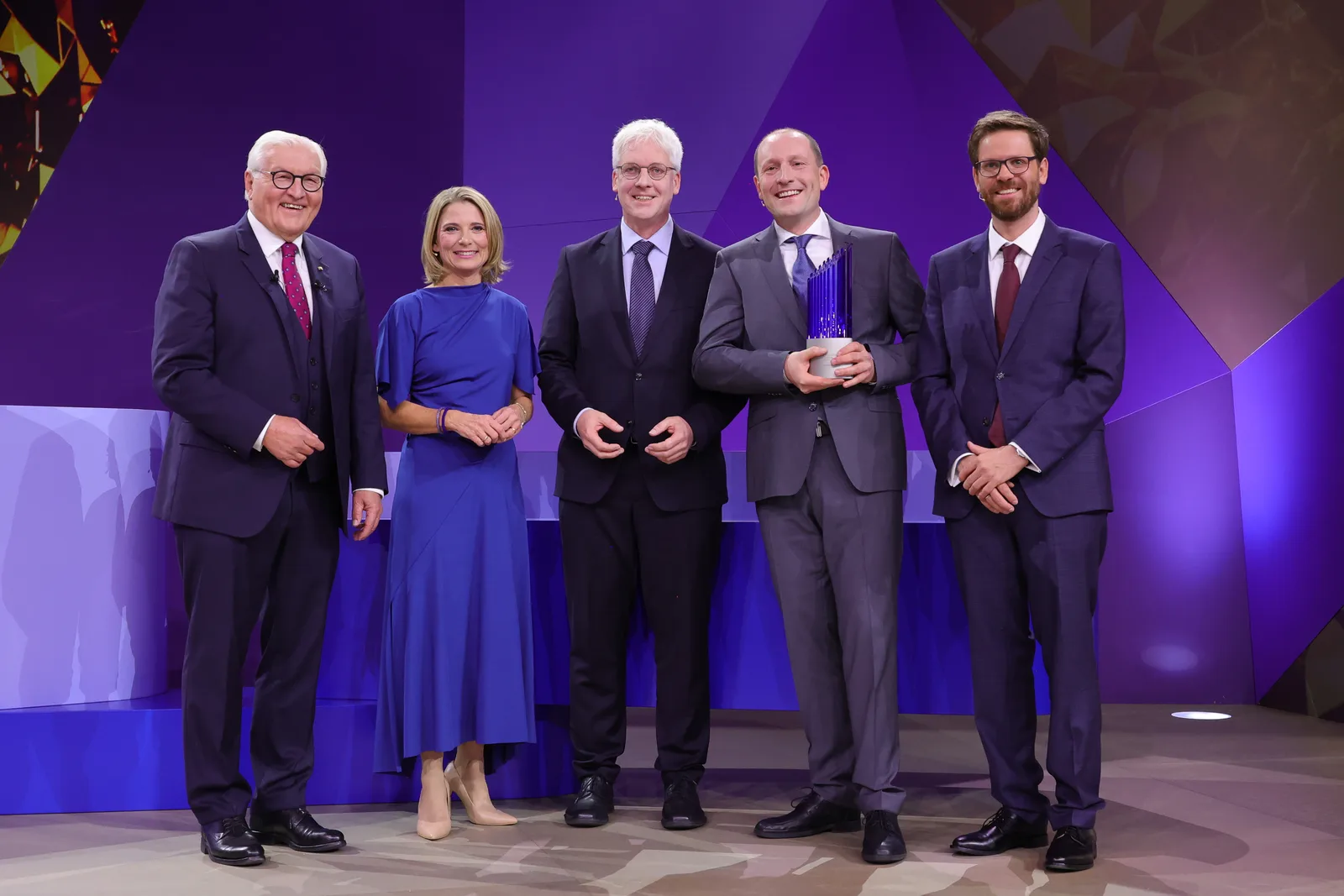
Federal President Frank-Walter Steinmeier presented the €250,000 prize in Berlin on November 18. The recipients were Professor Christian Koos of KIT’s Institute of Photonics and Quantum Electronics, who spoke for the team, along with Dr. Philipp Dietrich and Dr. Matthias Lauermann. Both did their doctoral work on optical microchips in Koos’s group, then took the research into two KIT spinoffs.
Nominated by a jury, and closed to applications, the annual prize recognizes science and engineering that is ready for the market. The timing fits a practical problem. Demand for fast, efficient fiber-optic links is rising with the build-out of artificial intelligence and data centers. Photonic chips, which move data with light rather than electrical signals, still face a stubborn bottleneck.
Even tiny misalignments can interrupt the light when a chip has to be joined to another chip or to a fiber. Conventional assembly lines up the parts on the sub-micrometer scale before they are fixed in place, which is slow and costly at volume.
Printed Light Bridges
The team’s process turns that sequence around. The components are placed and fixed only roughly. A high-resolution camera system then measures their true positions with an accuracy better than 100 nanometers, and software calculates a custom connection to match.
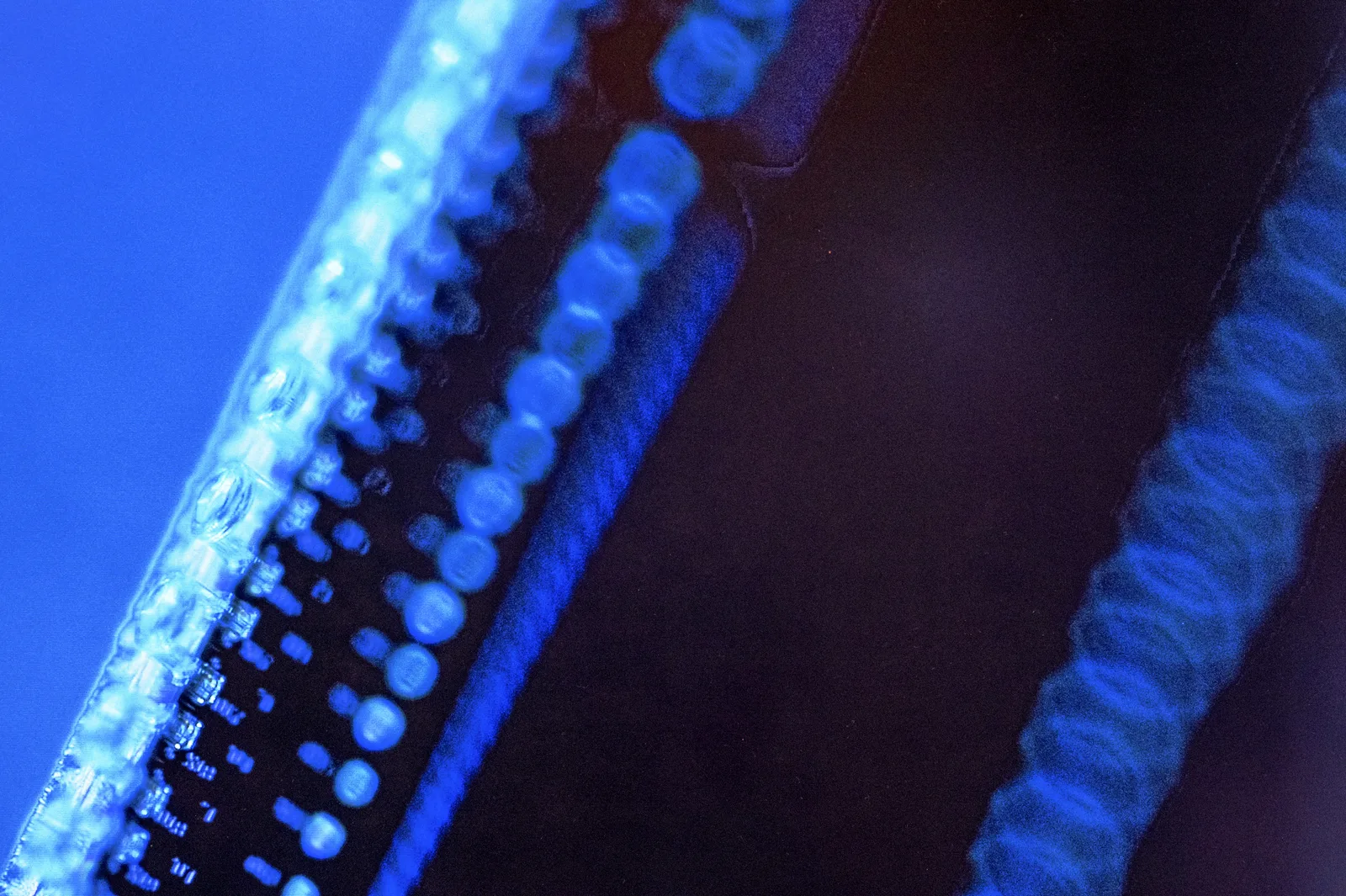
A nanoscale 3D printer that uses multiphoton polymerization then writes a three-dimensional waveguide, a photonic wire bond, directly between the parts. Those printed structures, which are about 100 times thinner than a human hair, guide light from chip to chip, or from chip to fiber, with very low loss. Industrial stress tests have also shown the bonds to be reliable, and different photonic components can then be combined without the old fine-alignment step.
Vanguard Automation, where Lauermann is a technology fellow, has turned that printing method into an industrial process for building the optical links. Keystone Photonics, where Dietrich is senior director of photonic test innovation, uses similar printed free-form structures to test chips while they are still on the wafer. That check happens before the chips are cut and assembled.
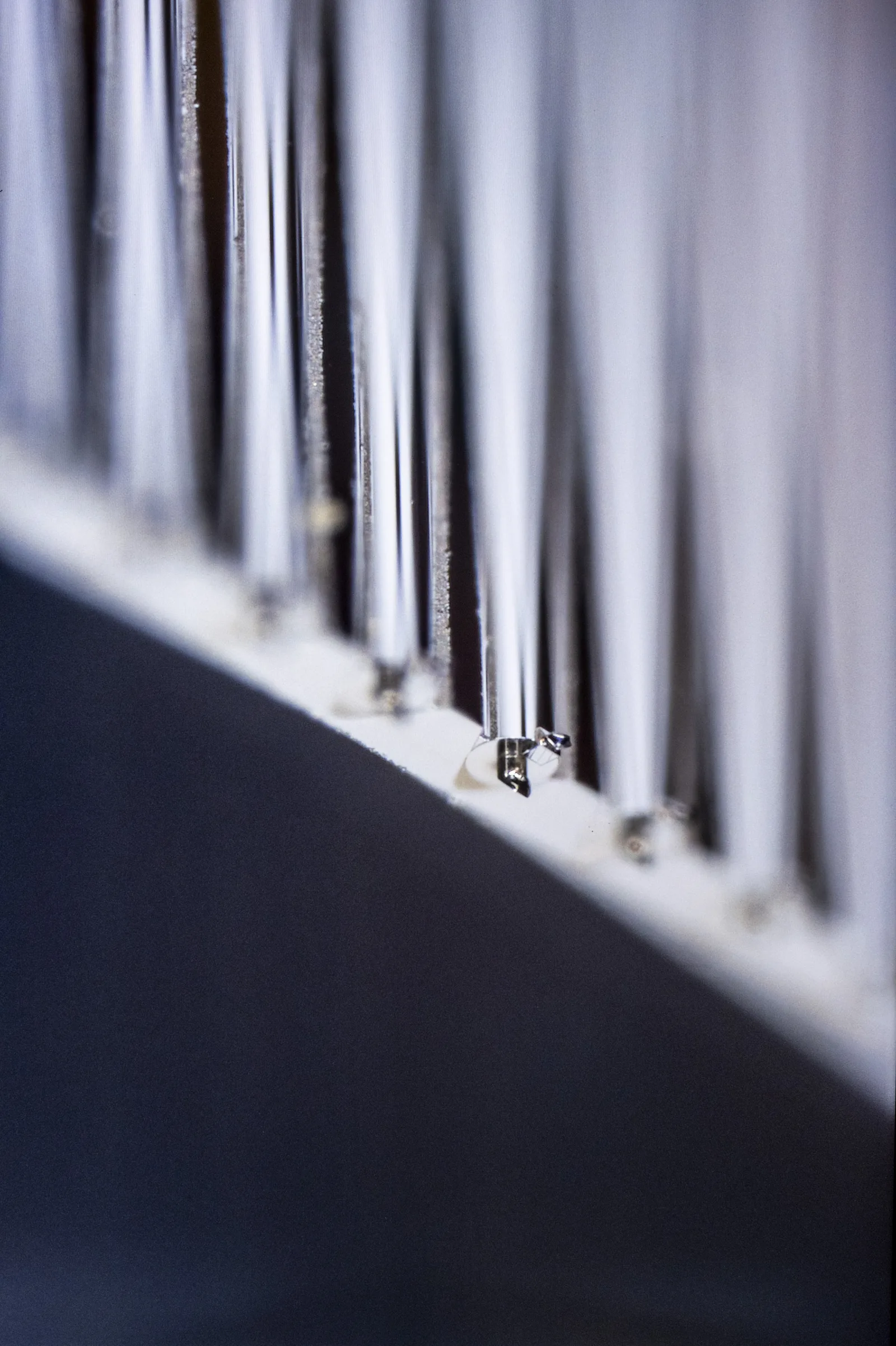
Those structures include 3D-printed microlenses that couple light into photonic circuits early enough to catch defective chips before costly later steps. Both companies now supply international customers in the chip and AI industries, and the processes are already in the production chains of major technology companies.
Koos put the industrial results plainly to KIT. “We’ve always been aware of the great potential of our research and the resulting developments, and our industrial success now proves that we were right,” he said.
The two startups have already increased revenue at their Karlsruhe sites. Vanguard Automation is now part of Sweden’s Mycronic, which makes electronics production equipment, and FormFactor, a semiconductor test company, has acquired Keystone Photonics. More than 70 jobs in integrated photonics have been created in the city, with more than 200 expected in the medium term. Development and manufacturing are set to stay there.