
Eplus3D’s new EP-M550L metal 3D printer uses up to 16 lasers and automated powder handling to make large batches of parts.
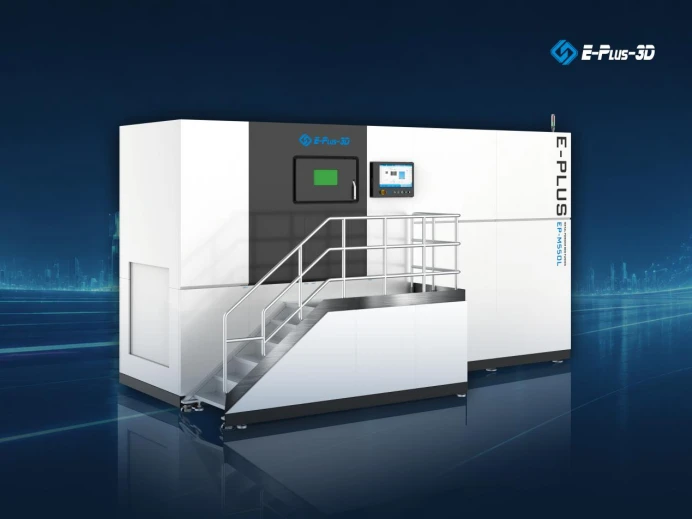
In metal powder bed fusion, lasers melt thin layers of metal powder, one on top of another, until a part is finished. More lasers mean faster builds, but some systems reach high output by relying on oversized build platforms, which take up more factory floor. Eplus3D went the other way with the EP-M550L, fitting up to 16 lasers over a standard 550 x 550 mm build area.
The full build volume measures 550 x 550 x 600 mm. Buyers can choose 8, 9, 12 or 16 lasers, with power options of 500 W, 700 W and 1000 W, and the theoretical printing speed reaches up to 560 cm³/h. That is double the 280 cm³/h listed for the earlier EP-M550, which has a 450 mm build height and up to eight lasers, according to its product page.
The extra lasers pay off most in batch production, where many parts share a single build. Eplus3D adds that the higher laser count does not cost precision, and that the machine keeps accuracy and process consistency across all its laser setups. The company aims the system at aerospace, mold and tooling, precision manufacturing and 3C electronics, the industry name for computers, communications and consumer electronics. Watch cases and mobile phone hinges are among the parts shown on the product page.
Printing capacity alone does not decide how efficient a factory is, though, because more output also means more powder to move and more builds to change over. That is why the EP-M550L, which builds on the automation design of Eplus3D’s EP-M300L, uses removable build cylinders, the containers in which the parts are printed. Printing and powder recovery can then run separately. Automated stations handle powder suction, sieving and recycling as well as cylinder transfer, while the powder stays under inert gas to prevent contamination and oxidation.
Depending on the setup, the line can also link to automated guided vehicles, which are self-driving carts, and to a manufacturing execution system, the software that plans and tracks production. Together, these features are meant to speed up changeovers between builds, cut repetitive manual handling and keep production running as capacity grows.
Visitors can see the system at Formnext 2026 in Frankfurt, where Eplus3D will be at booth 12.0-E101. The company built China’s first powder bed fusion machine in 1993 and now has facilities in Beijing, Hangzhou and Stuttgart, with customers in more than 50 countries and regions.
Source: Eplus3D