
UC San Diego engineers have 3D printed a soft six-legged robot in one piece that runs up to 4.72 meters per second without electronics.
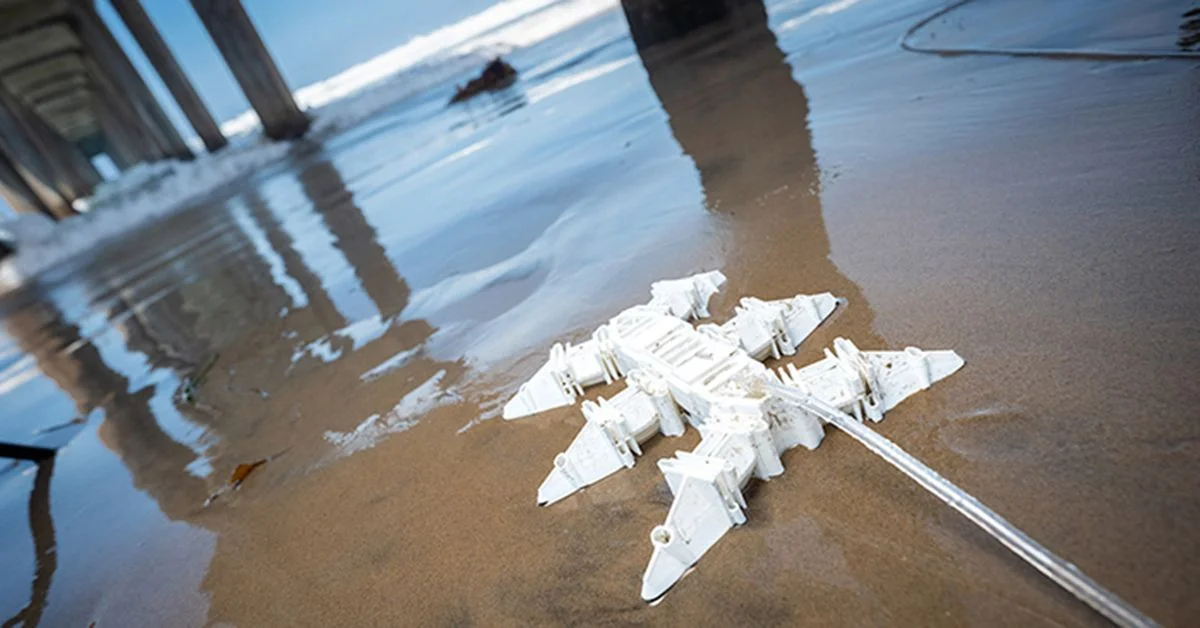
Soft robots are built from flexible materials instead of rigid parts and motors. One way to control them without electronics is to build air channels and valves straight into the body, and 3D printing can produce such a body without manual assembly. Until now, however, speed held the idea back. The team’s first 3D printed, air-powered soft robot, developed in 2022, managed just 4 centimeters per second, because it could only handle limited air pressure and airflow.
The new robot, built at the UC San Diego Jacobs School of Engineering, is 3D printed in one go from a single material. Inside, a connected series of chambers, valves and tubes drives the legs once pressurized air flows through. More pressure means more speed, so the researchers made the robot and its internal structures bigger and stronger. Very high pressure also wastes energy, though, because the robot then blows out air that still holds a lot of it.
To fix that, the team borrowed the idea of the compound steam engine, which lets steam expand through several chambers in turn. In the robot, pressurized air circulates twice, first through small high-pressure chambers that power the valves and then through larger low-pressure chambers that move the legs. As a result, it runs more than 100 times faster than the 2022 version.
“Our first walking robot demonstrated what was possible, but it was too slow,” said Yichen Zhai, a former postdoctoral researcher. “We hoped to overcome this limitation, and we were fortunate to find a solution to make the new robot 100 times faster.” Zhai led the team together with Professor Michael T. Tolley in the Bioinspired Robotics and Design Laboratory, which is part of the Jacobs School.
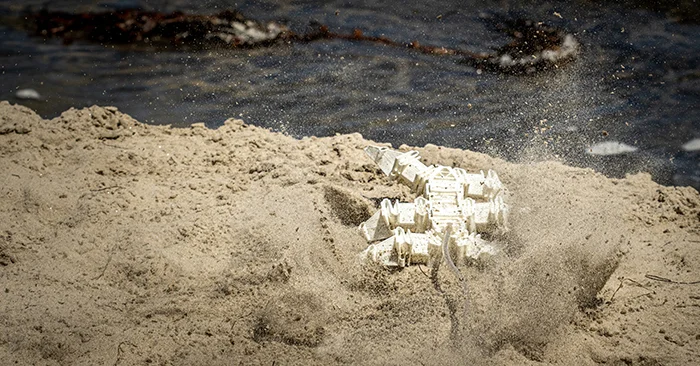
The team then put the robot on concrete, gravel, lawn, mulch and even sand. It also ran down stairs, swam in water and kept working underwater. In addition, the paper reports an estimated mechanical power output of 169 watts and shows the robot can also run on tap water instead of air.
For now, the robot only works while tethered to a source of compressed air, such as an air compressor. Next, the researchers want designs that use less air, so the robot could run untethered from a portable source such as a cartridge of compressed air. They also plan more complex motions for steering and handling objects.
Because such robots need no electronics, they could eventually work where electronics cannot, for example in areas with high radiation or magnetic fields, in disaster response and in space exploration. The National Science Foundation funded the work, which appears in the November 18, 2026 issue of Science Robotics.
Source: UC San Diego