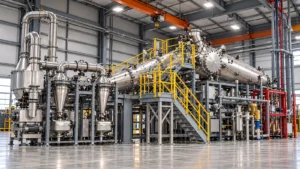

Japanese construction company Shimizu has 3D printed a one-piece rocket propellant tank about 1 meter wide, using WAAM metal 3D printing.
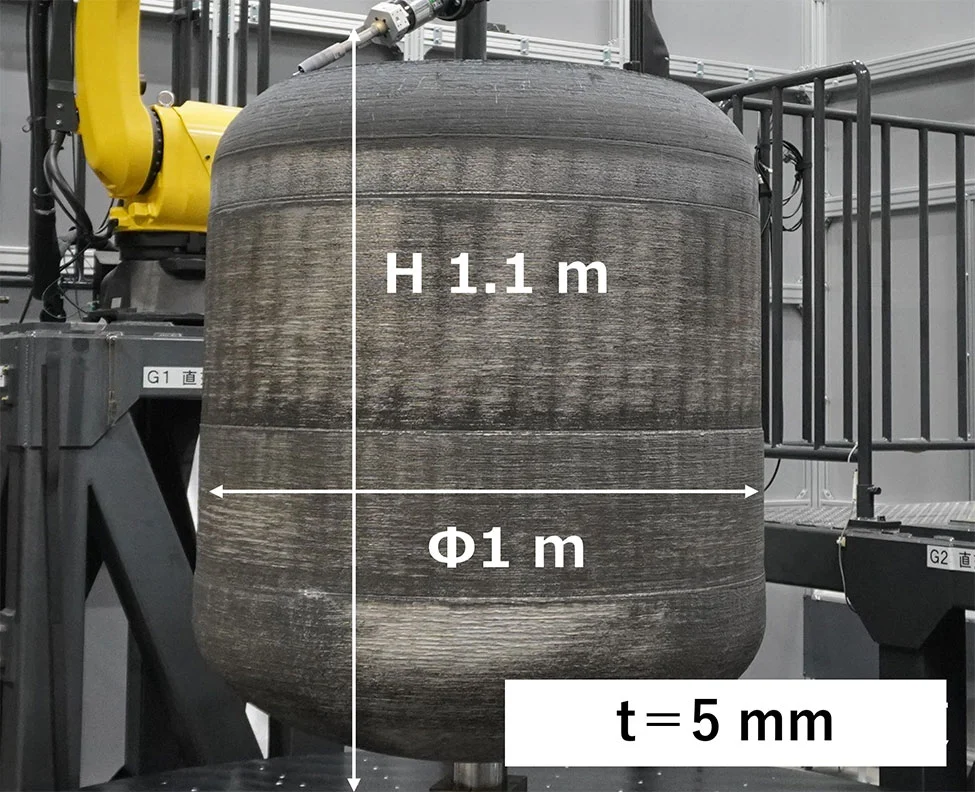
Demand for rocket launches has grown sharply in recent years, pushing companies worldwide to cut the cost of reaching space. Metal 3D printing has drawn attention for that reason, especially for rocket parts and tanks that must be both strong and light. Shimizu’s tank fits that brief, since it is among the largest rocket propellant tanks made by metal 3D printing in Japan. According to the labels on Shimizu’s photo, it stands 1.1 m tall with walls 5 mm thick.
The process is WAAM, short for wire arc additive manufacturing, in which an electric arc melts metal wire that is laid down layer by layer. Shimizu’s system is called hybrid because it combines adding material with machining it away, all in one setup. It pairs two robot arms around a rotary table. One deposits the metal, while the other carries a laser profiler that measures the shape of the build in real time and machines away defects when needed.
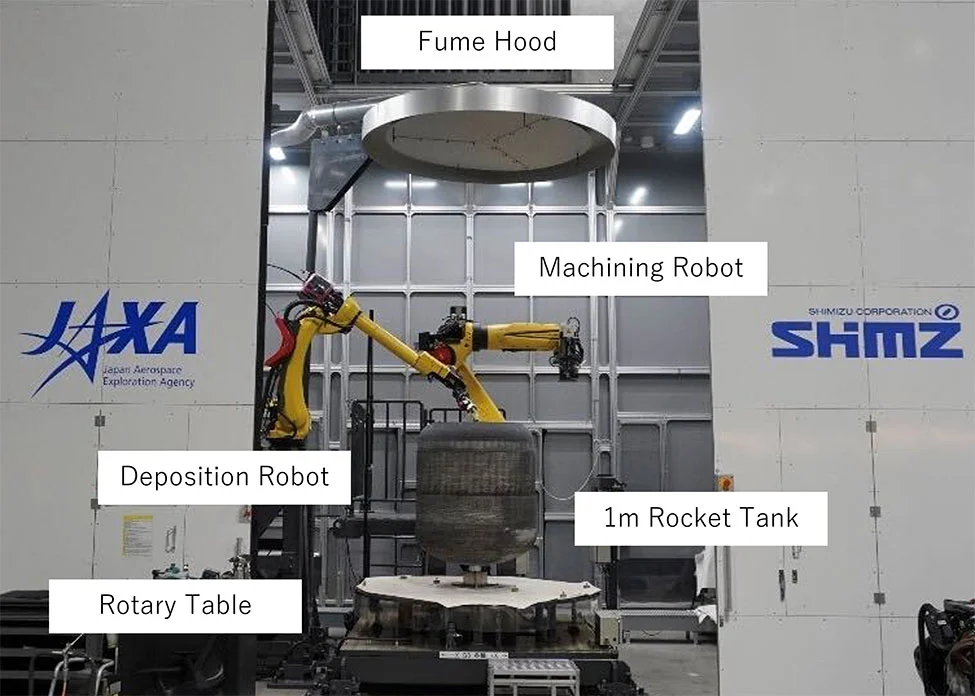
Those measurements feed a control loop, which adjusts the next deposition paths and layer heights. If the shape drifts from the plan, deposition pauses, the machining robot corrects the defective area and printing resumes. As a result, defects are corrected during the build itself.
The finished tank then went through an internal pressure burst test, in which it is pressurized from the inside until it fails. It reached a burst pressure of up to 1.7 MPa (megapascals), a key check for a part that has to hold pressurized propellant.
Shimizu did not work alone. The hybrid system came out of joint research with the Japan Aerospace Exploration Agency (JAXA), which began in 2022 and focuses on making rocket propellant tanks by metal additive manufacturing. Since 2024, Shimizu has continued work on large liquid propellant tanks under the Space Strategy Fund, a Japanese government program set up under the country’s Basic Plan on Space Policy.
The next step is a much bigger tank. Shimizu will use the shape data and pressure test results from the 1-meter-class tank to refine its process further. By fiscal year 2028, it aims to print 2.5-meter-class tanks in one piece, a size suited to small and medium-lift launch vehicles.
Shimizu has also published a video of the printing process alongside the announcement on its website.