
Fairbanks Morse Defense and Hunt Valve are shipping a 3D-printed copper-nickel tailpiece, the first additively manufactured part to meet SUBSAFE Level I.
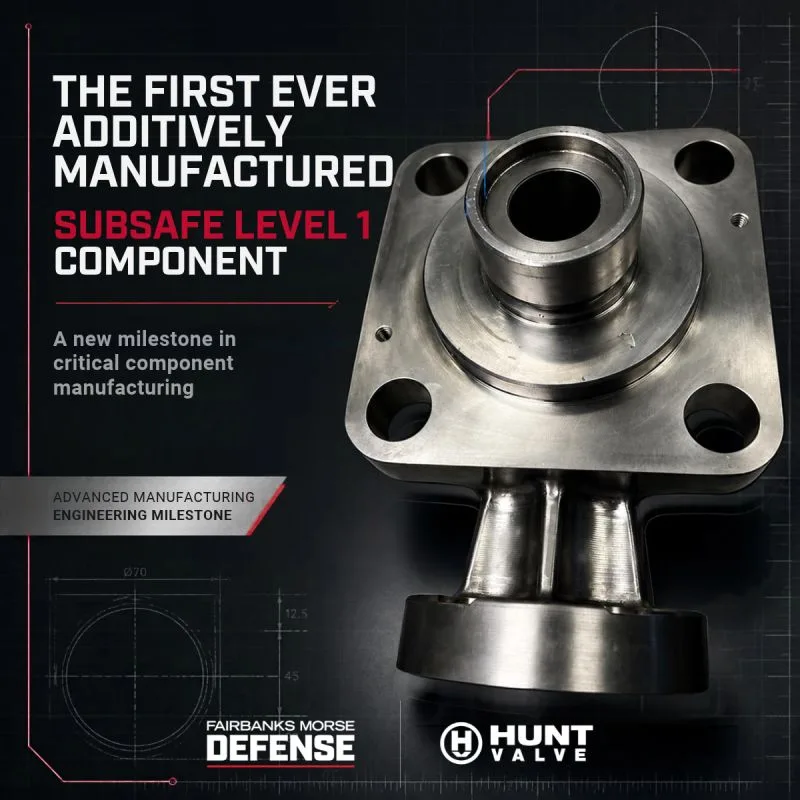
Fairbanks Morse Defense announced the shipment on LinkedIn on October 30. The part is a 2-inch angled tailpiece, built with Lincoln Electric Additive Solutions. Hunt Valve is a Fairbanks Morse Defense company. FMD thanked its engineers, quality professionals and production teams, along with Lincoln Electric.
SUBSAFE and Level I are among the U.S. Navy’s most demanding engineering and quality standards. They govern the parts that help bring every submarine home. FMD frames the part as a step toward normalizing 3D-printed submarine parts, a key enabler for fleet maintenance and sustainment.
Under the Navy’s new additive manufacturing standards, the tailpiece met full Government Contract Quality Assurance compliance from start to finish. It replaces a traditional casting. That should cut lead times on critical components and help keep maintenance schedules on track.
The partners have been working toward this for a while. In 2024, Hunt Valve won a contract from the Maritime Sustainment Technology and Innovation Consortium for a 70-pound 3D-printed valve assembly. It was the first printed assembly to be installed on a U.S. submarine. Printing was set to match or beat sand-cast quality in about two-thirds less time. Lincoln Electric prints the copper-nickel valve body, and Hunt Valve makes the remaining parts and assembles the valve.
Copper-nickel is a big reason printing pays off here. Sand-cast copper-nickel is highly porous and often has a high fall-out rate, which delays deliveries. Printed valve bodies have far higher first-time yields, so manufacturers don’t need to pad schedules for rejects.
Back then, additive manufacturing for submarine components had only been possible for small parts, and copper-nickel work was rare. The 2024 contract lets the printed valve go on any U.S. submarine class. FMD expected the approach to speed up production of fleet components by up to 75%, leaving foundries free to focus on larger parts.
Andrew Pfister, FMD’s vice president of aftermarket and product development, made the supply chain case back then. “By scaling additive manufacturing, we can reduce shipping from other parts of the world and increase the speed of production at home,” he said.
The tailpiece now takes that work to the Navy’s top tier of submarine parts. Its qualification is backed by underwater explosion shock testing of a separate additively manufactured tailpiece.
Source: Fairbanks Morse Defense on LinkedIn, via MarineLink