
Bambu Lab’s H3C can print thin and thick layers side by side on one surface, using a different nozzle size for each region.
The company laid out how it works in a blog post on November 9. Most slicers can change layer height as a print climbs. Neighboring regions at the same height still follow one shared layer schedule, though. Swapping nozzles fixes line width in X and Y, but leaves the Z axis untouched.
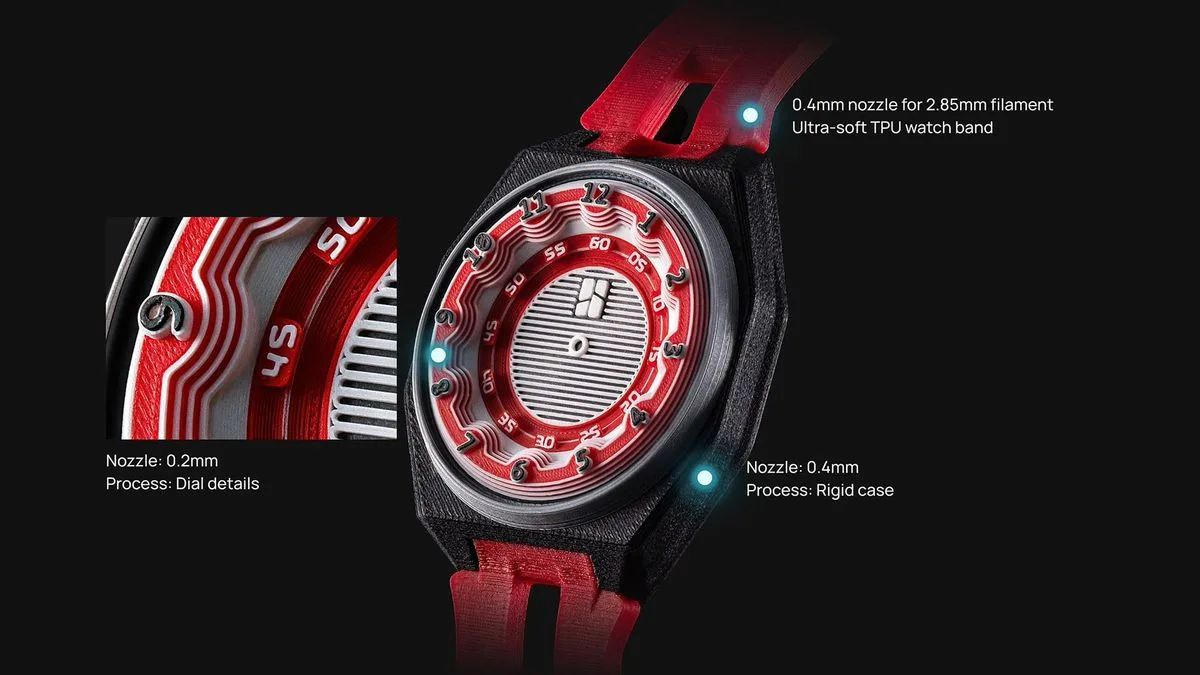
Bambu Lab uses a printed watch to show the trade-off. The dial wants a 0.2 mm nozzle for its tiny numerals and tick marks, while the chunky case is happy with 0.4 mm. Run the whole part on thin layers and the case wastes hours. Run it on thick layers and the dial loses its sharpness on slopes and reliefs.
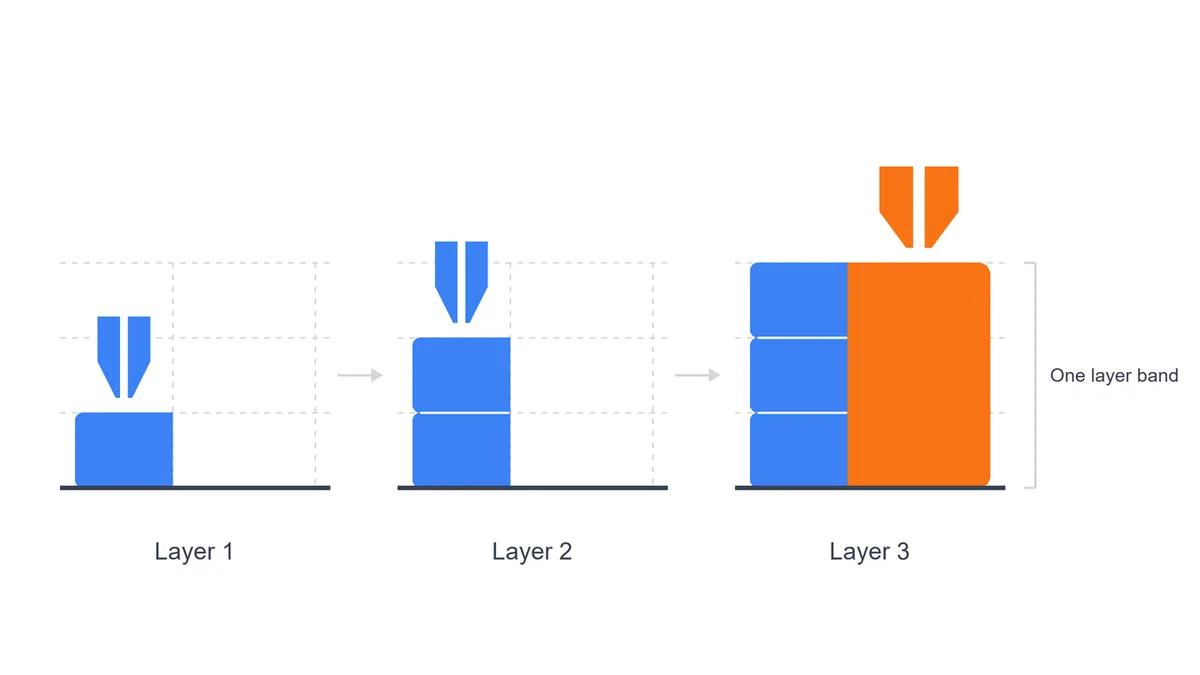
The H3C slicing engine gets around this with what Bambu Lab calls layer bands. Inside each band, the fine nozzle lays down several thin layers. The larger nozzle then adds one thick layer, and both regions meet at the same height before the next band starts. Think of three thin courses of brick next to one brick three times as tall.
That sounds tidy, but the software has a lot to sort out. It decides where the two regions meet, which nozzle goes first and how to keep tool changes to a minimum. It also plans travel moves so the nozzle doesn’t scrape the side that briefly stands taller.
Users could fake this before by splitting a model into separate parts, each with its own nozzle and layer height. That falls apart as soon as a curve or a numeral changes. In Bambu Studio’s mixed-nozzle mode, you paint a region or drop in a modifier box instead. Alignment, tool changes and paths are recalculated every time you slice. To Bambu Lab’s knowledge, the H3C is the first commercially available 3D printer to do this natively on the same surface.
Soft TPU is the printer’s other party trick. The demo watch has an ultra-soft TPU band, printed with a 0.4 mm nozzle for 2.85 mm filament. In an X post the same day, Bambu Lab showed a shoe printed in 75A TPU on the H3C’s new FlexFeed extruder. The cam-driven mechanism keeps tension steady at up to three times the flow rate of traditional printers.
Other Bambu machines are next. Native mixed-nozzle support for the H2D, H2C and X2D is in development.
Disclosure: this article contains affiliate links. If you buy through them, 3DPrinting.com may earn a commission at no extra cost to you. This does not influence our coverage.
Source: Bambu Lab