
SWISSto12 has passed the critical design review for two 5G phased array antennas it is building for UNIVITY’s demonstration satellites.
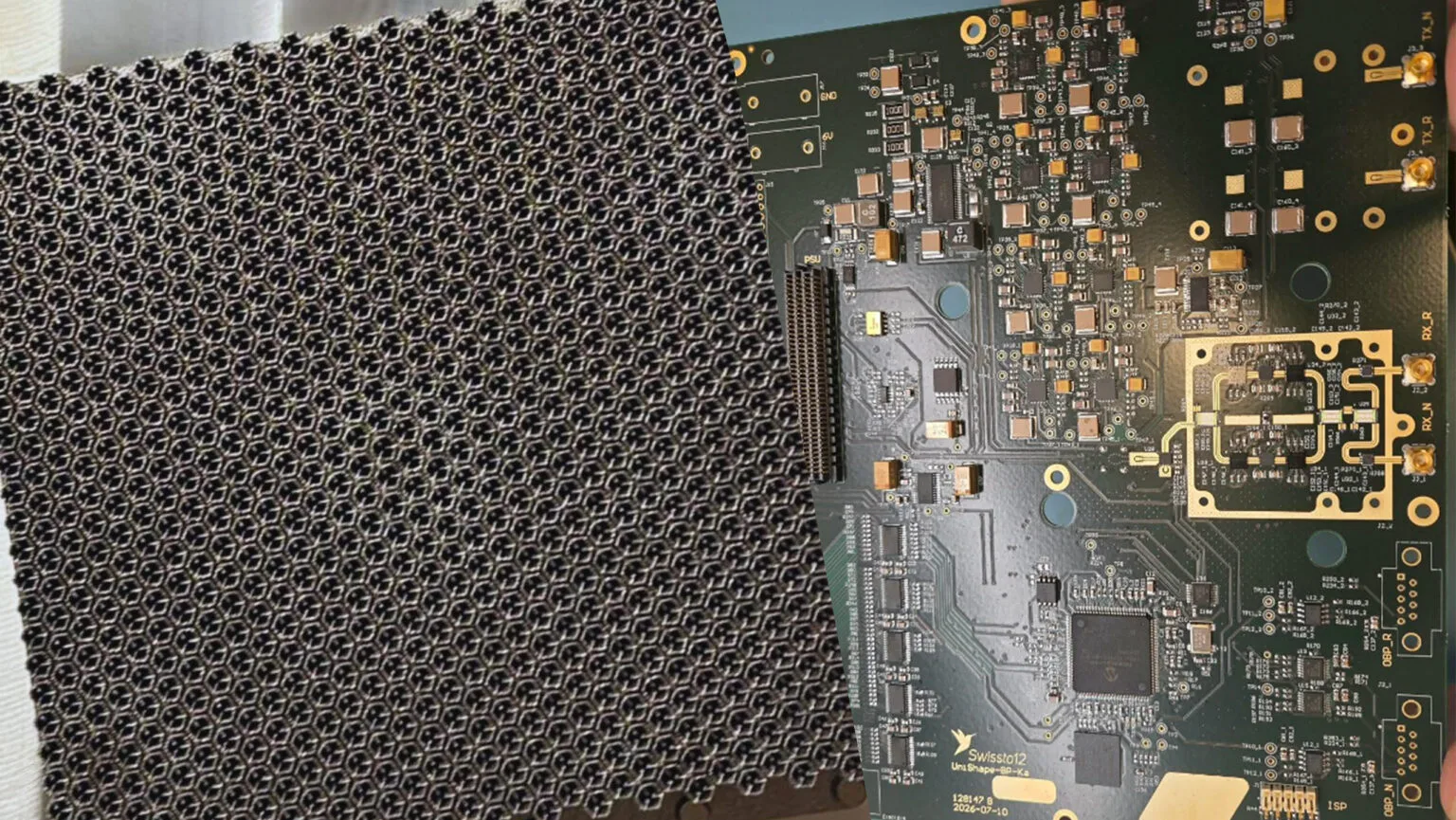
The milestone was announced on November 9 from Renens, Switzerland, and Paris, France. The review covers a pair of active antennas. An S-band direct radiating array handles direct-to-device service, connecting standard 5G phones straight to the satellite. A Ka-band array operating at 26 GHz carries broadband and feeder links. Together they let one satellite offer both kinds of 5G connectivity.
That dual role is the point for UNIVITY. The company is developing a Very Low Earth Orbit constellation that uses telecom operators’ own 5G spectrum to deliver high-speed, low-latency internet from space. UNIVITY pitches it as shared, neutral infrastructure. Operators would sell broadband and direct-to-device service under their own brands, alongside their ground networks. The antenna work sits in UNIVITY’s uniShape program, backed by France 2030 and the French space agency CNES.
3D printing comes in at the front of the antenna. SWISSto12 prints the passive radiating front ends, and its arrays use radiating elements with integrated miniaturized, low-loss filters. The Swiss company also designs and builds the beamforming circuit boards and supplies the digital controls. Everything is made at its facility in Switzerland, under the HummingLink line of complete antenna systems, from specification to finished product.
Speed is what both sides highlight. Emile de Rijk, SWISSto12’s CEO and founder, credits the in-house approach. “Reaching Critical Design Review in less than one year was possible due to SWISSto12’s proprietary and differentiated payload and antenna technology and a vertically integrated delivery model,” he said. “It’s a significant milestone for the program.”
UNIVITY CEO Charles Delfieux tied the hardware to the business case. “Active antennas are central to our 5G payload architecture,” he said. The same milestone, he added, shows SWISSto12 can keep up with the uniShape roadmap.
Founded in 2011, SWISSto12 is delivering payloads for several low Earth orbit constellations and seven of its HummingSat geostationary platforms. Its payloads can fly on any platform and in any orbit, either on a third-party satellite or on HummingSat, its own compact platform. Patented manufacturing and design technologies, 3D printing among them, sit behind that hardware. Revenue reached $140 million in 2025, backed by more than $500 million in contracted orders and 110% compound annual growth since 2022.
With the design review closed, the program moves into flight hardware production. An extensive verification and acceptance campaign follows.
Source: SWISSto12