
Stanford surgeons rebuilt a patient’s chest wall with a custom osteobionix prosthesis, the first adult implantation of the device in the United States.
The operation took place on July 28 and lasted more than 16 hours. Stanford Medicine described it on November 9. The team removed a tumor along with five ribs and portions of the lung and clavicle.
The patient, in their 40s, first sought care for right shoulder pain. Imaging found a large mass in the right chest wall, and a biopsy confirmed Ewing sarcoma. This rare bone and soft-tissue cancer usually develops in childhood, most often between the ages of 10 and 20.
The tumor sat extremely close to the brachial plexus, the nerve bundle that gives the arm its function. Thoracic surgeons Lillian Tsai and Leah Backhus saw no standard implant that would work. “There really was no good existing prosthesis option on the shelf,” said Backhus.
Backhus had been exploring a customized prosthesis from Spanish company osteobionix since July 2024. She traveled to Barcelona to see it and took part in a reconstruction using the device. Instead of a rigid design, it has spring-like ribs that move with the patient’s natural breath.
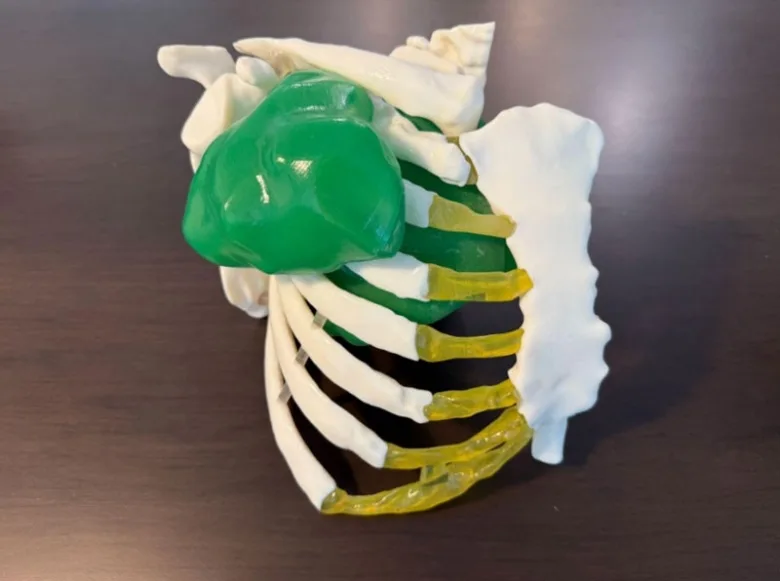
Planning leaned on a 3D-printed model. Stanford’s 3D and Quantitative Imaging Lab built it from the patient’s imaging. It showed the tumor next to the ribs, lungs and major nerves. Backhus called it “critical.” The team used it to map incisions and rehearse the operation before the patient was under anesthesia.
In parallel, engineers in Spain built a digital model of the chest wall and tumor from CT scans. Surgeons and engineers simulated the resection and refined the design over multiple rounds of review. Tsai and Backhus pushed for a modular build, so the implant could adapt to what they found in the operating room.
The device isn’t FDA-approved, so Tsai spent months working with the FDA and Stanford’s Institutional Review Board. The case went through the FDA’s compassionate use pathway. Chemotherapy continued in the meantime, and the tumor shrank enough to spare one rib the team had planned to remove.
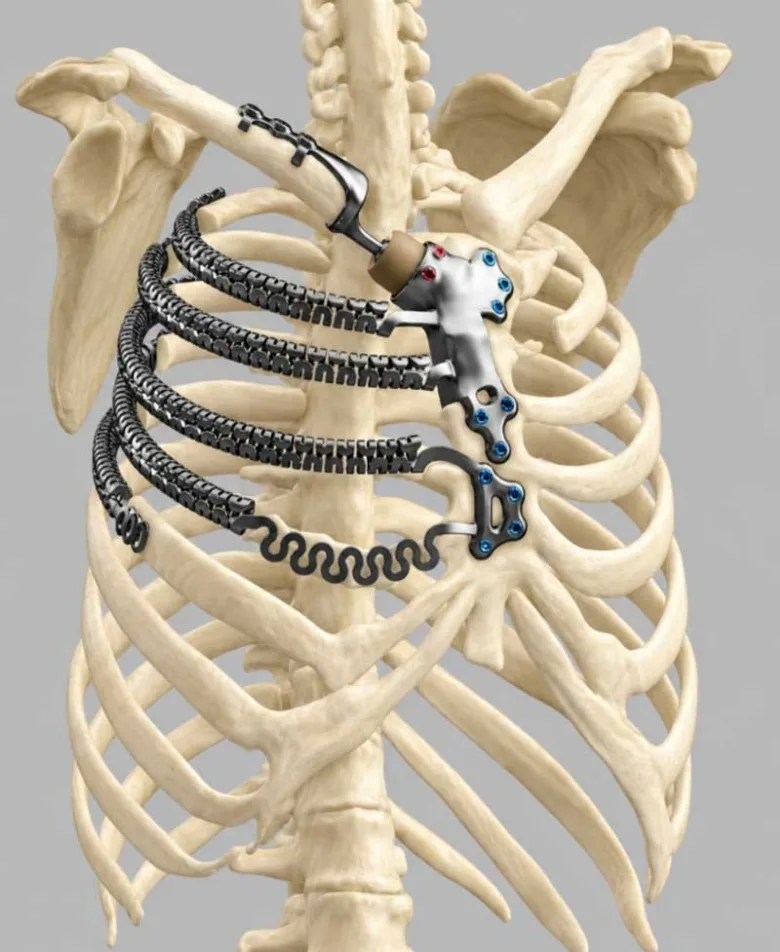
During surgery, the tumor came out with parts of the ribs, lung and clavicle as a single specimen. The implant has flexible ribs and porous surfaces meant to support bone integration. A custom ball-and-socket component rebuilds the joint between the clavicle and the breastbone, designed to preserve shoulder movement.
Recovery has gone well. Early numbness in two fingers began resolving within a few days. With physical and occupational therapy, the patient regained full range of motion in the shoulder and has done well since hospital discharge.
Source: Stanford Medicine