
Fraunhofer IGD will show software at Formnext 2026 that reduces the visible steps 3D printers leave on sloped and curved surfaces.
Some 3D printing processes are voxel-based, which means the printer builds a part from a grid of tiny cubes called voxels, much as a photo is made of pixels. Turning a smooth digital shape into that grid forces small rounding errors. On inclined and curved surfaces those errors line up into visible steps, known as staircase artifacts, which spoil the surface and add post-processing work.
Fraunhofer IGD’s answer is Shape Dithering, a patented method that works purely on the geometry and needs no parameters to tune. Dithering is a familiar trick from image printing, where scattered dots make a picture look smoother than its few colors would allow. In the same way, the software spreads the rounding errors across the surface in a controlled manner, so they no longer pile up into large, clearly visible patterns. What remains are very fine variations, and the printing process itself evens those out because it naturally blurs the smallest details. The result is better surface quality and a closer match to the intended shape, which means less post-processing or faster printing.
For Dr. Philipp Urban, who heads 3D printing research and development at IGD, the point is where the fix happens. “With Shape Dithering, we address the issue not at the hardware level, but in the digital representation of the geometry,” he said. “Quantization errors are distributed so that the characteristic staircase artifacts are significantly reduced in the resulting part.”
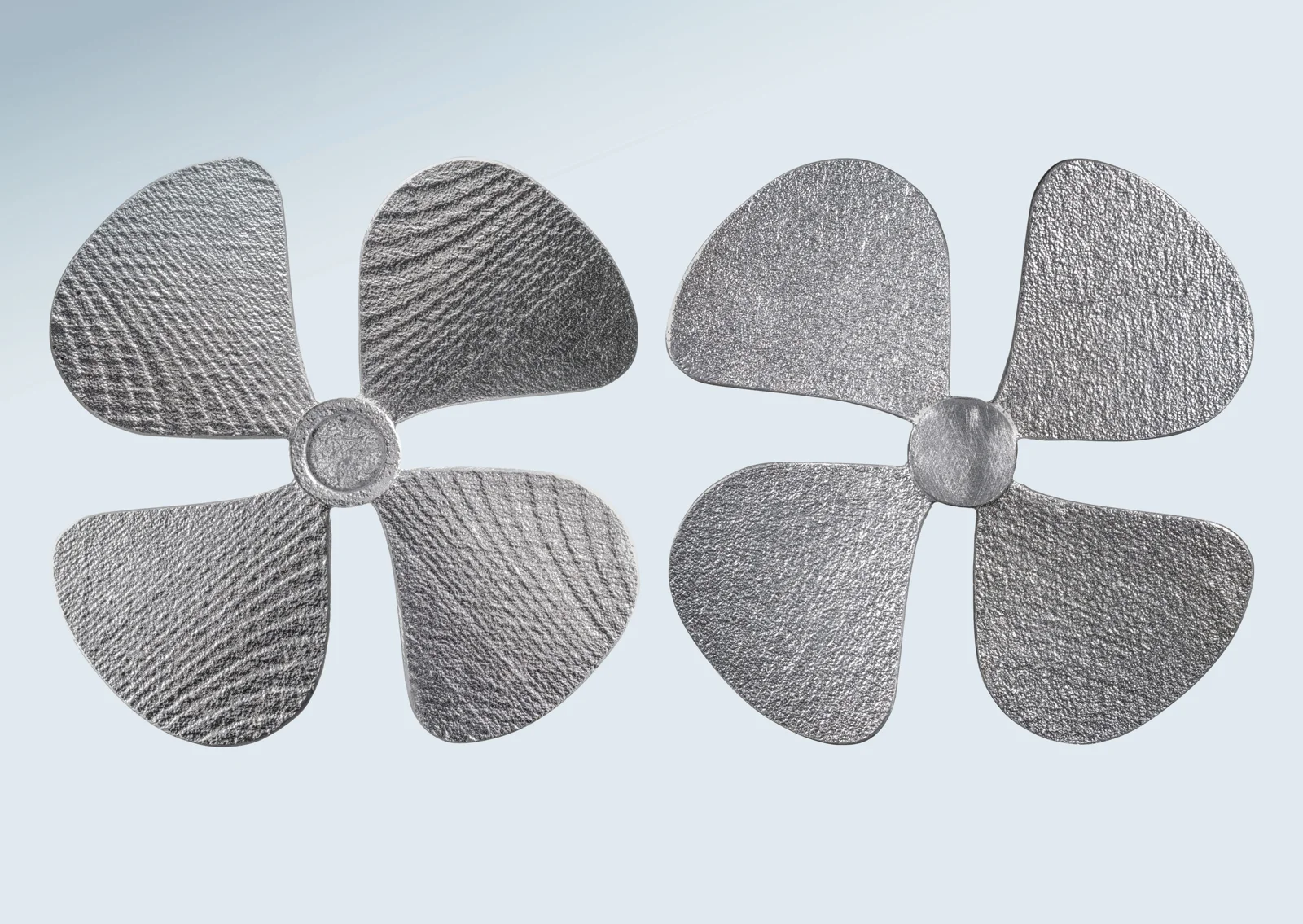
At the show, IGD will demonstrate the method with the Fraunhofer Institute for Casting, Composite and Processing Technology IGCV on a cast aluminum part. Its mold was made by powder bed binder jetting, a process in which a print head deposits liquid binder to glue powder together layer by layer. The mold contains sections with and without Shape Dithering, so visitors can compare the two directly. The part is cast from the aluminum alloy AlSi7Mg0.3 at 720 °C, and the mold uses a commercial furan no-bake binder with layers 300 micrometers thick. Since the freeform surface was left untreated after casting, the effect of the digital processing stays directly visible.
IGD is bringing two more software tools to the show. With the Fraunhofer Institute for Industrial Mathematics ITWM, it will present software for designing parts from unit cells. These are three-dimensional building blocks whose shape and layout set how a part behaves mechanically. RISTRA-AM, meanwhile, predicts how parts warp in laser-based metal 3D printing. It runs the inherent strain method for calculating that distortion on graphics processors, which makes it 10 to 100 times faster than established CPU-based methods. Engineers can then test part orientations and support structures before printing.
Visitors can see all three at the joint booth of the Fraunhofer Competence Field Additive Manufacturing, Hall 11.0, Booth D31, during Formnext in Frankfurt from November 17 to 20, 2026.
Source: Fraunhofer IGD