
3D Printing
News Videos Newsletter Contact us
Home / News / Printed Into the Part: Why Manufacturers Are Moving to 3D-Printed QR Codes

Printed Into the Part: Why Manufacturers Are Moving to 3D-Printed QR Codes

March 5, 2026

When medical device manufacturer CONMED started using Rize’s additive manufacturing platform to embed QR codes directly into printed parts, the company’s group manager David Perron put it plainly: their development process “requires numerous iterations to get the part features just right.” Having a unique, unspoofable code built into every version of every part wasn’t a luxury, it was the only reliable way to know which iteration you were actually holding. For manufacturers still relying on adhesive labels and post-process ink marking, that’s a gap worth examining.
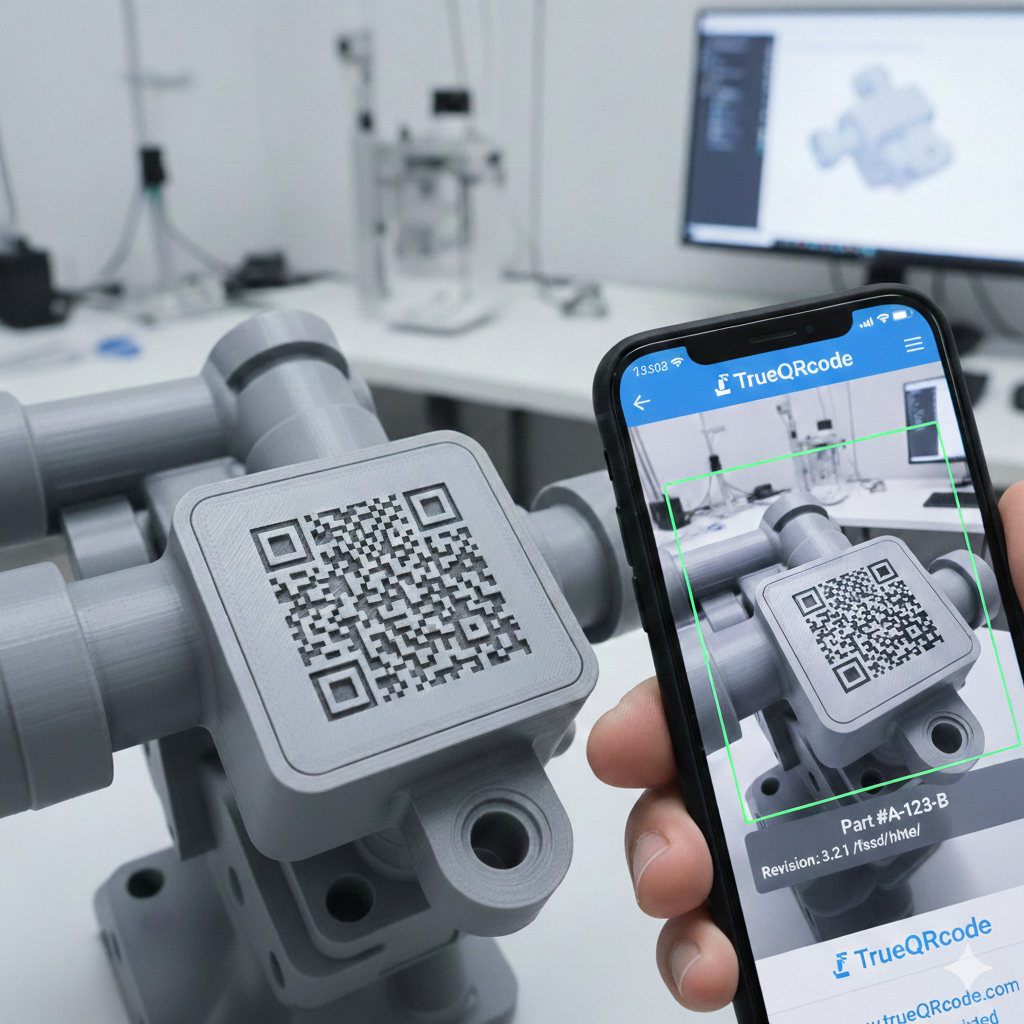
What a 3D-Printed QR Code Actually Is

Rather than being applied after manufacturing, the QR matrix is embedded into the CAD model itself as raised relief or recessed grooves becoming a permanent feature of the part. There are two main approaches: geometry-based contrast, where recessed cavities cast enough shadow for a smartphone scanner to read the code (viable on any single-material FDM or SLS printer); and multi-material or ink-jetting systems, which deposit pigmented ink at the voxel level for sharper contrast on complex surfaces. Rize, the platform CONMED used, combines FDM extrusion with piezo ink-jetting in a single pass. Its VP of marketing Julie Reece described the result as “an immutable digital connection between the physical part and its digital twin.”

The workflow is simple: generate the QR geometry with a tool like QR2STL, boolean-merge the STL into your part in CAD, and print. The code cannot be rubbed off, peeled away, or misplaced.

Where It Makes the Most Sense

Jigs, fixtures, and tooling are the obvious starting point. Parts that spend years on the shop floor, exposed to heat and coolant, and expected to carry revision information that a paper tag cannot survive. A printed QR code on a fixture links directly to the current assembly procedure, calibration record, or revision history without any additional marking step.

In regulated industries (medical devices, aerospace, automotive) part provenance must be demonstrable for the component’s entire lifetime. For polymer and composite parts produced additively, embedding the identifier during printing eliminates secondary marking entirely, removing both the cost and the misidentification risk that comes with labeling batches after the fact.

Prototyping is a third use case worth noting. When revision A and revision B of a bracket look identical, encoding the version directly into the part removes bench-level ambiguity without handwritten tags or manual tracking.

Static vs. Dynamic: A Permanent Decision

Once a QR code is printed into a part, it cannot be reprinted. This makes the static vs. dynamic choice more consequential than it would be on a label. A static code encodes a fixed string directly into the pattern: suitable for immutable identifiers, but a liability if the destination ever needs to change. A fixture printed two years ago with a static URL will still point to that URL even after the document moves or the procedure is superseded.

This is where the infrastructure behind the code matters as much as the code itself. Using dynamic QR codes for industrial traceability means the physical code never changes, but the destination it points to can be updated instantly. This could be useful for a revised work instruction, a new compliance document, an updated maintenance schedule, etc. Dynamic codes also capture scan analytics: timestamps, locations, and frequency data that give operations teams a passive audit trail with every scan.

Design Parameters That Determine Scannability

Three factors drive whether a printed code actually scans. Resolution sets the minimum module size: FDM requires at least 1.5–2mm per module; SLS and MJF can go smaller. Contrast determines reliability: dark surfaces, or parts dyed black post-print, outperform light gray, where shadow depth alone must distinguish modules. Surface geometry matters too: flat and gently curved surfaces are forgiving; compound curves distort the pattern and should be avoided. Finally, selecting a higher error correction level builds in redundancy that keeps a worn or partially damaged code readable, worthwhile for any part destined for a demanding industrial environment.

From Afterthought to Architecture

Part marking has historically been the last step before a component ships. Additive manufacturing inverts that logic: when the code is part of the CAD file, traceability becomes a design parameter, decided alongside wall thickness and material choice, not applied as an afterthought on the dock.

The barrier to entry is low. A free geometry tool, a minor CAD modification, and a considered choice about what the code should point to. The result is a part that carries its own permanent history no label required.

Share:
WhatsApp Twitter Facebook LinkedIn Buffer Reddit E-mail
Join our newsletter

Our newsletter is free & you can unsubscribe any time.

Latest posts

MIT’s 3D-Printed Concrete Bridge Shows Printer Hardware, Not Concrete, Is the Limiting Factor

MIT researchers have 3D-printed and load-tested a 2.3-meter concrete bridge using a computational framework that bakes a printer's physical limitations directly into the... read more »

Construction
MIT's 3D-Printed Concrete Bridge Shows Printer Hardware, Not Concrete, Is the Limiting Factor

Manchester Researchers Link Temperature Swings to Defects in Aluminium 3D Printing

Scientists at The University of Manchester have found that small temperature changes during molten metal deposition can substantially alter the quality of 3D-printed... read more »

3D Printing Metal
Manchester Researchers Link Temperature Swings to Defects in Aluminium 3D Printing

University of Illinois Engineers Build First 3D Thermal Cloak Using 3D-Printed Aluminum

Engineers at the University of Illinois Urbana-Champaign have built the first physical device that can hide objects from heat in any direction, a... read more »

News
University of Illinois Engineers Build First 3D Thermal Cloak Using 3D-Printed Aluminum

Best Large Format 3D Printers 2026: Big Builds Compared

Large format stopped being exotic. A 256 mm cube is the consumer standard now, and the interesting machines start where it ends: 330,... read more »

3D Printers

EPFL’s 3D Printable Elastomer Is 15 Times Tougher Than Comparable Materials

Researchers at EPFL have found that a soft material built for 3D printing also solves one of materials science's stubborn problems: making elastomers... read more »

Materials
EPFL's 3D Printable Elastomer Is 15 Times Tougher Than Comparable Materials

Best Multicolor 3D Printers 2026: Every System Compared

Multicolor went from party trick to default in about two years. Color systems now ship in $299 bundles, toolchangers and multi-nozzle machines have... read more »

3D Printers

University of Utah Develops Holographic 3D Printer That Completes Prints in 20 Seconds

University of Utah engineers have built a holographic 3D printer that produces complete shapes in a single exposure rather than building them layer... read more »

News

Inside Vietnam’s First Connected Surgical Ecosystem, and the Role 3D Printing Plays Within It

When Vinmec switched on a nationwide robotic surgery network, the real advance was the connective tissue around it: preoperative 3D reconstruction, surgical simulation,... read more »

Medical

Best Castable Resin 2026: Clean-Burnout Picks for Jewelry Casting

Castable resin exists for one moment: the burnout. A printed pattern goes into investment plaster, the kiln takes it to several hundred degrees,... read more »

Resin

Best Water-Washable Resin 2026: Easy Cleanup Without the IPA

The messiest part of resin printing has never been the printing; it is the tub of isopropyl alcohol waiting afterwards. Water-washable resin removes... read more »

Resin

Social

  • Facebook Facebook 3D Printing
  • Linkedin Linkedin 3D Printing
Join our newsletter

Our newsletter is free & you can unsubscribe any time.

Featured Industries

  • Automotive
  • Aerospace
  • Construction
  • Dental
  • Environmental
  • Electronics
  • Fashion
  • Medical
  • Military
  • Anycubic Kobra S1 Combo

    • - Print size: 250 x 250 x 250 mm
    • - budget multicolor printing
    More details »
    $429.00 Anycubic
    Buy Now
  • Snapmaker U1

    • - Print size: 270 x 270 x 270 mm
    • - multi-color printing with SnapSwap
    More details »
    $849.00 Snapmaker
    Buy Now
  • Flashforge AD5X

    • - Print size: 220 x 220 x 220 mm
    • - dual extrusion system
    More details »
    $399.00 Flashforge
    Buy Now
  • Flashforge Adventurer 5M

    • - Print size: 220 x 220 x 220 mm
    • - 600mm/s travel speed
    More details »
    $299.00 Flashforge
    Buy Now
  • Qidi Max 4

    • - Print size: 390 x 390 x 340 mm
    • - active cooling air control
    More details »
    $1,219.00 Qidi
    Buy Now
  • Anycubic Photon Mono M7

    • - Print size: 223 x 126 x 230 mm
    • - 10.1 inch 14K screen
    More details »
    $279.00 Anycubic
    Buy Now
  • Creality K2 Plus

    • - Print size: 350 x 350 x 350 mm
    • - multi-color printing
    More details »
    $1,199.00 Creality
    Buy Now
  • Qidi Q2

    • - Print size: 270 x 270 x 256 mm
    • - enclosed heated chamber up to 65°C
    More details »
    $580.00 Qidi
    Buy Now
  • Flashforge Guider 3 Ultra

    • - Print size: 330 x 330 x 600 mm
    • - dual extruder system
    More details »
    $2,999.00 Flashforge
    Buy Now
  • Creality Hi Combo

    • - Print size: 260 x 260 x 300 mm
    • - up to 16-color printing
    More details »
    $399.00 Creality
    Buy Now

Company Information

  • What is 3D Printing?
  • Contact us
  • Join our mailing list
  • Advertise with us
  • Media Kit
  • Nederland 3D Printing

Blog

  • Latest News
  • Use Cases
  • Reviews
  • 3D Printers
  • 3D Printing Metal

Featured Reviews

  • Anycubic Photon Mono M5s
  • Creality Ender 5 S1
  • The Mole 3D Scanner
  • Flashforge Creator 3 Pro

Featured Industries

  • Automotive
  • Aerospace
  • Construction
  • Dental
  • Environmental
  • Electronics
  • Medical
  • Military
  • Fashion
  • Art
2026 — Strikwerda en Dehue
  • Home
  • Join our mailing list
  • Contact us
Blog
  • Latest News
  • Use Cases
  • Reviews
  • 3D Printers
  • 3D Printing Metal
Featured Industries
  • Automotive
  • Aerospace
  • Construction
  • Dental
  • Environmental
  • Electronics
  • Medical
  • Military
  • Fashion
  • Art
Company Information
  • What is 3D Printing?
  • Contact us
  • Join our mailing list
  • Advertise with us
  • Media Kit
  • Nederland 3D Printing