
Prusa Research has launched Prusament PETG ESD, a carbon-filled filament designed for direct contact with sensitive electronics.
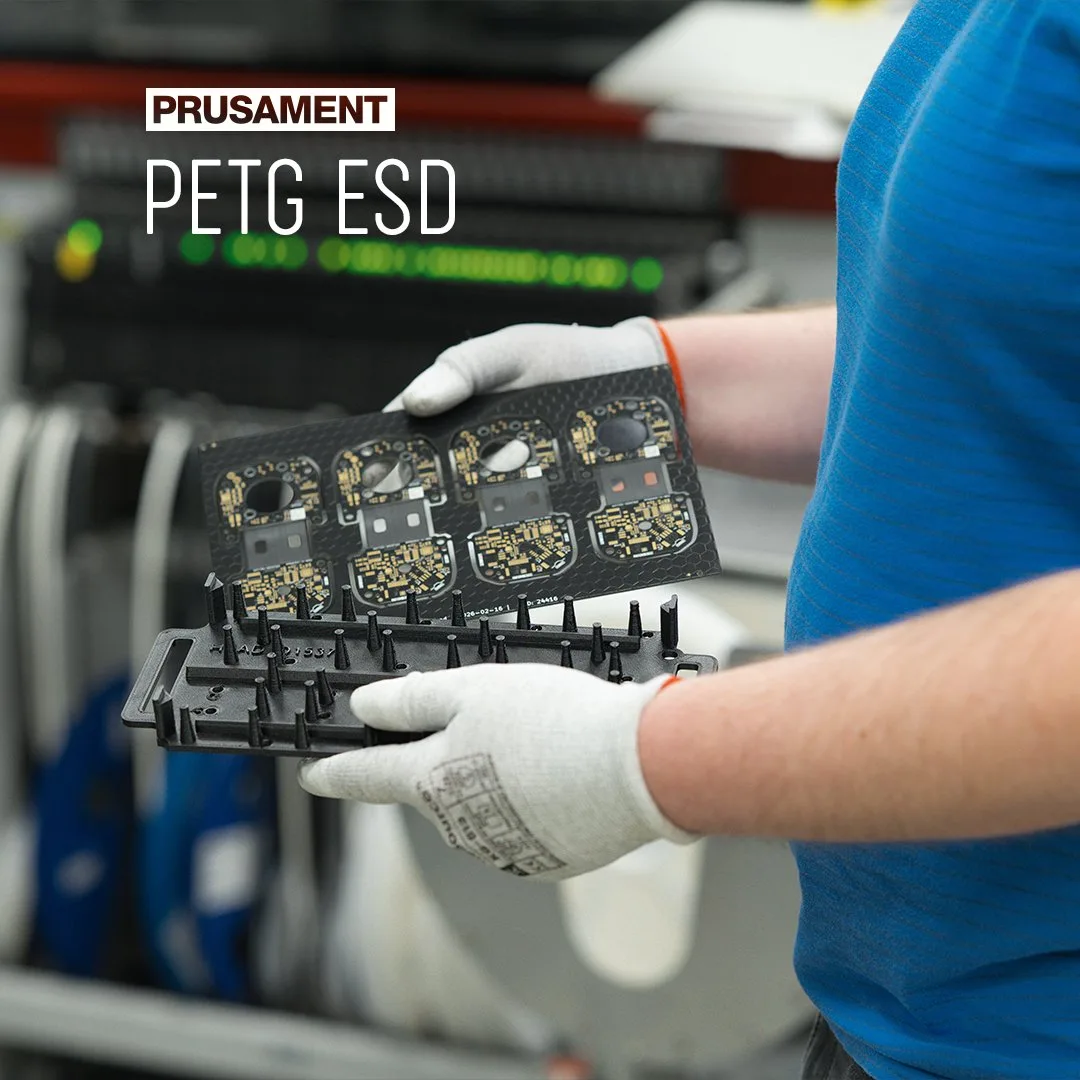
Static is what this material is built to handle. Its electrostatic-dissipative properties come from carbon nanotubes rather than conductive carbon black. Because the nanotubes don’t release into the surroundings, the filament is suited to housings and other structural parts of sensitive equipment.
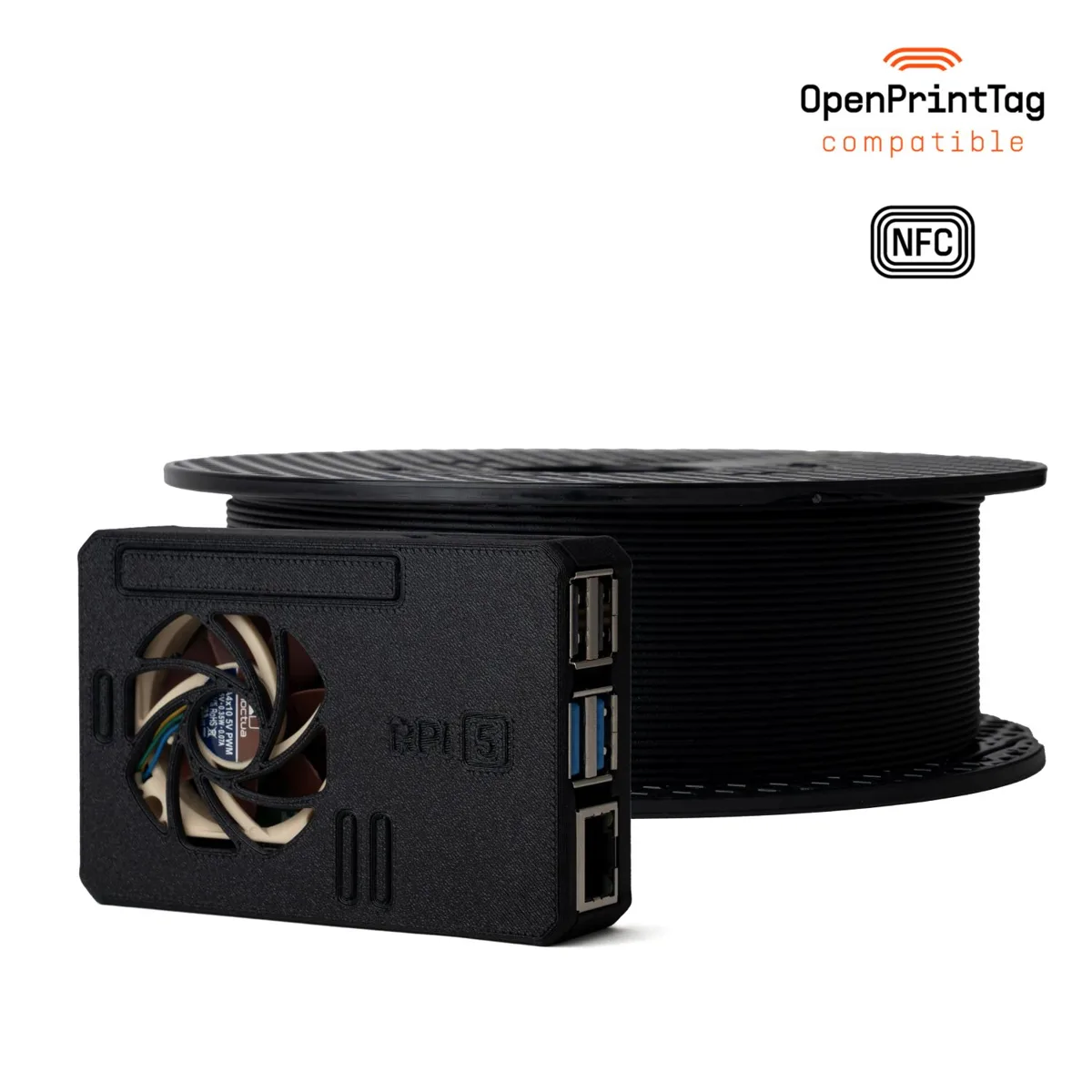
Unlike most ESD-safe materials, it also contains reinforcing carbon fibers. They improve dimensional stability and thermal resistance, so large models print with very little to no warping, and they give the surface a slightly rough, matte black finish.
The technical sheet is aimed at engineers. Volume resistance is 7.7 × 10⁶ ohms, and surface resistance measures 7.1 × 10⁵ ohms on the top layer and 1.6 × 10⁶ ohms on the bottom. Prusa says those surface values stay the same across structural and speed profiles, upright or flat prints, and 15% or 100% infill, as long as the temperature is unchanged. At around 290°C, though, the material can become electrically conductive rather than dissipative.
Printing it takes some preparation. The recommended settings are a 265°C nozzle and a 90°C bed, and the nozzle should be a hardened 0.4 mm one because the abrasive carbon fibers can damage brass. The filament is also hygroscopic, so it needs drying at 65°C for six to eight hours before use. Print profiles are available for the MK4S, CORE One+/L+, XL+ and HT90, and Prusa recommends its Satin, TXT or PP steel sheets.
Prusa already uses the material in its own production. When the company powder-coats its print sheets, particles pile up on the bottom edges and leave an uneven coating. To fix that, it printed a PETG ESD fixture that attracts part of the paint and prevents overcoating. That printed part served as a working prototype, tested in a real environment, before the fixture was made in metal and in large quantities.
Prusament PETG ESD is here! ⚡ Our new carbon-filled filament is designed for direct contact with sensitive electronics. It combines electrostatic-dissipative properties with improved thermal resistance, excellent dimensional stability, and a matte black finish.… pic.twitter.com/IjfvGZXUN1
— Prusa3D (@Prusa3D) November 10, 2026
The trade-off is lower toughness than standard Prusament PETG. Like the rest of the range, it is made in-house in Prusa’s own facilities in the Czech Republic and Delaware. Each spool ships with diameter readings measured along its entire length, plus weight and ovality, and the 1.75 mm filament is held to ±0.04 mm. A 1 kg spool costs €61.90 including VAT and is in stock now. It comes on the new spool, whose OpenPrintTag NFC tag the Prusa mobile app can read offline.
Source: Prusa Research