
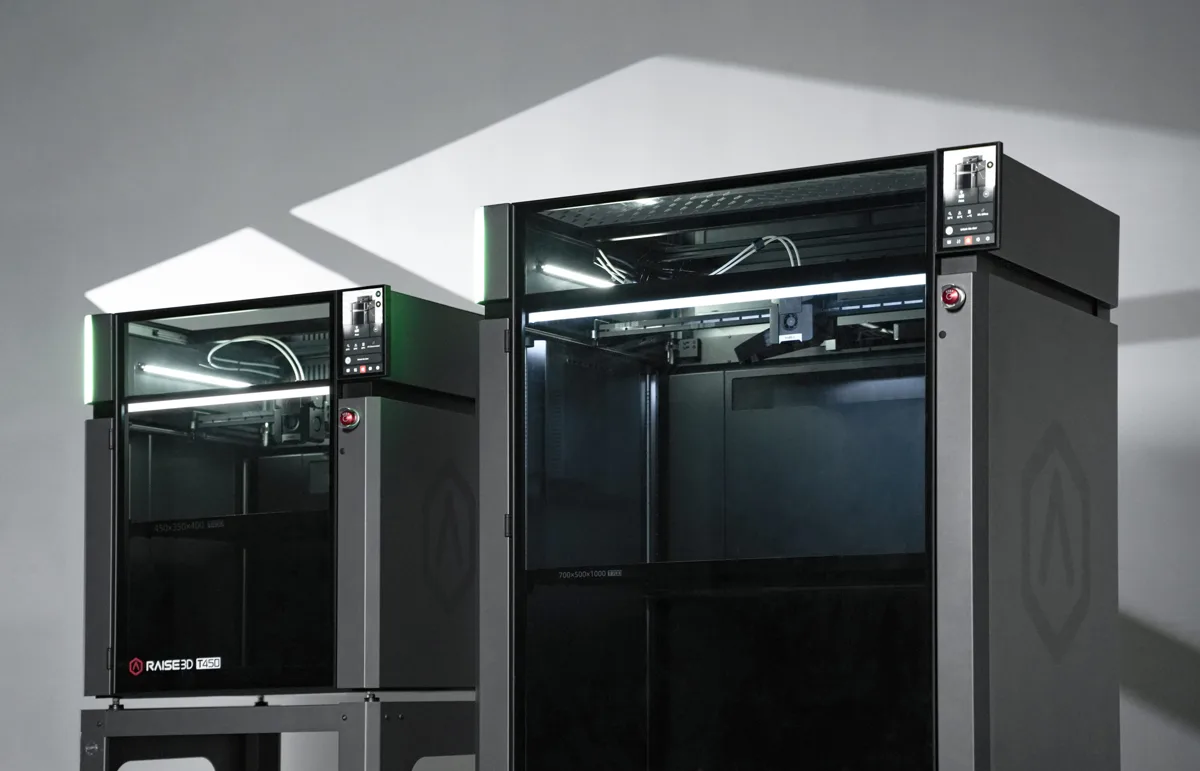
Raise3D has closed a $15 million C2+ funding round and introduced two large-format FFF 3D printers, the $4,999 T450 and the $15,999 T700.
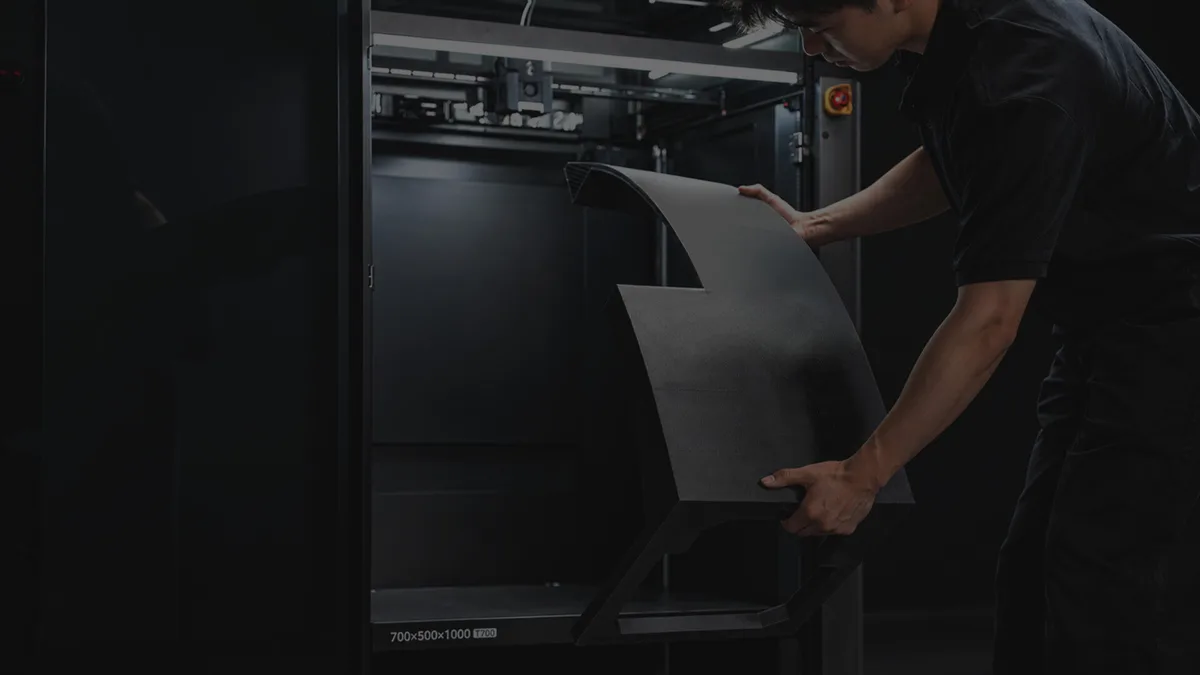
Size is the problem these machines target. When a part is bigger than a printer’s build volume, it has to be split, printed in sections, then aligned, bonded and finished. Each of those steps adds work and can introduce assembly error, so the T Series aims to print suitable parts in one piece.
The T450 is the more compact of the two, with a 450 × 350 × 400 mm, 63-liter build volume and a chamber actively heated to 70°C. The T700 works at a different scale. Its 700 × 500 × 1,000 mm volume holds 350 liters, while its chamber reaches 60°C and it uses a standard 0.6 mm nozzle instead of the T450’s 0.4 mm. European prices are the same in euros, at €4,999 and €15,999.
Both printers feed a single nozzle from two filament paths that merge at a Y-junction, a system Raise3D calls TwinFlow. In high-flow mode, two identical filaments are pushed through together. That lets the T Series reach up to 600 mm/s under specific test conditions, while the T450 hits 80 mm³/s of volumetric flow. A second mode runs two materials in sequence for soluble supports or dual-color parts.
Moving a print head across that much space takes extra drive power. A CoreXY system with four frame-mounted motors handles the XY axes, and it is designed to reduce vibration, surface ringing and the risk of layer shifts.
Heat is the other half of the design. Nozzles reach 420°C and the build plate 120°C, enough for fiber-filled PET CF, PPA CF and PPS CF. Because the nozzle pairs a copper-chromium-zirconium base with a solid silicon carbide tip that resists fiber wear, users don’t have to swap nozzles to move to those composites.
Battery maker CATL offers a working example. For CATL’s cell-transport trays, Raise3D used the T450 and T700. Production time fell from about 40 days to 10, while tray weight dropped from about 8 kg to 2 kg. A technical lead at CATL tied the result to speed. “Raise3D’s complete 3D printing solution has helped CATL innovate more efficiently and shorten product development cycles,” the lead said.
SLS users get upgrades too. A software update raises the build height of existing RMS220 printers from 350 to 450 mm, which adds about 30 percent to the build volume without a hardware change. The new B520 automates sandblasting of polymer powder bed parts, and it also works with third-party SLS, MJF, SAF and HSS machines.
The new funding will go into large-format FFF, SLS and DLP development, hardware-software integration, and expansion into new applications and global markets. While the consumer market keeps expanding, CEO Edward Feng sees more opportunity in professional applications, where part size often sets the limit. “By making it more accessible to produce larger parts, large-format 3D printing can help users explore applications that were previously limited by size and cost,” he said.
Raise3D will show the T450 and T700 at Formnext 2026 in Frankfurt from November 17 to 20, at Hall 12.1, Stand D21.
Source: Raise3D