
3D Printing

Buyer guides

  • Best 3D printers
  • For beginners
  • Multicolor
  • Resin printers
  • Budget (under $400)
  • For kids and schools
  • For miniatures
  • Large format
All printer guides

Brands and compare

  • Bambu Lab lineup compared
  • Compare printers
  • Full color 3D printers
  • Large scale and industrial

Reviews

  • Elegoo Mars 5 Ultra
  • FLSun T1 Pro
  • QIDI Tech Q1 Pro
All reviews
Best 3D Printers 2026: Buyer’s Guide

Start with the top picks

Best 3D Printers 2026: Buyer’s Guide

Twenty printers tested and ranked, from $169 to the H2D.

See the picks

Filament

  • Best PETG filament
  • Best PLA filament
  • Best TPU filament
  • Best ABS and ASA filament
  • Engineering filaments
  • Composite filaments
  • Flexible filaments
  • Bio filaments
All filament guides

Resin

  • For miniatures
  • Tough and ABS-like
  • Castable resin
  • Water-washable
  • Flexible resin
All resin guides

Accessories

  • Filament dryers
  • Printer enclosures
  • Wash and cure stations
Best Filament Dryers (2026 Guide)

Most-clicked accessory

Best Filament Dryers (2026 Guide)

Wet filament causes most failed prints; the fix costs less than a spool.

Compare dryers

Buyer guides

  • Small objects
  • Medium objects
  • Large objects
  • Professional scanners
  • Scan with your phone
All scanner guides

Software and service

  • 3D scanner software
  • Scanning service vs buying

Reviews

  • Revopoint MetroY Pro
  • Revopoint Inspire 2
  • Revopoint Trackit
All scanner reviews
3D Scanners 2026: The Complete Buying Guide

Find the right scanner

3D Scanners 2026: The Complete Buying Guide

Nineteen scanners from $400 to $40,000, sorted by object size.

Open the guide

Design and AI

  • AI 3D model generators
  • 3D modeling and CAD software

Print prep and control

  • Slicers
  • STL repair tools
  • Printer host and remote control

Reviews

  • Meshy Edit
  • Tripo H3.1
  • Meshy 7.1
All software reviews
Best AI 3D Model Generators for 3D Printing (2026)

Fastest-growing guide

Best AI 3D Model Generators for 3D Printing (2026)

Type a prompt, get a printable model: the tools we tested, free tiers first.

Try the tools

Start here

  • What is 3D printing?
  • How much does it cost?
  • FDM vs resin
  • Best printers for beginners

How it works

  • What is a 3D printer?
  • How does 3D printing work?
  • Types of 3D printing
  • Metal 3D printing

How-tos and glossary

  • 3D printing glossary
  • Food-safe 3D printing
  • Setting up a school program
  • Free 3D printable models
What is 3D Printing?

Start here

What is 3D Printing?

The one-page explainer, then how much it costs and which technology to buy.

Start reading
Black FridayNEW

Latest

  • Prusa Launches Prusament PETG ESD, a Carbon-Filled 3D Printing Filament for Electronics
  • Raise3D Closes $15 Million Round and Introduces T450 and T700 Large-Format 3D Printers
  • Fabri Uses 3D-Printed Patterns to Speed Up Investment Casting
  • Revopoint Black Friday 2026: Up to 50% Off 3D Scanners, Plus 5% Extra for Our Readers
  • Fairbanks Morse Defense Ships First 3D-Printed SUBSAFE Level I Submarine Part
All news

Use cases

  • Prague Firefighters 3D Print Their Own Gear on a Prusa CORE One L
  • OECHSLER Scales Carbon Lattice Production to 40 Printers Running Around the Clock
  • Reverse Engineering Without CAD Data: How the MetroY Ultra Turns Physical Parts into Digital Designs
  • Michigan State Engineers 3D Printed Helmet Inserts to Help Quarterbacks Tackle Crowd Noise
  • 3D Printed Quiet Pickleball Unveiled
All use cases

Industry

  • Automotive
  • Aerospace
  • Medical
  • Dental
  • Construction
  • Rapid prototyping
  • Electronics
  • Food
  • Fashion
  • Bioprinting
Prusa Launches Prusament PETG ESD, a Carbon-Filled 3D Printing Filament for Electronics

Latest

Prusa Launches Prusament PETG ESD, a Carbon-Filled 3D Printing Filament for Electronics

Prusament PETG ESD is a carbon-filled, electrostatic-dissipative 3D printing filament made for parts that touch sensitive electronics.

Read more
Contact
  • Home
  • Products
  • Videos
  • Newsletter
  • Contact us

Buyer guides

  • Best 3D printers
  • For beginners
  • Multicolor
  • Resin printers
  • Budget (under $400)
  • For kids and schools
  • For miniatures
  • Large format
All printer guides

Brands and compare

  • Bambu Lab lineup compared
  • Compare printers
  • Full color 3D printers
  • Large scale and industrial

Reviews

  • Elegoo Mars 5 Ultra
  • FLSun T1 Pro
  • QIDI Tech Q1 Pro
All reviews

Filament

  • Best PETG filament
  • Best PLA filament
  • Best TPU filament
  • Best ABS and ASA filament
  • Engineering filaments
  • Composite filaments
  • Flexible filaments
  • Bio filaments
All filament guides

Resin

  • For miniatures
  • Tough and ABS-like
  • Castable resin
  • Water-washable
  • Flexible resin
All resin guides

Accessories

  • Filament dryers
  • Printer enclosures
  • Wash and cure stations

Buyer guides

  • Small objects
  • Medium objects
  • Large objects
  • Professional scanners
  • Scan with your phone
All scanner guides

Software and service

  • 3D scanner software
  • Scanning service vs buying

Reviews

  • Revopoint MetroY Pro
  • Revopoint Inspire 2
  • Revopoint Trackit
All scanner reviews

Design and AI

  • AI 3D model generators
  • 3D modeling and CAD software

Print prep and control

  • Slicers
  • STL repair tools
  • Printer host and remote control

Reviews

  • Meshy Edit
  • Tripo H3.1
  • Meshy 7.1
All software reviews

Start here

  • What is 3D printing?
  • How much does it cost?
  • FDM vs resin
  • Best printers for beginners

How it works

  • What is a 3D printer?
  • How does 3D printing work?
  • Types of 3D printing
  • Metal 3D printing

How-tos and glossary

  • 3D printing glossary
  • Food-safe 3D printing
  • Setting up a school program
  • Free 3D printable models
Black FridayNEW

Latest

  • Prusa Launches Prusament PETG ESD, a Carbon-Filled 3D Printing Filament for Electronics
  • Raise3D Closes $15 Million Round and Introduces T450 and T700 Large-Format 3D Printers
  • Fabri Uses 3D-Printed Patterns to Speed Up Investment Casting
  • Revopoint Black Friday 2026: Up to 50% Off 3D Scanners, Plus 5% Extra for Our Readers
  • Fairbanks Morse Defense Ships First 3D-Printed SUBSAFE Level I Submarine Part
All news

Use cases

  • Prague Firefighters 3D Print Their Own Gear on a Prusa CORE One L
  • OECHSLER Scales Carbon Lattice Production to 40 Printers Running Around the Clock
  • Reverse Engineering Without CAD Data: How the MetroY Ultra Turns Physical Parts into Digital Designs
  • Michigan State Engineers 3D Printed Helmet Inserts to Help Quarterbacks Tackle Crowd Noise
  • 3D Printed Quiet Pickleball Unveiled
All use cases

Industry

  • Automotive
  • Aerospace
  • Medical
  • Dental
  • Construction
  • Rapid prototyping
  • Electronics
  • Food
  • Fashion
  • Bioprinting
Contact
Blog
  • Latest News
  • Use Cases
  • Reviews
  • 3D Printers
  • 3D Printing Metal
Featured Industries
  • Automotive
  • Aerospace
  • Construction
  • Dental
  • Environmental
  • Electronics
  • Medical
  • Military
  • Fashion
  • Art
Company Information
  • What is 3D Printing?
  • Advertise with us
  • Media Kit
  • Nederland 3D Printing
Home / News / QIDI Max4 Large-Format 3D Printer Debuts at Formnext 2025
creality header

QIDI Max4 Large-Format 3D Printer Debuts at Formnext 2025

November 18, 2025

Formnext 2025 in Germany brings another wave of industrial 3D printing launches, and QIDI is using the event to introduce its new flagship system: the QIDI Max4. Positioned as the largest print-size option among consumer-grade enclosed printers, the Max4 aims to tackle a long-standing challenge in this segment: the “difficulty in achieving both large print size and high precision.”
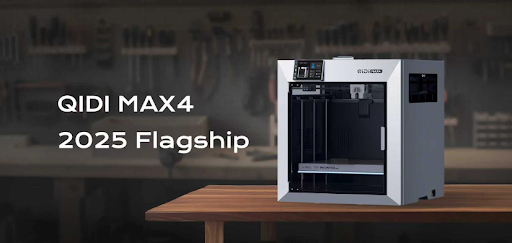
According to QIDI, the Max4 combines a significantly expanded build volume with motion control, thermal management and automation features designed for professional users who want to produce large parts without compromising on detail or reliability.

Large build volume with uniform thermal control
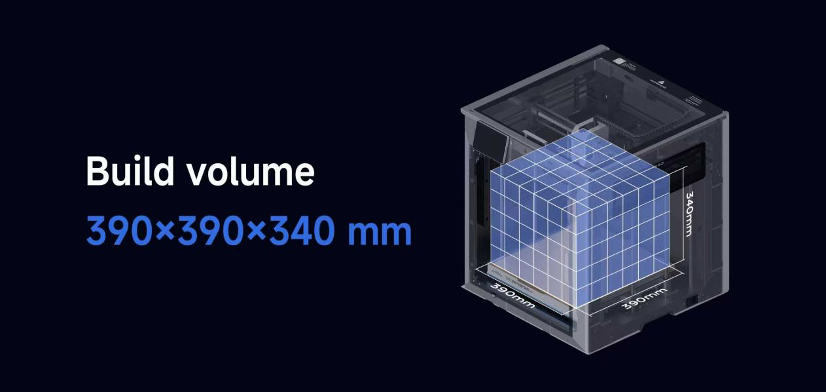

The QIDI Max series has built its reputation on large-format and versatile printing, and the Max4 pushes that further. The system offers a build volume of 390 × 390 × 340 mm, which QIDI states is 55% larger than the previous Max3. This size targets applications such as large industrial components, intricate molds and customized prototypes, where single-piece builds can reduce assembly steps and potential weak points.

To support this envelope, the Max4 uses a 390 × 390 mm heated bed with a full-surface silicone thermal layer and densely distributed heating wires. QIDI highlights this as one of the most uniform heating designs in its class. A high-efficiency insulation cotton layer beneath the bed further stabilizes temperature across the surface. Together, these elements are intended to improve first-layer adhesion and keep large-format prints stable, with reduced risk of warping across the build plate.

High-flow extrusion and controlled printing environment

On the extrusion side, QIDI equips the Max4 with a new high-flow hot-end rated at 40 mm³/s. This is designed to enable significantly faster print speeds, particularly useful when filling a large build volume, and to help reduce overall production cycles for sizable parts.

The nozzle is made from hardened steel, which broadens material compatibility beyond basic filaments. QIDI lists support for standard PLA and ABS, alongside some industrial materials such as abrasive carbon fiber–reinforced nylon. This combination of higher flow and wear-resistant hardware is aimed at users who need throughput and composite capability on one machine.

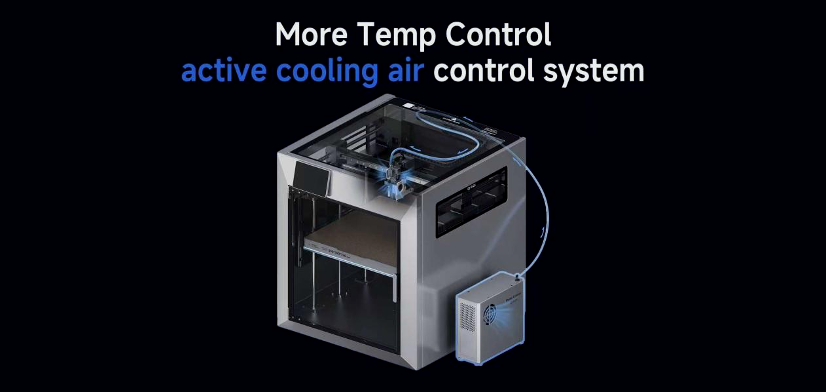
Thermal control extends beyond the bed and hot-end. The Max4 debuts QIDI’s self-developed Active Toolhead Cooling System, referred to as the “Polar Cooler.” This system directs cooled air directly onto the extruder and filament path to improve heat dissipation and help prevent clogs during demanding jobs.
Max4 QIDI TECH

In parallel, the printer uses a second-generation Active Chamber Heating system that can maintain an internal temperature of up to 65°C with optimized air circulation. QIDI positions this as a key enabler for high-temperature materials, naming ABS, ABS-CF and PC as examples that benefit from a heated environment and stable airflow.

Motion system upgrades for stability and precision

To improve print stability and part quality at speed, the QIDI Max4 introduces a new closed-loop motor system on the XY axes. Instead of running open-loop, the motors work with a closed-loop encoder that monitors errors and compensates for deviations on the fly.
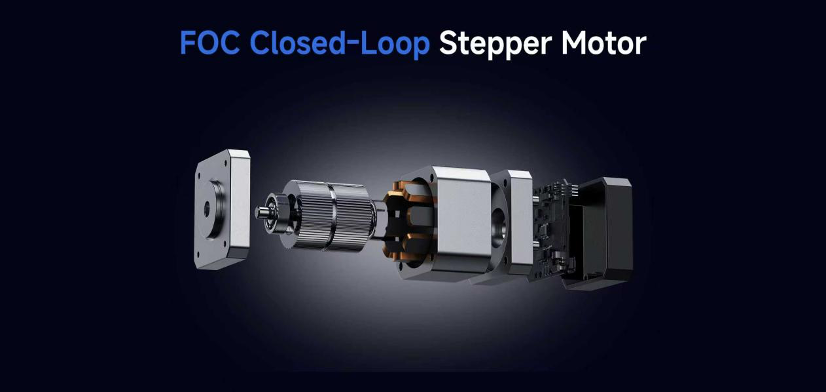
QIDI outlines three main benefits of this approach. First, greater stability: the system aims to prevent step loss and reduce layer misalignment over long or complex jobs. Second, improved accuracy: reduced torque ripple is intended to lower surface artifacts such as visible rippling or cogging. Third, enhanced efficiency: the closed-loop motors are designed to run cooler and quieter at high speeds, which can lessen thermal impact on internal components and contribute to a longer operational lifespan.

Z-axis performance receives similar attention. The Max4 uses 2 mm lead screws combined with an anti-backlash nut to remove vertical play and maintain consistent positioning. This configuration is aimed at smoother Z motion and higher Z-axis accuracy, with the goal of minimizing layer lines and improving surface detail, especially on tall parts that occupy much of the printer’s build height.

Beyond the core motion components, QIDI adds several supporting features: a new auto-leveling sensor, industrial-grade linear rails and custom 1.5GT belts. Together, these elements are intended to deliver smoother, more precise motion control while enhancing the machine’s durability under frequent use.

AI monitoring, interface updates and QIDI BOX integration

On the usability and automation side, the QIDI Max4 introduces an AI recognition system built around a high-performance processor. Using a high-definition camera, the printer continuously monitors the print in real time and analyzes image data alongside print commands. When it detects issues such as “spaghetti” failures or problems in support structures, the system can automatically pause the print and send an alert. This is designed to cut down on wasted material and reduce the need for constant manual supervision on longer jobs.
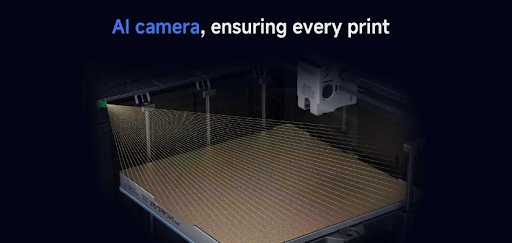
AI MAX4 Camera

The user interface has been updated as well. A new large screen and redesigned UI aim to offer smoother fingertip control and a more modern interactive experience, from setup to monitoring.

For multi-color and multi-material workflows, the Max4 can be paired with the QIDI BOX. This accessory extends the printer’s capabilities by supporting up to 16 colors simultaneously and providing filament drying at temperatures up to 65℃. In combination with the printer’s high-temperature chamber and hardened nozzle, this setup is positioned for use cases ranging from multi-color artistic models to engineering-grade composite parts and complex, multi-material objects.

Market positioning, availability and sales plans

With its larger build volume, reinforced motion system, high-flow hotend, chamber heating and AI-driven monitoring, the QIDI Max4 is presented as the new flagship in QIDI’s lineup. The company frames the system as a competitive entry in the large-format enclosed desktop segment, targeting professional users who want higher efficiency, stable performance and an increasingly automated user experience in a single machine.

QIDI states that the Max4 is now available for global pre-order through its official channels.

According to the Qidi official website, BFCM sales will launch today on November 18th, and interested customers can watch for upcoming promotions there.

By combining high-temperature capability, precision-focused motion control and expanded multi-material options via the QIDI BOX, the Max4 positions itself as a large-format platform for both functional and creative work. Its launch at Formnext 2025 underlines QIDI’s intention to grow its role in the professional 3D printing space and to compete more directly in the large-format category.
Share:
WhatsApp Twitter Facebook LinkedIn Buffer Reddit E-mail
Join our newsletter

Our newsletter is free & you can unsubscribe any time.

Latest posts

Prusa Launches Prusament PETG ESD, a Carbon-Filled 3D Printing Filament for Electronics

Prusament PETG ESD is a carbon-filled, electrostatic-dissipative 3D printing filament made for parts that touch sensitive electronics.

Filament
Prusa Launches Prusament PETG ESD, a Carbon-Filled 3D Printing Filament for Electronics

Raise3D Closes $15 Million Round and Introduces T450 and T700 Large-Format 3D Printers

Raise3D closed a $15 million C2+ round and introduced the T450 and T700 large-format FFF 3D printers, priced at $4,999 and $15,999.

3D Printers
Raise3D Closes $15 Million Round and Introduces T450 and T700 Large-Format 3D Printers

Fabri Uses 3D-Printed Patterns to Speed Up Investment Casting

Fabri, founded by MIT alumni, 3D prints resin patterns for investment casting and is qualifying parts for Raytheon, Lockheed Martin and Sikorsky.

News
Fabri Uses 3D-Printed Patterns to Speed Up Investment Casting

Revopoint Black Friday 2026: Up to 50% Off 3D Scanners, Plus 5% Extra for Our Readers

Revopoint's Black Friday sale runs November 9 to 30 on its official store, with up to 30% off new 3D scanners, up to... read more »

News
Revopoint Black Friday 2026: Up to 50% Off 3D Scanners, Plus 5% Extra for Our Readers

Fairbanks Morse Defense Ships First 3D-Printed SUBSAFE Level I Submarine Part

Fairbanks Morse Defense and Hunt Valve are shipping a 3D-printed copper-nickel tailpiece, the first additively manufactured SUBSAFE Level I component.

3D Printing Metal
Fairbanks Morse Defense Ships First 3D-Printed SUBSAFE Level I Submarine Part

Meshy Edit Review: Fixing the Four-Eyed Dragon

Meshy Edit promises to fix one part of an AI-generated 3D model without regenerating the rest. I used it to repair the four-eyed... read more »

Reviews
Meshy Edit Review: Fixing the Four-Eyed Dragon

Stanford Uses a 3D-Printed Model to Plan First US Adult Osteobionix Chest Wall Implant

Stanford surgeons used a 3D-printed model to plan a 16-hour operation that ended with the first US adult implantation of an osteobionix chest... read more »

Medical
Stanford Uses a 3D-Printed Model to Plan First US Adult Osteobionix Chest Wall Implant

SPEE3D Plans 50 Cold Spray Metal Printing Factories Across Asia Pacific, Starting in Darwin

SPEE3D plans 50 advanced manufacturing factories across Asia Pacific. Phase One of the first, its NodeZERO hub in Darwin, has now launched.

3D Printing Metal
SPEE3D Plans 50 Cold Spray Metal Printing Factories Across Asia Pacific, Starting in Darwin

SWISSto12 Passes Design Review for 5G Satellite Antennas With 3D-Printed Front Ends

SWISSto12 has cleared the critical design review for the S- and Ka-band phased array antennas on UNIVITY's 5G demonstration satellites.

News
SWISSto12 Passes Design Review for 5G Satellite Antennas With 3D-Printed Front Ends

Bambu Lab H3C Mixes Layer Heights on the Same Surface

Bambu Lab's H3C slicer lets a fine nozzle print thin layers and a larger nozzle print thick ones, side by side on the... read more »

News
Bambu Lab H3C Mixes Layer Heights on the Same Surface

Social

  • Facebook Facebook 3D Printing
  • Linkedin Linkedin 3D Printing
Join our newsletter

Our newsletter is free & you can unsubscribe any time.

Tripo

Tripo

Free to $110/mo
  • 60% off Tripo Pro with code 3DPRINTING.
Tripo
View at Tripo tripo3d.ai

Elegoo Neptune 4 Plus

~$269 on sale, ~$330 between sales
  • Large-format open-frame bed-slinger with a 320×320×385 mm build volume, Klipper pre-i…
Elegoo Neptune 4 Plus
Buy Now elegoo.com

MatterHackers PRO Series PCTG

  • Strongest homebrand PCTG for US buyers with diameter continuously measured using a 3-ax…
MatterHackers PRO Series PCTG
Buy Now matterhackers.com

Hatchbox ABS

  • Long-standing community staple offering pure ABS formulation with full heat deflection…
Hatchbox ABS
Buy Now amazon.com

Elegoo Centauri Carbon

~$315
  • A fully enclosed CoreXY machine at a budget price, featuring carbon fiber-reinforced ax…
Elegoo Centauri Carbon
Buy Now elegoo.com

Siraya Tech Cast

~$62 to $80/kg
  • A wax-based castable resin with low-ash burnout designed for direct investment casting,…
Siraya Tech Cast
Buy Now siraya.tech

Polymaker PolyLite ABS

  • Uses specialty bulk-polymerized ABS resin with significantly lower volatile content tha…
Polymaker PolyLite ABS
Buy Now polymaker.com

Anycubic Photon Mono M7 Pro

~$459-$669
  • One of the largest MSLA build volumes at a consumer price (223 × 126 × 230 mm) with 1…
Anycubic Photon Mono M7 Pro
Buy Now anycubic.com

Site footer

The 3DPrinting.com newsletter

The week’s best reviews, buyer’s guides and deals. One email every Friday, no spam.

By subscribing you agree to our privacy policy. Unsubscribe anytime.

3D PRINTING.COM

Independent reviews, buyer’s guides and news about 3D printers, materials, scanners and software.

Reviews

  • All reviews
  • 3D printers
  • Filament & materials
  • 3D scanners
  • Software
  • Compare products

Buyer's guides

  • Best 3D printers
  • Best resin 3D printers
  • 3D printers for beginners
  • Best PLA filament
  • Best slicers
  • Best pro 3D scanners

Learn & news

  • Latest news
  • Deals
  • What is 3D printing?
  • FDM vs resin
  • Use cases by industry
  • Glossary

Company

  • About us
  • Contact us
  • Advertise with us
  • Media kit
  • Nederland 3D Printing

© 2026 3DPrinting.com · Strikwerda en Dehue

  • Privacy policy
  • Terms of use
  • Affiliate disclosure
  • RSS