
University of Arkansas researchers have 3D printed LEGO-like bricks from pure lunar regolith simulant, fusing the powder with a laser and no binder.
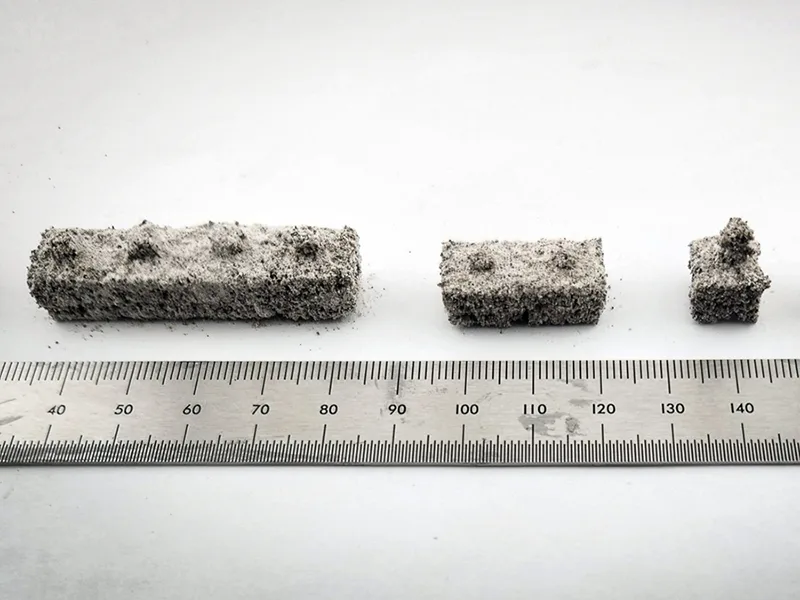
Building on the Moon with material that is already there could reduce what NASA needs to send from Earth as it works toward lunar settlements. Other researchers have printed regolith with binders, but those binding agents would also have to be shipped from Earth, which is exactly the cargo this approach tries to avoid.
The team used laser powder bed fusion. A fine powder is spread across a flat bed and sintered by a laser, then the bed is lowered and fresh powder is added for the next layer. As feedstock it chose Lunar Highlands Regolith Simulant, or LHS-1, a commercially available material designed to mimic the samples collected during the Apollo missions.
Real regolith is an awkward building material because it contains no organic matter, only loose, jagged particles formed over billions of years as asteroids and micrometeorites struck the Moon. According to the university, the Arkansas group is the first to sinter the simulant directly into reconfigurable building blocks without a binder, using a relatively low power light source. First author Cole McCallum, an undergraduate at the time, described the result simply. “There’s nothing else it’s binding to. The regolith powder is binding to itself,” he said.
The bricks are only a few centimeters wide. Some are shaped like crosses and others like the letter H, and the two shapes fit together like LEGO into larger structures without any joining material. In the paper, published in NPJ Advanced Manufacturing, the team also tested sintered cubes for compressive strength and porosity and measured a peak strength of about 3.4 MPa.
Strength is still the limit. Blocks made from pure regolith are more porous and structurally weaker than parts printed with binders, and McCallum is careful about what they can carry. “These structures we’re making can be self-supported,” he said. “But I would be hesitant to say our process could be used for something that’s supporting other loads at this moment yet.”
For senior author Wan Shou, an assistant professor of mechanical engineering, the next questions are how the process behaves in microgravity and vacuum. The bricks’ mechanical performance also has to improve before they are practically useful. Even so, Shou remains optimistic that the approach could offer an efficient way to make components and structures for a permanent settlement on the Moon.